Slow Democracy – The Scale of Time and the Scale of Size
Slow Democracy – Susan Clark and Woden Teachout
Slow food celebrates diversity and local traditions: briny seafood from Maine, wild rice from the shores of Lake Superior, artichokes from the dry, hot hills of California. Similarly, slow democracy applauds the range of regional democratic practices. New England town meetings don’t need to be spread like frosting across American townscapes. Other, very different examples of slow democracy have taken root from Oregon to Georgia, and from downtown Chicago to coastal New Hampshire—each with its own regional flavor. Slow democracy celebrates the terroir of community process.
…
Slow food has shown that in the interest of efficiency and cheap food, policies often are skewed toward corporate agriculture and consolidation, resulting in food and food systems that are unnatural and unhealthy. Similarly, slow democracy observes that we have moved increasingly toward centralization and privatization of public resources and decision making. In the name of efficiency, we often give only lip service to citizens’ wisdom, and as a result, we wind up with unrepresentative, unsustainable decisions and a discouraged, democratically anemic citizenry.
…
Finding a place in the life of the already overburdened and underprivileged—such as single working parents, or low-wage workers who string together two or three jobs—is one of the greatest challenges of slow democracy. But these are the populations most often shut out of the democratic process, and most in need of what it has to offer. Slow democracy incorporates people from all walks of life and the full range of the human condition: from talkers to doers, from those who value charts and graphs to those who love chatting over coffee. It makes room for those who like to talk at microphones but also celebrates the vast majority of us who would, frankly, rather die than make a speech. It builds on the already-existing web of relationships that form a community, recognizing that some of our best ideas come while taking a walk with a neighbor. And it forges new relationships, introducing us to people we might have avoided but come to appreciate.
Human Nature, Education, Ecology – Dewey, Darwin, Midgley, Kropotkin [Part II]
At Home in the World: Human Nature, Ecological Thought, and Education after Darwin – Eilon Schwartz
Midgley’s philosophy sees human emotions and not reason as defining the human essence…For Midgley, there is no contemplation without the emotions which shape and direct our reasoning. Those emotions, many of which are found in other social species, are central goods for humans, regardless of whether they are unique. It is an argument which we have seen by Darwin, relying on Hume, and continuing through Kropotkin and Dewey.
Emotions are what give direction to human actions. Without them, human life loses it motivation and its compass. Whereas the rationalist model sees the direction of human life through an emotion-less or emotion-served reason, Midgley contends that our emotions give structure and meaning to our actions. A life without emotions is one that lacks a meaningful structure from which to apply reason. In such a situation reason becomes lost at best, and dangerous at worst. Midgley’s definition of wickedness, and Darwin’s and Dewey’s too, is based on the absence of emotions, not their presence.
…
…Our emotions, therefore, are central to the educational process of clarifying and pursuing the ends of human life.
The moral life is the life that is lived in pursuit of the good life, that is, the life that a human being is meant to live. Education is about helping the individual identify the good and moral life, and offering tools to pursue it. The good life is not discovered outside of the emotional life, as the rationalist model would suggest, but rather through its cultivation. Emotions therefore, are both ends and means.
…
…The fact that emotional education is so consciously absent from school curriculums, for example, particularly as one advances in age, is a dangerous mistake of schooling, when looking at education through Darwin’s eyes.
…
Emotional education, therefore, should not be seen as being opposed to rational education, but rather as an integrated view of reason made up of emotions, and emotions shaped through reason.
…
The Darwinian perspective sits at the crossroads between the essentialist and constructivst position. Accepting human beings as social beings, it recognizes that meaning is mediated and emerges from the social world. However, claiming that there is a strong human nature, inherited at birth, it maintains that socialization takes place in interaction with an innate nature which is always present and active.
…
Kropotkin, Dewey, and Midgley all contend that our innate human natures offer a moral instinct which allows us to resist culture when it moves to forms that are dehumanizing, that is, against our nature. Strongest in our childhood, before socialization has overwhelmed it, ideally it is fostered and developed by culture but also remains as a wellspring from which to oppose culture, if necessary.
Darwin’s worldview, of course, was not an objective fact of the world, but rather an organizing metaphor, capable of changing when challenged with discrepancy from the empirical information which justifies it. Being well read, attending to the larger picture, and examining competing versions of the larger picture were all necessary steps to Darwin’s theory of evolution, according to Midgley. Science exists within a culture, not separate from it. Studying the worldview, therefore, and building one’s own, is central to being able to navigate the path to a truly human life, is the goal of education. One cannot do without a worldview; it is only a question of whether one critically attends to it or not. The humanities are central to this purpose.
…
Midgley is very clear about the usefulness of uselessness in the curriculum…Midgley’s curriculum, therefore, puts a tremendous emphasis on exactly those subjects that in an instrumentally driven curriculum would have little place. It is exactly because they are useless – that is, an ends and not a means – that they are most valuable. As she attacks the instrumental “use” of education, she argues that when education focuses solely on training for employment, without tending to human life and its manifold needs as ends, one will find despair, alienation, depression, and with their concomitant failure in the workplace. An ends-driven “useless” education might also be the most useful of educations, nurturing meaning and motivation.
…
[quoting Roland Martin] One finds repeated demands for proficiency in the three Rs, for clear, logical thinking, and for higher standards of achievement in science, mathematics, history, literature, and the like. one searches in vain for discussions of love or calls for mastery of the three Cs of care, concern, and connection.
Beck and Kosnick structure the emotionally rich class and school community into three clusters that need to be nurtured: a community of rich conversation; a community of celebration, joy and openness; and a community of tenderness, security, friendship and mutuality. Furthermore they argue that “emotional education” should not be defined as a separate subject, but rather should be woven into the very heart of a school’s culture.
…
…it is not the subject matter on its own which brings the message, but rather a particular attitude to life which must pervade the teaching. It is not only what we teach, but how we teach. Without love, for example, science is curiosity without values; with it, science becomes a “reverent understanding of the universe.”
Darwinism has been perceived as an anti-religious worldview. But if we define religiosity as understanding that we are part of a larger whole which gives us meaning, and the experience of transcendence in our lives, then Darwinism surely advocates a religious worldview. Science does not stand in opposition to religion, nor independent of it, but as a central tool in teaching wonder, awe, and reverence, and approaching the world with wonder is a necessary ingredient in true scientific pursuit.
Steven Wright vs. Stephen Wright – Double Ontology, Escaping the Art World – Baudrillard & Kaprow and Abbott & Costello
[Cue video to 7:06 – 7:32]
“But it is no longer a question of either maps or territory. Something has disappeared: the sovereign difference between them that was the abstraction’s charm. For it is the difference which forms the poetry of the map and the charm of the territory, the magic of the concept and the charm of the real. This representational imaginary, which both culminates in and is engulfed by the cartographer’s mad project of an ideal coextensivity between the map and the territory, disappears with simulation, whose operation is nuclear and genetic, and no longer specular and discursive. With it goes all of metaphysics. No more mirror of being and appearances, of the real and its concept; no more imaginary coextensivity: rather, genetic miniaturization is the dimension of simulation.”
[From that other comedic genius, Jean Baudrillard]
“…the idea of art cannot easily be gotten rid of (even if one wisely never utter the word). But it is possible to slyly shift the whole un-artistic operation away from where the arts customarily congregate, to become, for instance, an account executive, an ecologist, a stunt rider, a politician, a beach bum. In these different capacities…[art] would operate indirectly as a stored code that, instead of programming a specific course of behavior, would facilitate an attitude of deliberate playfulness toward all professionalizing activities well beyond art. Signal scrambling, perhaps. Something like those venerable baseball aficionados in the vaudeville act that began, “Who’s on first?”
[Kaprow invoking comedy]
[signal scrambling]
“Use the country itself, as its own map”: operating on the 1:1 scale – Stephen Wright
…They seem to be seeking to escape performative and ontological capture as art altogether. It is certainly possible to describe them as having a double ontology; but it seems more closely in keeping with their self-understanding to argue that this is not an ontological issue at all, but rather a question of the extent to which they are informed by a certain coefficient of art. Informed by artistic self-understanding, not framed as art.
[see Kaprow’s “stored code” above]
This may be a way to renegotiate the asymmetrical relationship between art and memory. Though both are constructs, art long focused on shaping and reshaping memory’s matrix-like status — in other words, art stemmed from memory, yet somehow managed to scale memory down and thereby to hold it at a distance. The practices I have briefly described, and countless others today, have come to challenge this scalar bias and instead, increasingly, to operate on the 1:1 scale, no longer distinguishable from their object on the basis of scale and thus of use. Such full-scale aesthetics may make it possible to force memory to the fore as a dimension of the historical present, and as such, fully political.
[see Baudrillard’s “mad project” above]
I love Steven and Stephen (talk about double ontology!!!), but I think Steven’s distillation wins in this instance. I also think Stephen cites terribly insufficient examples of “escape.” And the challenge to ontology itself offered by Baudrillard should at least, when talking of maps and territories, be addressed if only to engender the silly confusion of a theoretical vaudeville.
Human Nature, Education, Ecology – Dewey, Darwin, Midgley, Kropotkin [Part I]
At Home in the World: Human Nature, Ecological Thought, and Education after Darwin – Eilon Schwartz
For Kropotkin, it meant no less learning with, from and for others. A return to nature’s laws meant a return to the human being as primarily a social being. Education takes place in social settings, and aims to reinforce our natural connections with one another. Our humanity is not expressed through developing our individual talents and abilities, but by building bonds outward into the world…
…
Dewey is arguing for a view of morality which emerges from the evolutionary story. Humans are not at war with their natures, trying to suppress the less desirable elements. They need to cultivate a balanced sense of their multiple characteristics in order to live a richly human life. The good for the human species, like all species, emerges from within the evolutionary story, and is not independent or opposed to it.
…
While education needs to foster growth, it also needs to help celebrate the meaning of the moment. Schooling, therefore, should not only be directed to the further development of the child, but should also allow the child to be who s/he is. Human nature is not only about becoming, but also about who the child already is. Dewey’s extremely difficult pedagogic task was to allow the child to at once delight in his/her own being, in the nonreflective joy of the moment, and simultaneously to nudge the child to see within the moment the potential for further growth…
…
[quoting Midgley] The notion that we “have a nature,” far from threatening the concept of freedom, is absolutely essential to it. If we were genuinely plastic and indeterminate at birth, there could be no reason why society should not stamp us into any shape that might suit it. The reason people view suggestions about inborn tendencies with such indiscriminate horror seems to be that they think exclusively of one particular way in which the idea of such tendencies have been misused, namely, that where conservative theorists invoke them uncritically to resist reform. But liberal theorists who combat such resistance need them just as much, and indeed usually more…
…
Human beings, therefore, share a common nature, which forms the substrate on which meaningful human life is based. Attempts to deny that humanity, to place upon it a life for which it is unsuited, we call dehumanization. The very idea of dehumanization is predicated on the idea that there is a human essence which has, in some fundamental sense, been degraded. Restoring our humanity presupposes that there is some essential humanity which needs to be restored. Furthermore, according to Midgley, that essence is where humanity finds resources with which to resist socialization.
…
Midgley tries to disconnect equality from a disembodied sameness, and instead advocate for equality in its embodied context: “…equality is not sameness. A belief in sameness here is both irrelevant to the struggle for equal rights and inconsistent with the facts. It ignores massive evidence of sex differences in brain and nerve structure occurring long before birth, and also of behavioural differences which are evidently independent of culture and sometimes contrary to it. It amounts to an extraordinary notion – evidently held on moral grounds – of the original human being as something neutral, sexless and indeterminate, something wholly detached from the brain and nervous system.”
…
[quoting Midgley on secular humanism] We need the vast world, and it must be a world that does not need us; a world constantly capable of surprising us, a world we did not program, since only such a world is the proper object of wonder. Any kind of Humanism which deprives us of this, which insists on treating the universe as a mere projection screen for showing off human capacities, cripples and curtails humanity. “Humanists” often do this, because where there is wonder they think they smell religion, and they move hastily in to crush that unclean thing. But things much more unclean than traditional religion will follow the death of wonder.
…
Wonder is not simply curiosity. Curiosity is wonder without awe and reverence. It has lost the wider context. The object of our curiosity is in danger of becoming something without value, our relationship to it that of having knowledge devoid of wisdom. For Midgley, there is a paradox in the relationship with others around us – people, animals, plants, mountains, and rivers as examples. On the one hand, we experience wonder as we ponder something which is separate from us, something fundamentally different from us, with an evolutionary story and purpose of its own. And yet, simultaneously, we recognize that its meaning comes from the same story that human meaning comes from, and that our life’s purpose is intimately connected to the same source. Children, poets and scientists – that is, human beings who relate to life with a sense of humility and awe – have a particular prescience for wonder.
Liberal Arts – Uselessness and Leisure against mere Work
Whither the Liberal Arts College? Or, Why Bloom’s Critique Doesn’t Matter – Jeffrey Polet
American higher education lacks the sense, MacIntyre argues, of a common enterprise. Rather it is dominated by an opportunism wherein universities seek to enrich themselves and fight the prestige battle, and students are motivated by careerism. The hallmarks of these places are professionalization and specialization, and in the process they lose sight of the one (truly liberal) question that would help make an education coherent: the question of what it is to be a human being. To ask this question would raise issues of the limits of scientific knowing, of the nature and quality of a moral life, of understanding the depths of self-deception, inquiring into the social dimensions of human activity, and so forth, and in a systematic rather than haphazard way. (There may be individual faculty who raise such questions, but such questioning is not woven into the curriculum.)
We are not inclined to pursue such an approach to education. Most colleges and universities have been thoroughly corrupted in the sense that as they become more specialized and professionalized in their internal functioning, they encourage the development of a faculty who are invested in not raising the larger questions about the purpose of education, and a student- body who will increasingly mimic this professionalization and specialization in pursuit of a well- paying job. When embedded in a culture that sees upward mobility and deracination as primary goods, the labor market begins to unify the shaping of student preferences. In that sense, once the servile arts are introduced into the liberal arts context, they quickly overwhelm it and reduce the liberal arts into a mere “value added” good.
…
What we won’t do is provide them with answers to the question of what it means to be a human being that takes seriously issues of contemplation or leisure. Newman argued that a liberal arts education is one wherein modes of action have their ends in themselves: they are not primarily directed to extrinsic purposes such as satisfying a requirement or getting a good job…
…
…frees us from mere idleness or mere labor, and places us, Pieper claims, into positions of worship and festive hope. In that sense, knowing born of leisure cannot be directed by anything other than its goal, and can serve no purpose other than itself – else it would be servile rather than liberal. To subsume liberal education to the needs of the state or the economy (which is much the same thing) is to destroy liberal education, for then it becomes merely a means rather than an end. A liberal education by the nature of the thing limits the power of the state and its coordinating administrative impulses.
…
…Not understanding leisure, neither can we understand work. And not understanding work, neither can we understand how to fill student’s hours, or our own, in any meaningful way. We vitiate the classroom of its noble purposes and we create an indulgent but not coherent education.
…
Any sensible conservative critique of the university must, I think, take seriously the problems concerning what technology wills for itself; how the impulse to universalization and abstraction destroys that which is particular and near; and how questions about who we are and what we are destined for are occluded. It must see the interrelatedness of these problems. It should see college life not as primarily directed toward the formation of skills and habits that prepare one for engagement in the modern economy, but as an interval in life where students are encouraged to the most useful of activities by pursuing useless ones.
It is now more imperative than ever that liberal arts colleges rethink who they are and what they are doing. In an age of centralized state authority, crony capitalism, and military expansion, the call goes out once again for social institutions dedicated to alternate modes of community. Surely this is what MacIntyre was getting at when he noted that resistance to the Roman imperium coalesced when individuals “ceased to identify the continuation of civility and moral community with that imperium,” but rather began to form new communities where the moral life in its wholeness could be sustained amidst the coming barbarism. For that reason, the liberal arts college that serves the American imperium least serves it best. And that is what Bloom didn’t understand.
The Primal, the Modern, and the Vital Center – Living Places – The Cultural Errors of Modernity
The Primal, the Modern, and the Vital Center – Donald Oliver, Julie Canniff, and Jouni Korhonen
…authentic face-to-face communication may not be necessary in the short run, but in the end it is a requisite for a compassionate and balanced culture and society.
…
…What one is or what one will be “worth” is determined [in modernity], not by some inner connectedness to the people one cares for, or the natural world that sustains one, or a transcendent reality that unites all being, but rather by the price a product or even one’s own being can “command” in the market place [also by how well one performs within the highly reductive and specialized arena of institutionally defined “cultural production.”].
Actions such as bonding with a mate, playing with children, or eating a meal with friends are not generally characterized as “progress,” while constructing a new airport or highway is [or say making a “significant” or “critical” art work].
…
What happens when the specialization and fragmentation overtake a society to the point that only verbally complicated and clever people can function and adapt well to the pace of novelty and change generated by innovative engineers? And what happens to the more primal qualities of life for everyone under these circumstances?
…
…as the larger and more universal forms of social structure (governments, economic corporations, media, schools and universities, etc.) gain virtually monopolistic control over the livelihood and information provided to common people and their meaning-making organs of communication, the opportunity to participate in constructing and negotiating one’s culture and identity within local to middle level settings is reduced and with it one’s multilayered and authentic relational identity. The world then comes to be constituted only by powerful corporate places populated by really “significant people” in “important but distant places” who appear in the newspapers or magazines or on the TV screen or even the internet who drive rapid changes. And all of this drama is virtually inaccessible to marginally significant or insignificant “local places,” i.e. one’s private dwelling or neighborhood or church or coffee break at work.
…
This organic view of society…associates goodness with health – but not necessarily with continuing progressive change or improvement…It is important to point out that our theory includes balance between deeply encultured traditional institutions and modern, novel, pragmatic modes of functioning. It is, in fact, the compulsive modern use of our rational pragmatic gifts as we engage in the constant effort to “improve” things which may undermine the quality of life and sustainability of many “living places.”
G.K. Chesterton – Man for All Seasons, or the power of being contrarian
Man for All Seasons: Why everybody loves G. K. Chesterton – Andrew Ferguson
Why does everyone love him so? Well, not everyone, of course. Here’s what I mean: “Today Chesterton is not among the best known of authors,” wrote the right-wing anarcho-capitalist Joseph Sobran. “But among those who do know him, he is one of the best loved.” And those who do love him are as likely to be on the left as on the right, among vegans and carnivores, bohos and ultramontanes, theocrats, agnostics, and Bible burners alike. Almost everyone.
…Chesterton is a funny writer who doesn’t tell jokes; the humor bubbles up organically, from the nature of the material and from the attitudes the author strikes.
…
Avoiding the most fashionable forms of respectability became a central theme of his life and work.
…
His geniality helped him survive for much of his career as a party of one. His main target, polemically and personally, was materialism, philosophical and economic. He saw the totalitarian danger implicit in the desacralization of the world, to use Mircea Eliade’s unlovely phrase for the fading away of religious belief. The culprits were the Moderns, particularly in Science—the capitalization is a sure mark of ironic scorn—and most particularly in Darwinism. The weapon the Moderns wielded was as popular among the intellectuals of his day as among our own: the belief that the truest way to explain a human being and his behavior was to reduce him to his constituent parts, buzzing neurons and involuntary impulses and biological imperatives buried deep in the history of the species, as if the whole of the person was not superior to the sum of the parts, and could not be qualitatively different from the parts.
…
The glibness in Chesterton’s essays was greatly aided by competent schooling and vast reading, staggering by our own standards but fairly common for a well-educated gentleman in turn-of-the-century England. Whether it was Hindu birthing practices or the flora of Pago Pago, Chesterton knew just enough of his subjects to make plausible and sweeping assertions—but not so much that he hampered himself with qualifiers, contradictions, exceptions, or any other complications.
…
It was the Moderns, he insisted, who were doing what they accused Catholics of doing, abandoning intellectual curiosity and openness of mind for an “imaginative bondage” that ruled too many ideas and experiences out of court to give a compelling, much less satisfying, account of life. As a Catholic, by contrast, he could feast on “living ideas,” in “an active, fruitful, progressive and even adventurous life of the intellect.”
The Solidity of the Insubstantial – Kathleen Dean Moore
Concrete Footing: On the solidity of the insubstantial – Kahthleen Dean Moore
This is what breaks our hearts, we soft beings who desperately love what is destined to disappear – our own lives, the singing substantiality of our daughters and sons, the spans of city bridges.
…We stand on time and sand. We stand on truth. Waiting for the bus, we stand on forests of sea lilies flattened into streets. What is durable? The shadow of a roofline cast on a concrete wall. A memory of the swallows that once slid down the rising air above a city street. A yearning for the child who long ago walked out the door. The tube of emptiness inside a pipe. The smell of dust in silent light. Can we find the beauty in fleeting moments, held in the conscious mind? If not, all our loves will be sorrows. And all our astonishments will be overwhelmed by regret, that these wonders cannot last forever.
William Deresiewicz – Moral Imagination – Specialization
What Are You Going to Do With That? – William Deresiewicz
…It is the nature of specialization, after all, to be specialized. No, the problem with specialization is that it narrows your attention to the point where all you know about and all you want to know about, and, indeed, all you can know about, is your specialty.
The problem with specialization is that it makes you into a specialist. It cuts you off, not only from everything else in the world, but also from everything else in yourself…
…there’s nothing wrong with thinking that you got an A because you’re smart. But what that Harvard student didn’t realize—and it was really quite a shock to her when I suggested it—is that there is a third alternative. True self-esteem, I proposed, means not caring whether you get an A in the first place. True self-esteem means recognizing, despite everything that your upbringing has trained you to believe about yourself, that the grades you get—and the awards, and the test scores, and the trophies, and the acceptance letters—are not what defines who you are.
She also claimed, this young woman, that Harvard students take their sense of self-efficacy out into the world and become, as she put it, “innovative.” But when I asked her what she meant by innovative, the only example she could come up with was “being CEO of a Fortune 500.” That’s not innovative, I told her, that’s just successful, and successful according to a very narrow definition of success. True innovation means using your imagination, exercising the capacity to envision new possibilities.
But I’m not here to talk about technological innovation, I’m here to talk about a different kind. It’s not about inventing a new machine or a new drug. It’s about inventing your own life. Not following a path, but making your own path. The kind of imagination I’m talking about is moral imagination. “Moral” meaning not right or wrong, but having to do with making choices. Moral imagination means the capacity to envision new ways to live your life.
…
Moral imagination is hard, and it’s hard in a completely different way than the hard things you’re used to doing. And not only that, it’s not enough. If you’re going to invent your own life, if you’re going to be truly autonomous, you also need courage: moral courage. The courage to act on your values in the face of what everyone’s going to say and do to try to make you change your mind. Because they’re not going to like it. Morally courageous individuals tend to make the people around them very uncomfortable. They don’t fit in with everybody else’s ideas about the way the world is supposed to work, and still worse, they make them feel insecure about the choices that they themselves have made—or failed to make. People don’t mind being in prison as long as no one else is free. But stage a jailbreak, and everybody else freaks out.
…
Think of what we’ve come to. It is one of the great testaments to the intellectual—and moral, and spiritual—poverty of American society that it makes its most intelligent young people feel like they’re being self-indulgent if they pursue their curiosity. You are all told that you’re supposed to go to college, but you’re also told that you’re being “self-indulgent” if you actually want to get an education. Or even worse, give yourself one. As opposed to what? Going into consulting isn’t self-indulgent? Going into finance isn’t self-indulgent? Going into law, like most of the people who do, in order to make yourself rich, isn’t self-indulgent? It’s not OK to play music, or write essays, because what good does that really do anyone, but it is OK to work for a hedge fund. It’s selfish to pursue your passion, unless it’s also going to make you a lot of money, in which case it’s not selfish at all.
…
…The world is much larger than you can imagine right now. Which means, you are much larger than you can imagine.
Richard Shusterman – Art, Self-fashioning, Philosophy
Interview with Richard Shusterman in Parachute: Art and Self-Fashioning
Philosophy can be practiced simply as an academic pursuit of theory, but it can also be practiced as an art of living. Here again, I try to combine both practices (as was common in ancient times). I write academic books and articles, but I also see my philo-sophical work in terms of an æsthetic project of em-bodied life, a Gesamtkunstwerk of engaged living in a wider social world beyond the borders of my skin and professional philosophy.
…
…A philosopher’s life and œuvre can be conceived, lived and assessed in terms of the way we evaluate artworks. We can appreciate its harmony, dynamics, beauty, originality, structure, development. One notices if the philosopher’s work becomes merely repetitive or whether it evolves in new, perhaps dramatically different but still coherent ways. (One thinks here of early and later Wittgenstein or early and later Heidegger or even early and later Foucault.) In the project of philosophy as a self-critical, self-perfecting, self-fashioning art of living, one is at the same time both creating an œuvre and struggling to formulate and defend the criteria by which that œuvre will be evaluated. But this is also true for great poet-critic-theorists like T.S. Eliot or great painter-theorists.
Tiny Invisible Molecular Moral Forces – William James
“I am done with great things and big things, great institutions and big success, and I am for those tiny, invisible molecular moral forces that work from individual to individual, creeping through the crannies of the world like so many rootlets, or like the capillary oozing of water, yet which if you give them time, will rend the hardest monuments of man’s pride.”
― William James
Leisure, Not Work – Or Why a Politics Organzied Around Work(ers)(ing) is a Bad Idea
What Work Is Really For – Gary Gutting
Everything depends on how we understand leisure. Is it mere idleness, simply doing nothing? Then a life of leisure is at best boring (a lesson of Voltaire’s “Candide”), and at worst terrifying (leaving us, as Pascal says, with nothing to distract from the thought of death). No, the leisure Aristotle has in mind is productive activity enjoyed for its own sake, while work is done for something else.
We can pass by for now the question of just what activities are truly enjoyable for their own sake — perhaps eating and drinking, sports, love, adventure, art, contemplation? The point is that engaging in such activities — and sharing them with others — is what makes a good life. Leisure, not work, should be our primary goal.
Dewey – The Art of Life
From Outline of a Critical Theory of Ethics (1891!!!) – John Dewey
If the necessary part played in conduct by artistic cultivation is not so plain, it is largely because ‘Art’ has been made such an unreal Fetich [sic] – a sort of superfine and extraneous polish to be acquired only by specially cultivated people. In reality, living is itself the supreme art…
Allan Kaprow – Tail Wagging Dog – Participatory Activity
Tail Wagging Dog – Allan Kaprow
I would like to imagine a time when Tail Wagging Dog could be experienced and discussed outside the arts and their myriad histories and expectations. It would be a relief to discard the pious legitimizing that automatically accompanies anything called art; and to bypass the silly obligation to live up to art’s claim on supreme values. (Art saves the world, or at least the artist.) The arts are not bad; it’s the overinflated way we think about them that has made them unreal…in the foreseeable future, complete detachment from art culture is unlikely…The best that can be hoped is that a gradual weariness with the art connection will naturally occur as it appears, correctly, less and less important.
Interview conducted with Sean Dockray for 127 Prince – The journal that never really was
[127 Prince was a journal intended to deal with “social practice.” It had some amazing content, but never really got rolling. The domain has now been usurped by a porn site, but it is still viewable here. I thought I would re-post this 2009 interview with Sean Dockray…to release it from, er…bondage so to speak.]
Editor’s Note:
This interview was conducted over 18 months ago. Sean and I (R. Szott) agreed early on that we would exert an extremely light editorial touch in order to allow our conversation to avoid being too polished. There are many things we might have said differently if we took the usual editorial scalpel to things. This is especially true now that so much time has passed between the exchange and its publication. It is also quite long due to its unexpurgated nature. I hope that the patient reader will find it as rewarding to follow Sean’s thoughts as I found it…
Randall Szott: There’s never really an ideal place to start an interview, but maybe my “discovery” of some things you’re up to will work. I stumbled my way into AAAARG.ORG and Telic Arts Exchange and then into The Public School before I realized that you were connected to each of them! There’s an obvious self-organizing/pedagogical thread to those enterprises and a concern with thinking in interesting ways about publics and how to organize, exchange with, or challenge them. This seems to extend across your practice as a whole. I was wondering if you could place these things in their context (as you imagine it) or say whether you see them as intersecting with broader, or even narrower, concerns from other elements in your life and work.
Sean Dockray: You’re right, there is a self-organizing/ pedagogical thread there but with those projects I have been motivated much more by selfishness than by wanting to spread education or knowledge or something like that. What I mean is that I want to be part of a social context in which people are talking and thinking about things, trying to figure out the world we’re in, what we’re doing, why we’re doing what we’re doing, what else we could do, and who we are when I say “we.” Although AAAARG.ORG is about 2 years old, I see it as connected to its previous incarnation aaaarg.e-rat.org and then before that, 9 years ago, Zine.E-Rat.Org. They’re all quite different from one another but I think they’re connected by a desire to get people together online around short pieces of criticism and theory with the hope that we could put those little pieces together into a plan or a big idea or a way forward.

To me, “getting people together” also means trying to find strategies to overcome disciplinary boundaries like art, history, engineering, architecture, design, politics, philosophy, science, etc. This probably comes from my own promiscuity – I’ve gone from mathematics to mechanical engineering to civil engineering to architecture to computer programming to writing to art. Regardless, I discovered that I am rarely as interested in interdisciplinary collaborations (like an artist and a scientist do something and learn something from each other in the process) as in trying my best to ignore the idea of disciplines altogether. For example, the names AAAARG.ORG and The Public School don’t tell you who you have to be to participate. Also, when the conversation revolves around the idea of disciplines, it remains academic regardless of the conclusion. This seems to me another good reason for ignoring them.
I want to also say that these projects aren’t for everyone, but I do want them to be accessible to everyone. In other words, the projects are never changed to make them more appealing, more fun, or more friendly, but I spend a great deal of time trying to make sure that if someone has the attention span that they know what is involved, how they can participate, how the project functions, and so on. The Public School makes transparency of process a central part of its operation. For me, bars, bedrooms, and basements are the best places for conversations about ideas – not university seminar rooms.
Large, ostensibly product-less websites like Facebook, YouTube, and Google fascinate me because they have had such a real cultural impact in a short period of time and they use the labor of millions of people. I think its worthwhile to experiment with similar forms, or platforms, in order to demonstrate alternatives because for all the insidious data mining and lifestyle marketing, these things have an enormous amount of potential for those of us in the world of cultural production.
One more thing: I studied architecture in college and I remember being paralyzed by the realization that 98% of all new construction – or something like that – in this country is not designed by architects. And at the same time, we were relentlessly driven to arrive at a building at the conclusion of every project. It was very frustrating because it seemed like architecture was all about transforming the material world but then we were making drawings and models of stuff that would never get built. Since then, I’ve become more interested in working outside of architecture on a 1:1 scale, producing models that exist and function in the world, and that hopefully transform the context they’re put into.
RS: The first thing that jumps out at me in your answer is the crucial distinction you draw between creating “something for everyone” vs. “open to everyone. “I find that people can be critical of something like AAAARG.ORG because the texts and conversations there tend to be extremely academic and a very particular type of academic thinking as well. In fact, I made that criticism to you. But nothing in its structure dictates that it must be that way. So critics, including myself, have the opportunity to post other things, and start other kinds of conversations. If we pass on that opportunity, that’s our responsibility. Or do you think you should take a more active role in “steering” things?
SD: Everything you say is true but although anyone could post anything, that doesn’t happen, as you’ve noticed. Some people tend to conform to the existing context and other people are just not interested by it, period. Social networking websites usually seem to be for everyone – the whole point is that you will define your own territory with other people like you somewhere within the site. Any exclusions are explicit (spelled out in the terms of service) but exclusion is not really in the spirit of those things, so what exclusions there are can be blamed on the users. Any “open-system” is never entirely open. There are always rules (explicit and implicit) and customs and initial conditions and the general look of things.

A few notes about AAAARG.ORG: there are practically no instructions anywhere; it really is not user friendly; I do respond to emails explaining over and over how to contribute texts, if someone writes to ask; I have uploaded some of the texts, people I have personally pulled onto the site have uploaded some others, and total strangers account for the rest. I think it’s important to mention what I mean when I say I “pull” people on to the site. When I was younger, I had good friends in several different contexts but those contexts never really overlapped. Nevertheless, I had always maintained this hope that at some point we would all be living together, which was probably selfish and naive. Similarly, I often now find myself involved in some temporary social formation – a simple friendship, a collaborative project, an exhibition that I am organizing, teaching a studio class, a staff member at a university hired to help the grad students, etc. – and somehow we all get to talking about ideas in relation to short non-fiction texts. I want to read what other people are excited about and also to give what I find useful. But more than that, I want those different parts of my life to join together somehow. So I always push AAAARG.ORG on just about everyone I meet that I think would appreciate it and hope that it grows into something.
Your distinction between letting positive feedback drive something into homogeneity versus “steering things” is extremely important. Although I probably have a more optimistic view than you of the variety of thought on AAAARG.ORG, I do wince when a few very academic things come in. With The Public School we probably strike a better balance between the two. Nonetheless, I think it’s absolutely worthwhile to wrestle the type of writing that tends to be on AAAARG.ORG away from the academy (by which I mean institutionalized education). Yes, a lot of the irritating habits, terminologies, and funny jokes are products of that institution but I feel as if a certain mode of critical thought was given over to the academy at some point (or they hijacked it) where I don’t find it terribly alive.
RS: When you mention “bars, bedrooms, and basements,” it immediately brings to mind something I quote far too often from the philosopher Richard Shusterman: “After the conference papers are over, we go slumming in their bars.” This resonates directly with your sensibility in that he’s critiquing the institutions of academe for being unable to recognize the value of the various informal settings and practices that contribute to intellectual and social life. What I find so appealing in your projects is the various ways you try to square the circle, so to speak, of creating a structure that both makes a conversation more than just a conversation but also just a conversation. Does this make sense to you? You mentioned “transparency of process” with regard to The Public School but I guess what I’m getting at is do you think about transparency of apparatus as well? Would you like for the way the platform stages things to fade into the background? Or is part of what interests you foregrounding how these “social contexts” shape the possibilities of community and learning?
I would think architecture offers an interesting perspective on disciplinarity. It is its own discipline, of course, but it is quite broadly constructed as a discipline. One of the things that always appealed to me about art is the invitation “to ignore the idea of disciplines altogether” as you put it. Unfortunately, not enough artists take up this invitation and we end up with a lot of those insipid collaborations you mention. Florian Waldvogel makes some useful distinctions between multidisciplinarity, interdisciplinarity, and transdisciplinarity. Basically, the first is disciplines working along side one another around a common issue, the next is an exchange of concepts and methods and the last, which I think is what you’re getting at, approaches problems independently of specific disciplinary methods and creates disciplinary mongrels in which ideas dictate method/form rather than the reverse.
Finally, your thoughts on the ways you’ve decided to employ architecture toward ends other than buildings are touched on in a piece you co-wrote titled Building Sound: An Alternative Medium for Architectural Research. The summary of the piece on your website describes it as thinking about “…using radio as a platform for broadcasting architecture.” It is much more than that – it’s really a riff on how to utilize architecture, or architectural thinking, to construct things in the broadest possible sense of “construct” and “things.” Could you say a bit more about how that essay came to be written, and where you are now relative to it?
SD: I am very interested in how context shapes our social relations and knowledge. And I am also very interested in the staging being apparent because among other things it is often a good conversational device. But, as you put it, it should be “just a conversation” at a certain point which I take to mean that it should work, it should be functional. Sometimes critique seems pointless because it has a certain “no shit” quality to it (thank you for pointing out what we already know, now what?) At the same time there seems to be a cultural desire to be beyond critique, which is dangerous. I’d like to have it both ways.
Architecture’s perspective on disciplinarity is definitely a God’s-eye-view. Vitruvius begins his Ten Books on Architecture with, “The architect should be equipped with knowledge of many branches of study and varied kinds of learning, for it is by his judgment that all work done by the other arts is put to test.” Anyway, you are probably right that I would align myself more with the last of those three choices. But I am also tempted to say that no matter how we rearrange our relationship to the disciplines, it never ceases being academic when we think about it in those terms. Are these different mutations of disciplinarity primarily invested in rehabilitating the academy?
There was a symposium in 2004 at UCLA’s architecture department called “Media, Messages, and Modes” which I think was formed to acknowledge the rise of architecture magazines and monographs as places where architectural research was happening and to question the point of an architecture PhD and how the dissertation might become more culturally relevant. At the time, Fiona Whitton (my partner and co-director of Telic), Tom Pilla, and I were producing a monthly radio program within an organization called the Institute for Advanced Architecture (IAA), and one of the symposium organizers asked me to give a presentation about this radio project. We (with another member of the IAA) wrote Building Sound, which is not very acceptable academic writing. When presenting, I showed slides and held up a radio to a microphone while Fiona broadcasted the Building Sound text from the school’s exhibition space – it was totally ignored for the rest of the symposium. I thought we did something really special because in the process of broadcasting our talk, we were also broadcasting to thousands of people who would have driven through the signal on the nearby 405 freeway. Sure, it was a literal way to break beyond the walls of the institution but it seemed like the symposium was asking for these kinds of provocations; instead discussion was focused around papers that encroached ever closer to the vernacular (dissertations about malls and suburban houses, for example). It was an experience that demonstrated to me that quirky subject matter alone doesn’t democratize something.
I actually just re-read our essay again for the first time in two years because of your question. One thing that immediately jumped out at me is from the “On The Expanded Audience” section which concludes, “This may not be a radio of mass-appeal but it should be a radio of mass-availability” which obviously resonates with what we were discussing above with the “for everyone” vs “open to everyone.” From my perspective, the piece basically argued that architects are missing the boat by carrying on myopically about buildings, and pictures of buildings ,when there are so many other games out there, so many ways to be designing the world, which is ostensibly the goal of the profession. Radio was the subject of the Building Sound essay but it hopefully gestured towards media and communication networks in general, things we were thinking about while producing the show. I think that may have been one of the first projects where I wasn’t working at model scale or representing something and so the essay has an undercurrent of coming to terms with that. Since then, I’ve been pulled more towards the art discourse – not because I was so enamored with art but because I thought a lot of art’s “to scale” experimentations were exciting in a way that I wished architecture would be. I’m thinking about lots of things – an unordered tip of the iceberg could be the inflatables fad in the early 70s, Tim Hawkinson’s Uberorgan, Andrea Fraser’s tours, Vito Acconci performances, the Center for Land Use Interpretation and its neighbor the Museum of Jurassic Technology, etc. The creation of informal, temporary spaces, worlds, experiences, institutions, and so on seemed to me what architects could be doing but generally weren’t, or if they were they didn’t always identify as architects anymore.
RS: I’m going to resist the temptation to respond point by point and zero in on your mention of how you came to art as a field of operation. I’ve talked and written a bit about people who are in art not because of some love for art itself but because of the pragmatic/experimental possibilities it offers. Another quote I use too often comes from the collective IC-98:
“…the world of contemporary art has proved to be the most flexible environment for diverse projects, being a free zone of experimentation within the society at large…the projects are labeled art only for strategic reasons – the strategy works as long as the concepts of art do not come to dominate the discourse…you call yourself artist, just because it is institutionally convenient…”
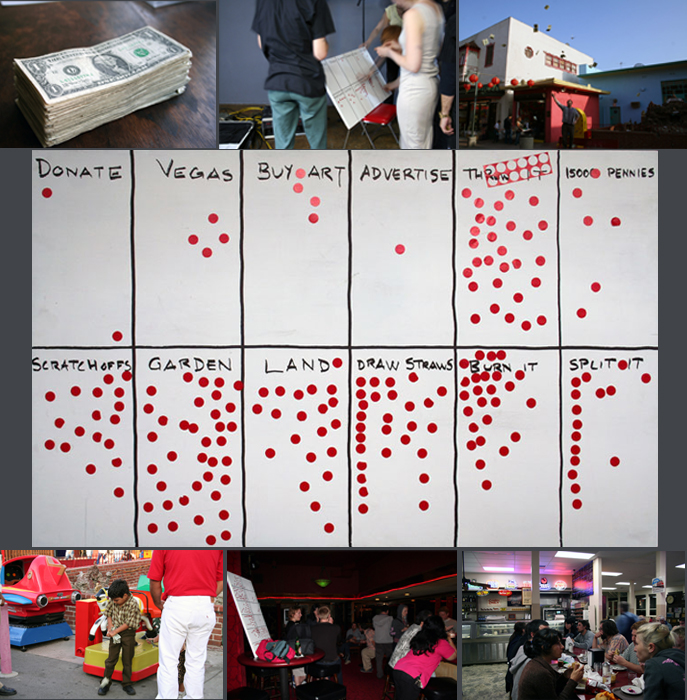
So I’m wondering if this resonates with you. If so, I’m wondering how, or if, you try to insure that your “to scale” experiments don’t become bogged down in the disciplinary baggage of art. Or do I have it all wrong? Are you interested in what framing things as art brings to the table?
SD: Running Telic Arts Exchange for a few years was interesting for me – before that I assumed galleries just bracketed off Art from the Life outside. It wasn’t long before I began thinking that galleries weren’t so special after all. They looked like art… barren and bright and unusual but, in the end, they were plain old shops just like everything else in the world. Then I thought that maybe what our gallery could do is be more like the world but at the same time be clearly something different, something not in the world. So I found myself interested in establishing a real boundary between art and life but this could be more of a mental boundary than a physical one. That is the framing I’m most interested in and I would lose interest in a project once that frame disappears.
I feel as though it is fashionable at the moment to say that we can “take advantage” of art’s networks of distribution to extend, expand, and connect projects, although it is certainly true to an extent. Maybe I’m a pessimist but I think capital will do this (extend, expand, and circulate) to us and our projectsto us and our projects regardless, whether or not we’re being strategic. Certainly we could insist on making our projects invisible so they continue to function primarily locally but I don’t see that as being inherently any better.
None of this really has to do with art history or disciplinarity. I suppose I don’t care very much about those things. I am attracted to art because some of the people are interesting to talk to and listen to (of course there are loads of bores too).
Although I run AAAARG.ORG, a theory text-sharing website, I feel embarrassed when I mention a theorist but there are a few times where a tiny little passage will plague me for years and so I talk about that passage a lot. Lately, it has been this one interview with Michel Foucault, called “Friendship as a way of life” where Foucault describes the relationship between men as something without a pre-existing model or institution and therefore something that requires constant invention. To me this perfectly sums up the spirit of what I would like out of my own life and projects.
RS: I’m in a bind here. Your answer is a good stopping point for the interview since you end with a summing up but I really feel like there’s a lot to take issue with.
It seems like you’re imagining a scenario where you can have it both ways, or several ways: gallery as just a shop, gallery as frame but somehow not the frame of art history, and you’d lose interest in a project without the frame? Then it is the frame that interests you and not the project which I find weird. And isn’t there a huge range of possibilities between using an art frame and making the project “invisible?” I’m also wondering where it’s fashionable to talk about using art networks tactically because I’ve rarely heard it said aloud.
As for your statement, “None of this really has to do with art history or disciplinarity. I suppose I don’t care very much about those things. I am attracted to art because some of the people are interesting to talk to and listen to (of course there are loads of bores too).” Isn’t this attitude exactly what I was alluding to in my question? This seems to indicate that operating in art is an entirely practical decision, i.e. a good place to find interesting people. This doesn’t seem to square with your more disicpline specific interest in framing experience.
SD: I feel like it’s barely started! We can’t end yet…
I think your email is so incredibly perceptive and right on it makes me feel a little naked. But there are a couple points I think I should respond to. The bigger thing is that I didn’t actually read your question in relation to our prior conversation and so my position to art comes off as even more schizo than usual. Concerning the scenario where I want to have it both ways: for some of the projects I was talking about (Telic Arts Exchange, The Public School) the project is the frame. One day we were having a lecture and I asked myself what the difference would be if it weren’t a lecture but a class. I think the difference is substantial. People generally come expecting to put themselves into it: they will prepare in advance, they will carry on relationships afterward, people even intuitively assign a different economic value to the two experiences. I am interested in framing – not for institutional legitimization but for the way the frame changes the way we treat the world (I’m sure this overlaps with the claims of aesthetics or art history but I’m just pretty ignorant about all of that.)
Anyway, I am interested in the projects, I swear! I consider the frame to be more about sensibility, enthusiasm, and energy than about territory, if that makes sense. And yes, I’ve failed in my explanation if I haven’t expressed a position of exploring the possibilities between using an art frame and making the project “invisible.” It was stupid to send my response so quickly. Fatherhood has me doing a lot things in some kind of hazy delirium.
I’ve heard talk about using art networks tactically in a couple panels and in discussions at the public school! I realize “fashionable” is a judgmental word but I am interested in these discussions and am currently trying to enact them to a certain extent (“franchising” the public school). I think we should stay conscious of the fact that our “tactical use” of these networks satisfies the needs of international culture industry and maybe we’re not always as in control as we think we are (especially when using macho terminology like tactical and strategic).
Yes and I totally agree with what you’re alluding to. I never really saw art as discipline specific, so much as just plain reflective. For example, I think our government should have more accountability and discussion about why we’re doing what we’re doing and what other possibilities there are. I don’t think of this as particularly art historical, although I do see your point that art history has institutionalized this kind of self-reflection.
I just can’t stop! More on this…
“So I’m wondering if this resonates with you. If so, I’m wondering how, or if, you try to insure that your “to scale” experiments don’t become bogged down in the disciplinary baggage of art. Or do I have it all wrong? Are you interested in what framing things as art brings to the table?”
One of these experiments might have been the video game that Fiona and I made, called PACK-MAN, which was just a hack of PAC-MAN so that five people controlled the character instead of just one (rather than moving him, it was more like you were voting on where he should move and that was being tabulated in real time in a pretty fun/ frustrating way). After making the game, we invited people from the internet to make new games for the video game console that we had engineered and then had a “screening” of sorts with those games, which came in from all over the world. The disciplinary baggage of art just never came up. The game was extremely visceral – it would make you squirm in your seat and yell at your neighbor. But it’s not as if art was somehow holding the game back from being something more interesting. There wasn’t really any art interest in it to speak of. To be honest it was the same thing with Telic – we did fantastic things and many people enjoyed them but there was just not much friction or dialogue with art collectors, writers, curators, tastemakers, etc. (with few exceptions). My investment scheme, the fundraising show, and AAAARG.ORG are all the same story.

So any answer I could give is really pretty speculative. What I can answer is why I’m even hanging out in this part of town at all:
– I like people that I’ve found within the context of art. There are people who try and create other ways of living, working, coexisting, and so on.
– An analogy: when I was younger I only ate meat and starches. I became a vegetarian at some later point. There were many meals in which I couldn’t participate or partake, or I’d limit myself to the “sandwiches” section of the menu. Now, I will try anything you serve me and I look at the whole menu which makes me feel so much happier.
– The fact is there are networks of publicity, distribution, sharing, exhibition, etc. in place that change what’s possible with a project and who it can reach. I’m skeptical of my ability to “use” these networks and still smell clean but it’s something to consider, especially because it links up with the first point.
So, maybe one of the good things about not being very successful at art is that I end up being fairly oblivious to the real weight of that disciplinary baggage you’re talking about.
The “framing” part of your question brings up definition and territoriality that I tried to address previously, mainly by appealing to another possibility for framing which is more about a philosophy than drawing lines in the sand. Obviously there is some line-drawing involved but I think it is less about making pronouncements (“this is art”) than it is about being a part of a bigger conspiracy (its an arts context because the people I referenced in my first point act as if it were true). Honestly, Randall, I feel stupid writing too much about framing as art and non-art because I don’t feel like I have much to offer because I can’t tell where the answers get us.
Anyway, this all seems to be winding down. I’m a little sad about it because I enjoy corresponding with you and (obviously judging from the last paragraph) there is a certain self-assessment that your questions have given which has been rewarding and helpful for me.
RS: It’s funny how this interview has sprawled into a messier conversation. I was concerned with it being a bit formulaic but happy that it had stayed a manageable edit and now it has taken on a real life, “something that requires constant invention.” So I’m going to abandon specifying what is and is not part of the sanctioned dialog and really plunge in now. This is difficult though as I am out at sea and this makes concentrating difficult.
I guess my concern is that the way the frame changes perceptions is often a distraction. My go-to example is eating curry in a gallery. If you want to think about what it means to eat curry in a gallery or as art, then framing it in an art context obviously makes sense. But if your interest is in curry, or creating convivial relationships, then maybe eating it at home with your friends is the way to go. I personally couldn’t care less what it means to eat/make curry as art!
Now the idea of frame-as-sensibility is interesting but I wonder if creating that sensibility in a new context, other than an art one might not be more potent. I’m feeling like I give the art context too much power and you give it too little.
As for fatherhood causing you to do a lot of things “in some kind of hazy delirium,” welcome to the club!
Art has certainly tried to take ownership of a certain kind of reflexive thinking and art history has done its bit to chronicle the lineage of that thinking. What concerns me is that art as a method is too coupled with art as a discipline. I think this is what Kaprow was dealing with for years with his notion of the unartist. How do we create and experience things in complex multi-faceted ways without always getting bogged down in an art historical dialog? To use a loaded example, how do I experience for myself what it is like to play chess with a nude woman without having to talk about Duchamp? Or to be less loaded, with a nude man? The point being the “experience” is often usurped into a historical-critical artlike (to further evoke Kaprow) art conversation. The genius of Kaprow in my estimation is that he saw this so clearly and laid out a road map, an escape route. I lament that so few people appear to have really taken the plunge.
As for being tactical and strategic, yes, well I’m a very macho guy which is why I want to play chess with a naked woman! I use the term tactical because it has such currency but often substitute practical/pragmatic. Yes, I completely agree about the complications involved in tactical use of art networks which is why I’m always harping on the art baggage associated with choosing to operate that way. I was puritanical for several years about this and at that time would not have even engaged in this interview/conversation but have since decided that the trade-offs are in fact worth it at times.
I’ll try to get into a bit more later but I have to go make some brownies. Man, we’ve really flipped the script! If you’re up for it, I think it could be nice to publish two versions of the interview – the formal, edited version; and the raw material (including even this proposal). We could have links to both and people could see which was more useful, boring or otherwise…
SD: I agree with the broad strokes of what you wrote but I don’t see what I’m doing as making curry. To go back to the radio show paper we talked about earlier, this gesture of domesticating the world by bringing it in to architectural discourse (writing an academic paper about non-academic topics) or into the gallery (curry) is less interesting to me than in what I think is the opposite motion.
What complicates this for me is that three of the projects I’m talking about are galleries. Maybe the analogy breaks down a little (it’s not bringing a gallery into the gallery) but at the same time, why do they have to be galleries? Why can’t they be ___? And here I have to admit that I’m relying on the idea of the gallery as something that people (not only art people!) get.
A recent one is the Distributed Gallery, which is basically an arrangement I made with a few business owners in my neighborhood (where Telic Arts Exchange is and where I have lived for the past four years) to put video monitors in their businesses, without obstructing normal business. They are a restaurant called Via Cafe, an antiques and other cultural objects store named Fong’s, and an art clothes and bookstore, Ooga Booga. Oh, there is a fourth monitor in The Public School.
Even The Public School isn’t bringing a school into the gallery. Rather, we had a gallery (Telic Arts Exchange) for a few years and eventually decided that a school made a more interesting model for promoting, distributing, talking about, and attracting the kinds of practices and ways of thinking that we were interested in. So, we changed the gallery into a school.

All that aside, I agree with the spirit of your analogy except that I don’t always want to do things with friends (eating curry, maybe). I enjoy having public spaces for our differences and disagreements to play out. In a way, this conversation is a tiny version of that. How do we sustain that kind of playing field? Because I do value it. I guess I’m returning to the idea of “frame.” Maybe the word itself is a little rigid and too much about carving out space, about insides and outsides. If that’s what an arts context is then it will always be problematic in ways that you’ve been convincingly describing.
Yes! Can you elaborate more on this paragraph?
“Now the idea of frame-as-sensibility is interesting, but I wonder if creating that sensibility in a new context, other than an art one might not be more potent. I’m feeling like I give the art context too much power and you give it too little.”
I think I agree with you wholeheartedly, even if our misaligned perceptions are written into it.
Each morning, I wake up thinking what did I write last night? Even these emails are written in between episodes of dancing, making sausage rolls, eating dinner, filling the bath, sending an email for work. The partial attention is frustrating but of course I wouldn’t change it for anything.
I’m conflicted because I feel like I agree with you and Kaprow here, but…I like talking about things, Duchamp included! And I don’t think experience is just some raw, primal pure moment, but something that is accompanied by talking, wondering, doubting, remembering. It doesn’t bother me that people talk about Duchamp, even in the midst of an interesting experience, I just think it’s a shame if the conversation starts and ends there.
What are the trade-offs that you see?
RS: As has been duly noted by legions of folks the gallery is something people “get” because it has a specific history as a form. Why not a community center? Or, my favorite, a public library? Both of those seem more flexible as sites for bringing various publics together. Public libraries have meeting spaces that can be used for video screenings, board meetings, birthday parties, book signings, etc. Sure, it too has an institutional history but unlike a gallery it isn’t circumscribed by basically one disciplinary form. What does the gallery provide? Seemingly the precise thing you want to ignore…
The public library is one of the last great civic institutions and one well suited to address your desire for “public spaces for our differences and disagreements to play out.” And it also has the potential to draw a far more diverse group of people. I’d also offer the Lyceum and Chautauqua movements from the 19th century as forms to modify and utilize. To some degree, I think the Public School might be an example, but there is a vast history that seems barely tapped from those movements.
Maybe this addresses the “new context” you asked me to speak more about? Or maybe you wanted me to say more about our divergent takes on the frame…
Of course I’m not interested in some idea of pure, or primal experience, or what some might call “authenticity.” There is however, a qualitative difference in experience that is historicized or art historicized and one that is not. There is a difference in intellectualizing experience and surrendering to somatic sensation, too. I am bored with, and frustrated by, the incessant drive of many art worlders to bring everything into the intellectual/historical/critical/curatorial fold. Sometimes a conversation is better suited as just that – a conversation and not some parsed meta-conversational performance, something to be framed, examined, interrogated, deconstructed, etc. This leads to the obligatory Zen reference – Don’t confuse the finger pointing to the moon with the moon itself. And yeah, I know “the moon itself” is a complicated notion, especially to the kinds of people that write for exhibition catalogs. To them I say (doing my best Nietzsche): relax your crooked soul, have a glass of wine, and enjoy the moonlight. There will be plenty of time tomorrow for your zeal, your seriousness, and the fury your academic analysis!
“What are the trade offs that you see?”
Hey, who’s interviewing who here? I think the trade offs for me were simple – continue with the art of living as I imagined it and have a few, deep conversations/experiences with people in my immediate circle. Or tap into a much larger network and open things up all the while having to be in evasion mode and spending an inordinate amount of time explaining why art is not particularly relevant to what I’m interested in doing, or rather explaining what unart is. The art world is filled with interesting people, to be sure, but it’s also filled with myopic snobs and interminable bores. I basically decided that it was worth dealing with those folks to get to the interesting ones.
To get back to Kaprow and Duchamp: I decided I would skip a step and drop out immediately rather than build a career or credibility and then drop out as they did. Eight years of doing nothing, but doing a very particular kind of nothing, was enough. At the end of that time I had my purity but I missed out on a bigger conversation and came to see my hyper-localism as potentially selfish, hermetic. So here I am now able to think through things with someone like you. It is well worth the trouble.
SD: Well some of the shop owners who are hosting televisions for the Distributed Gallery get a gallery and, even if they think it’s an odd form for a gallery to take, they are more receptive to working with me on hosting the monitors because they see it as a part of something bigger. And it also helps when I try and get people to choose videos to put onto those televisions every month. I think I see what you’re saying but I maintain that the form of the gallery can be put into action in interesting ways, particularly in our neighborhood where the split between Chinatown tourism and contemporary art is fairly even.
Maybe this is really the wrong project for me to be bringing up because it doesn’t really aspire to “bringing publics together” in the way you’re describing. It is much more personal – I am having these ongoing relationships with friends/ business-owners in the neighborhood I rarely leave. It’s alarmingly intimate! And then, we don’t do any press releases or curatorial texts for the exhibitions. I just have a long conversation with whoever chose/ made the work for that month. I mean, I do sincerely hope that the patrons of these different businesses goes to the other shops but the scale and nature of discussion is much different than a local library. For example, an artist wants to show something pornographic and then I have to figure out how to handle the expectations for creative freedom that contemporary art instills with the totally understandable objections that someone with opinions and a business might have. It’s a bunch of very small interactions but I find them exciting, even if they occur under the rubric of a gallery.
I mean, I like some art too! And there are artists that I want to support. I do kind of think that a gallery is often the worst thing for an artist but not always. I guess my way of thinking is very American – if I don’t like it then do something about it. I mean, we got rid of our gallery and replaced it with The Public School. I am not sure I could agree with you any more (except for starting two new galleries immediately afterwards).
Maybe this addresses the “new context” you asked me to speak more about? Or maybe you wanted me to say more about our divergent takes on the frame… I’ve been overthinking things as long as I can remember. Long before I knew about any folds! I feel as though you’re setting up these oppositions that I can’t choose between. On the one hand, I completely buy what you are saying in your critique of intellectualizing experience but at the same time I am personally incapable of having a conversation without having a conversation about the conversation at the same time, and this started years before I’d ever seen a piece of art from the 20th century. As you can imagine, I am irritating at a party but this doesn’t have to have anything to do with art.
In spite of your claims for dropping out or disappearing or doing nothing, you’ve left quite a formidable trail of thought over the last few years on the internet, much of it very critical writing about art. Maybe this is all very cohesive for you but there is an ambivalence between leaving it all behind and wrestling with it, occasionally on its own terms (maybe the archival nature of the internet skews my perception and sense of time a little though? But it does seem like you’ve built up some credibility!)
So after eight years is there any conflict for you or is that my own projection and has it really become as transactional as you’ve described? By that I mean a trade-off, where you know what you want and you know what you need to do to get what you want. I am fascinated that you’ve spent so long doing “nothing” and that you’re maybe pulling an appearance act. But I guess what I’m wondering is there a risk for you? In what way do you expect to be transformed in this process (conflict) or do you not expect to be (transaction)?
Yes, I did also want you to write more about this “feeling like I give the art context too much power and you give it too little” comment because I think it is central to some of what we’re discussing. Does “too little” mean that I don’t acknowledge the decisions or values or ways of working that it foists on us? And “too much” means that you attribute almost magical capabilities for it to govern our practice, with little hope for us to evade it? I like to imagine that I am thoughtful about this but you still are probably right. But could you explain what you really meant if I’m wrong?
Anyway, your point was that it might be more potent to operate (frame-as-sensibility) in a different context. For me, this returns to a centrifugal desire (art dispersing outwards) as opposed to a centripetal one (the world selectively brought in to be “dealt with” by art). What I want to think about is how the things that I value (the people, the conversation, the occasional thoughtfulness, the experimentation, the disagreement, etc) continue to function through this movement.
You’ve written a couple of times about the tendency to over-think, over-analyze, over-historicize, over-frame within art discourse. And I do agree with you except that I think there is not enough thinking and talking going on. A lot of that energy has been corralled into artist statements and thesis papers and monographs and formula lectures and so on. These circulate easily but in my mind they are distinct from a thinking and talking that doesn’t resolve easily into a format, that is as undefined and self-contradictory as the world itself, that becomes something else and something else again, that doesn’t stand up to time, that doesn’t respond to the compulsion to do, that… etc. I’m sleepy again.
I’m not sure how long you imagine this conversation continuing but I want you to know that I will keep going until it exhausts itself, or you pull the plug!
RS: Wow, you really hit your stride in the last message!
You’re absolutely correct in seeing me as deeply conflicted. It’s like a bad relationship I just can’t end! Or I could try to dress it up in this Kaprow quote: “Nonart advocates, according to this description, are those who consistently, or at one time or other, have chosen to operate outside the pale of art establishments–that is, in their heads or in the daily or natural domain. At all times, however, they have informed the art establishment of their activities, to set into motion the uncertainties without which their acts would have no meaning.” I’m conflicted about that too as I’m not convinced the acts would have no meaning.
I have built up visibility or “an appearance act” as you term it, and others can judge whether that translates into credibility.
It’s funny because I am familiar with the term “transaction” in John Dewey’s sense. That sense is more like the way you employ “conflict.” For Dewey a social transaction involves the co-transformation of participants. It is a process based epistemology that seeks to avoid the usual dualisms of subject/object, mind/body etc. So yes, I very much hope that my relationship with the art world and the world generally is transactional, in my [Dewey’s] sense.
I think you have this right concerning me: being polemical is a nasty habit of mine and therefore I tend to veer towards “almost magical” attributions too often. I know that you are thoughtful, deeply so, about your projects, but in the course of our conversation it seems like you’ve consistently dismissed any potentially negative effects of art framing. I think another possible explanation lies in our own histories. I have consistently claimed that the things I do/have done are not art and that seems to invite people to disprove it. So I’ve had far too many conversations about why something is art. Since the frame is a given in your endeavors, in a funny way it is less visible as such. For instance, in describing the PACK-MAN piece you noted the idea of art never came up. So maybe we each need to reverse positions!
I’m pretty sure we are in agreement. My complaint is not with thinking, per se, but with the highly specialized and insular form of thinking that seems to dominate certain segments of the art world. And I love the notion of art discourse corralling thought. That metaphor resonates with my concern for making things projects, pieces, works, etc. It puts experience into a pen, chases it down, ties it up…The range of what is thinkable in the art world suffers from its narrowly conceived theoretical canon. There are so many forms of thoughtfulness and intelligence (especially emotional intelligence) that get swept aside in the embrace of what I feel is “theoretical fundamentalism.” Compassion, empathy, sympathy, love, pleasure, fun, etc. all bow down before the high theoretical altar and are approved only after proving that they’re not “just” fun or “just” tender but have a whole theoretical/intellectual armature beneath them that make it okay. I think you’re right to point out that a good deal of art world conversation ends up as a formulaic enactment, one that too often tends to “resolve easily into a format.” Ultimately I just wish that there were more at stake than what amounts to artsy thought experiments. Haven’t we basically shifted from art for art’s sake to academic criticality for academic criticality’s sake? And what have we gained in the process? Not much, if you ask me – thinner and thinner slices of experience parsed by narrower and more specialized tools yet cloaked in the banner of openness and diversity. Feels a bit like greenwashing…
SD:Wow, that Kaprow quote is an interesting one. There is a part of Bourriaud’s book Postproduction where he writes (I’m not going to bother looking this up, so I could very well be wrong here) that the exhibition space could operate as a kind of “basecamp” for art explorations afield. These guys are so far apart in so many ways but Kaprow’s quote does seem structurally similar here – art is the thing we always have to report back to. I haven’t thought this through before but it seems like describing having a computer but not a network connection. You can play games, write essays, make pictures and movies on your computer, but you just don’t have the same people around, the same system of distribution, and the “reporting” kind of keeps your connection active. One very well can cut the cord and do what they do and it still has meaning, of course, just not in the same way with the same people.

I mean the network analogy, although terrible in certain respects, is fun to think about with Dewey’s transactions: i.e., to think about the ways that writing, making videos, etc. changes when we’re doing it in tandem with a lot of other people (shooting a home movie to put on YouTube vs shooting a home movie to watch whenever you feel like setting up the projector in your place). Have things gotten to the point that a book we’ve read has no meaning unless we report on it to our friends or the public in some online forum? I don’t know if this is appropriate – sorry to shift art-specific discussion to culture in general but I feel as though these are all connected. After all, our very specific discussion is being conducted at a distance in solitude but through the Internet, the very thing that even made us aware of each other in the first place.
I have lately been referencing this one passage in Ernest Laclau and Chantal Mouffe’s Hegemony and Socialist Strategy about “articulation”, which I’ve remembered to broadly refer to that same transaction (although they are writing more about how groups with uncommon causes create chains of equivalence to form some kind of political movement). I’ve mainly been interested in talking about collaboration not as finding common ground – or each doing what we’re good at to get something done that we couldn’t do individually – but as working to a vaguely common goal with the understanding that we’ll each be transformed in the process (the first two are premised on a pretty stable sense of identity, unlike the latter). Anyways, I’d like to read more Dewey. I had a passing affair with pragmatism that I wouldn’t mind rekindling.
I recently had a discussion with someone who works on projects that I think are quite similar in motivation and spirit to what I do. He says that he does not call himself an artist but that in conversation with someone from the arts, it usually ends up at the reverse position, with that person saying, “You actually are an artist!” And I thought, my experience is the opposite. When asked “Are you an artist?” I will respond “yes.” But by the end of the conversation the person usually has their doubts. I think I prefer that!
I think focusing on the crossing in and out of the art frame – on one’s position with respect to the art frame – focuses attention on the art frame and makes it all mostly about the art frame. This is the art frame that generates all of those conversations about “Is it art? Or is it not art?” Those very conversations seem to be one of the most negative effects of art framing! That’s not to say there aren’t others though – maybe we could be more specific about what they are? It used to be that commodification was one, right? (I take the position that absolutely anything can be bought and sold if someone wants to buy it badly enough, so maybe it’s an obsolete concern.) I think limiting of the people who tend to be involved is another that you’ve brought up. I don’t want to totally evade your question but I think I need to know more of what you have in mind.
Even a week later, I am still taking this in: “to ‘resolve easily into a format.’ Ultimately I just wish that there were more at stake than what amounts to artsy thought experiments. Haven’t we basically shifted from art for art’s sake to academic criticality for academic criticality’s sake? And what have we gained in the process? Not much, if you ask me – thinner and thinner slices of experience parsed by narrower and and more specialized tools yet cloaked in the banner of openness and diversity. Feels a bit like greenwashing…”
RS: I wonder where you’ve gone with my “artsy thought experiments” comment. I also wonder where we are with our conversation and if you’ve imagined what might come of it beyond being an interview…
SD: Well you wanted more at stake than artsy thought experiments. Who can disagree with that? I’m a little torn though because I think there is a widespread, popular hostility to theory that attracts me to it. The thing is maybe to distinguish between theory and artsy thought experiments. Am I completely missing the point here?
Because of the sputtering last couple weeks, I feel a little as though our conversation is a land mass that’s still identifiable but lost its detail (writing to you makes me picture myself on a boat).
Well, quite obviously I hope that we stay in touch. I’d like to think it already went a little beyond being an interview, but I might be flattering myself to say that. I honestly feel privileged that you’ve taken the time to ask some very difficult questions and help me see things that might be limiting what I do, or choices I’ve accepted rather than made. In a way I don’t feel like it’s my place to imagine any more because I’m certain I probably got more out of this conversation than you did.
RS: Well the hostility to theory is not from the inside, is it? In my experience, it is only non-art people who have a (mostly well placed) aversion to theory precisely because it’s so hard to distinguish it from artsy gobbledy-gook.
The sentiment you’re expressing in your last statement is, well, NUTS. This conversation was so enriching and I’m so glad you agreed to it. I believe we’ve definitely move from “friends” to friends. That might be a good title?
SD: Oh, I wasn’t even thinking of artists using theory so much as the social practice of thinking in general. I understand that “theory” is now an umbrella term for all sorts of postmodern academic styles of writing and discussion that end up like inbreeding for ideas. I want to be clear that I am not defending this (whether in art or higher level education in general) even if I am using the term. Rather than taking up a position on the inside or on the outside, I like the idea of a parallel existence. I think young people do that with music. The idea of successive generations toppling each other like dominos makes less sense to me than the mutations that happen when things get done wrong and become really persuasive and amazing ideas. Although I don’t always have the self-discipline to do it. Thinking positively and keeping moving, when in an argument, always seems to lead to a more fulfilling place rather than taking a position of conflict (baggage).
It’s obviously nostalgia but I’m fascinated by a number of individuals who were alive in the 19th century doing things that seem radically disjunctive now, i.e. philosopher-businessmen-scientist types. You mentioned the Lyceums and Chautauqua, which I hadn’t heard of but I’ve looked them up and they’re definitely part of this same context. It seems as if life hadn’t been separated into the categories we find dominant now. I feel like we’re in a similar moment of cultural transformation where we really just don’t understand the world we live in. Theory should be a practice of thinking that helps us make that world better (unfortunately, it is the language of specialized academic discourse).
——————————————————————–
Sean Dockary is an artist in Los Angeles. He is a co-director of Telic Arts Exchange (http://telic.info) and has initiated a handful of collaborative projects including a school (The Public School), a theory text-sharing website (AAAARG.ORG), and an architecture radio show (Building Sound). He has contributed writing to X-TRA, Bidoun, Fillip, Volume, and Cabinet magazines, and his video and sculptural work have been exhibited at Gigantic Art Space, ESL, the Cheekwood Museum, the Turtle Bay Museum, and the Armory Center for the Arts. “The Public School (for Architecture)” in New York, a project in partnership with the architecture group, common room, was recently awarded a fellowship from the Van Alen Institute. With fellow collaborators in The Public School, Caleb Waldorf and Fiona Whitton, Sean organized a 13-day seminar at various sites throughout Berlin in July, called “There is nothing less passive than the act of fleeing,” which discussed the promises, pitfalls, and possibilities for extra-institutionality.
Philosophy, a Living Practice – Grace, Place, and the Natural World – Kathleen Dean Moore – The Ecology of Love
Words will never describe my love for Kathleen Dean Moore.
A Weakened World Cannot Forgive Us: An Interview with Kathleen Dean Moore – Derrick Jensen
Jensen: Immersion doesn’t occur overnight. It takes a long time to get to know a place, and for it to get to know you.
Moore: That’s especially true given the separations that characterize our contemporary Western lives. We don’t lead lives of “quiet desperation,” as Thoreau claimed. We lead lives of relentless separation – comings and goings, airport embraces, loneliness, locked doors, notes left by the phone. And the deepest of all those divides is the one that separates us from the places we inhabit. Everywhere I go, I encounter people who have come from someplace else and left behind their knowledge of that land. Universities, which should study connections, specialize in distinctions instead. Biologists in their laboratories forget that they are natural philosophers. Philosophers themselves pluck ideas out of contexts, like worms out of holes, and hold them dangling and drying in the bright light. We lock ourselves in our houses and seal the windows and watch nature shows on tv. We don’t go out at night unless we have mace, or in the rain without a Gore-Tex jacket. No wonder we forget that we are part of the natural world, members of a natural community. If we are reminded at all, it’s only by a sense of dislocation and a sadness we can’t easily explain.
…
…if philosophy is concerned with big, abstract ideas, then it must be di-vorced from the details of our lives. I believe that is a huge mistake. If philosophy is about big ideas, then it must be about how we live our lives. If I find out what a human being is, to borrow Socrates’ example, then I will know what makes one human life worth living.
…
…Most philosophers work in isolation on little intellectual islands, and when people live in isolation for a few generations, they start to speciate, develop their own languages, and twitter in words that only they can understand.
People are desperate for the kind of insights philosophers can provide. When I speak to fisheries biologists, or wetland managers, or conservation groups, they are all looking for someone to articulate the worldviews and values that can help us make sound decisions. Scientists can tell us how to save wild salmon, for example, but it’s up to philosophers and others to tell us why we should. The values, the moral imperatives, the framing ideas – all these are missing from the public debate, in part because philosophers are too busy publishing arcane tracts that no one but a tenure committee will ever read.
…
Jensen: Why is it so hard for philosophers to write about real-life issues?
Moore: I think part of the problem has to do with striving for a specific kind of clarity and certainty. It took me probably twenty years to realize how steep a price philosophers have paid for this peculiar clarity. The first thing to go was the philosopher as a person. By writing always about ideas and never about themselves, philosophers became disembodied authorities with no past, no future, no reason for wondering, or even for living.
What happened then is that the range of possible subjects narrowed: the things one can write most clearly about are also the simplest, and nothing in real life is simple. So the philosophers I met in graduate school wrote about such pure, slick-surfaced ideas as truth and consistency, but not about home, not about landscape, not about parents, not about fish.
Jensen: I would like a philosophy that teaches me how to live: How can I be a better person? How can I live my life more fruitfully, more happily, more relationally?
Moore: These are traditionally the most significant philosophical questions, but they’ve been washed off the surface of philosophy by the twentieth century.
It’s a failure of courage, I think. Real-life issues are messy and ambiguous and contradictory and tough. But their complexity should be a reason to engage them, not a reason to turn away. The word clarity has two meanings: one ancient, the other modern. In Latin, clarus meant “clear sounding, ringing out,” so in the ancient world, clear came to mean “lustrous, splendid, radiant.” The moon has this kind of clarity when it’s full. But today that usage is obsolete. Now clear has a negatively phrased definition: “without the dimness or blurring that can obscure vision, without the confusion or doubt that can cloud thought.” For probably twenty years, I thought that this modern kind of clarity was all there was; that what I should be looking for as a philosopher was sharp-edged, single-bladed truth; that anything I couldn’t understand precisely wasn’t worth thinking about. Now I’m beginning to understand that the world is much more interesting than this.
…
…to lead a moral life we have to acknowledge the depth and complexity of our ties to our natural communities – our own experience of caring for those communities, and the value we place on caring. And we must commit ourselves to acts that grow out of love. Aldo Leopold said, “Sing our love for the land and our obligation to it.” It’s amazing how quickly obligation follows on the heels of love.
What is called for are not just acts of enlightened self-interest, but acts that grow from our connections and acknowledge the worth of the land we care for so deeply. The right act isn’t the one that makes us happiest as individuals. The right act is the one that strengthens and reknits the web of relationships, and so tends, as Leopold said, “to preserve the integrity, stability, and beauty” of the community.
Figuring out what’s right in any given instance isn’t easy. You have to learn about your natural communities – how things fit together, what makes communities flourish, what weakens their bonds. You have to study what one might call “the ecology of love.”
Jensen: What is the relationship between love and the natural world?
Moore: I’m always surprised when a nature writer describes going off alone to commune with nature. That way of relating to nature is all about isolation, and I don’t have much patience with it. To me, that’s not what being in nature is about at all.
In my life, the natural world has always been a way of connecting with people – my children, my husband, my friends. The richness of my experience in the natural world translates immediately into richer relationships with people.
I think one of the most romantic and loving things you can say to another person is “Look.” There is a kind of love in which two people look at each other, but I don’t think it’s as interesting as the love between two people standing side by side and looking at something else that moves them both.
Let’s think about this in terms of what we were saying about memory and identity: If we are our memories, then to the extent that two people share memories, they become one person. The whole notion of the joining of souls that’s supposed to happen in marriage may come down to those times when we say, “Look,” to our partner, so the two of us can capture a memory to hold in common.
Art as Work = Punishment Not Virtue – Idlers vs. Puritans
So many familiar themes here. LeisureArts anyone? And this post on Basic Income or Art Leisure vs. Art Work and even an interview on Art Leisure.
Busyness serves as a kind of existential reassurance, a hedge against emptiness; obviously your life cannot possibly be silly or trivial or meaningless if you are so busy, completely booked, in demand every hour of the day…More and more people in this country no longer make or do anything tangible; if your job wasn’t performed by a cat or a boa constrictor in a Richard Scarry book I’m not sure I believe it’s necessary. I can’t help but wonder whether all this histrionic exhaustion isn’t a way of covering up the fact that most of what we do doesn’t matter.
I am not busy. I am the laziest ambitious person I know.
…
It’s hard to find anything to say about life without immersing yourself in the world, but it’s also just about impossible to figure out what it might be, or how best to say it, without getting the hell out of it again.
Idleness is not just a vacation, an indulgence or a vice; it is as indispensable to the brain as vitamin D is to the body, and deprived of it we suffer a mental affliction as disfiguring as rickets. The space and quiet that idleness provides is a necessary condition for standing back from life and seeing it whole, for making unexpected connections and waiting for the wild summer lightning strikes of inspiration …It almost makes you wonder whether loafers, goldbricks and no-accounts aren’t responsible for more of the world’s great ideas, inventions and masterpieces than the hardworking.
…
My old colleague Ted Rall recently wrote a column proposing that we divorce income from work and give each citizen a guaranteed paycheck, which sounds like the kind of lunatic notion that’ll be considered a basic human right in about a century, like abolition, universal suffrage and eight-hour workdays. The Puritans turned work into a virtue, evidently forgetting that God invented it as a punishment.
…
I suppose it’s possible I’ll lie on my deathbed regretting that I didn’t work harder and say everything I had to say, but I think what I’ll really wish is that I could have one more beer with Chris, another long talk with Megan, one last good hard laugh with Boyd. Life is too short to be busy.
In Search of the Mundane – Ordinary vs. Extraordinary – The Unremarkable
Redefining Success and Celebrating the Ordinary – Alina Tugend [See this as another example. Also see this dealing with this theme.]
As Brené Brown, a research professor at the University of Houston Graduate School of Social Work and author of the book “The Gifts of Imperfection” (Hazelden, 2010) said, “In this world, an ordinary life has become synonymous with a meaningless life.”
And that’s a problem. Because “extraordinary is often what the general public views as success,” said Jeff Snipes, co-founder of PDI Ninth House, a corporate leadership consulting firm. “You make a lot of money or have athletic success. That’s a very, very narrow definition. What about being compassionate or living a life of integrity?”
…
The problem is that we have such a limited view of what we consider an accomplished life that we devalue many qualities that are critically important.
…
She didn’t have a great job, she wasn’t married and never had children, so she wasn’t successful in either the traditional male or female sense, Ms. Porter said. But people would keep telling stories about her kindness.
“She had a lot of magic in her life, and that’s reassuring,” Ms. Porter said. “That you can live a full, interesting, ordinary life.”
“Ordinary has a bad rap, and so does settling — there is the idea is that we should always want more,” she said. “But there’s a beauty in cultivating an appreciation for what we already have.”
…
“For the growing good of the world is partly dependent on unhistoric acts; and that things are not so ill with you and me as they might have been, is half owing to the number who lived faithfully a hidden life, and rest in unvisited tombs.”
David Robbins – The Problems of Art – Inventing Contexts
“Forming Fun” – Hans Ulrich Obrist with David Robbins
It’s more about inventing a context. It’s not about bringing things into art, that Duchampian thing. Instead it’s about making a new context for cultural production and presentation. I’m not really interested in the problems of art anymore.
Mark Slouka – Humanities vs. STEM – Educating for the Spirit rather than the Market
Dehumanized: When math and science rule the school – Mark Slouka
In our time, orthodoxy is economic. Popular culture fetishizes it, our entertainments salaam to it (how many millions for sinking that putt, accepting that trade?), our artists are ranked by and revered for it. There is no institution wholly apart. Everything submits; everything must, sooner or later, pay fealty to the market; thus cost-benefit analyses on raising children, on cancer medications, on clean water, on the survival of species, including—in the last, last analysis—our own. If humanity has suffered under a more impoverishing delusion, I’m not aware of it.
…Still, capitalism’s success in this case is particularly elegant: by bringing education to heel, by forcing it to meet its criteria for “success,” the market is well on the way to controlling a majority share of the one business that might offer a competing product, that might question its assumptions. It’s a neat trick. The problem, of course, is that by its success we are made vulnerable. By downsizing what is most dangerous (and most essential) about our education, namely the deep civic function of the arts and the humanities, we’re well on the way to producing a nation of employees, not citizens. Thus is the world made safe for commerce, but not safe.
…
Triply protected from criticism by the firewall of their jargon (which immediately excludes the non-specialist and assures a jury of motivated and sympathetic peers), their economic efficacy, and the immunity conferred by conveniently associated terms like “progress” and “advancement,” the sciences march, largely untouched, under the banner of the inherently good. And this troubles me.
It troubles me because there are many things “math and science” do well, and some they don’t. And one of the things they don’t do well is democracy. They have no aptitude for it, no connection to it, really.
…
Not content with trivializing itself through the subjects it considers important, nor with having assured its irrelevance by making itself unintelligible, the study of literature, for example, has taken its birthright and turned it into a fetish; that is, adopted the word “politics”—God, the irony!—and cycled it through so many levels of metaphorical interpretation that nothing recognizable remains except the husk. Politically neuter, we now sing the politics of ocularcentric rhetoric. Safe in our tenured nests, we risk neither harm nor good.
Against Cosmopolitanism – Mark T. Mitchell – Rootedness vs. Restlessness – Wendell Berry
The Unmaking and Making of Community – Mark T. Mitchell
Skepticism about transcendent reality tends to lead in the direction of philosophical materialism, and philosophical materialism in our age has opened the door to the more general materialism of consumerism…Home tends to become merely a launching place for economic and hedonistic endeavors, and individuals tend to lose any abiding concern for the long-term future of the local community. In such a setting, any notion of community membership, which evokes ideas of commitment and loving concern over a lifetime, is replaced by the much narrower concerns for personal affluence and individual pleasure.
…
…a healthy local community comprises particular people inhabiting a particular place and sharing local customs, activities, and stories. In short, they participate in a complex web of relations that are flavored by the particular history, geography, and culture of that place. When we describe a local community in those terms, it becomes clear how a massive national community is simply an impossible ideal. Even more fanciful is the notion of a world community. To be sure, because we share a common nature and many common needs and desires, we can empathize with and render aid to humans from radically different communities. But the cosmopolitan ideal that one can be a “citizen of the world” is only imaginable if we strip down the rich notion of community to mean something like “the brotherhood of man.” The idea of universal brotherhood is appealing and, as far as it goes, it is true, but abstract brotherhood is not the same as living in a local community with men and women of flesh and blood… it may be easier to love the world than to love our neighbor. Ultimately, when love for a particular place and the people inhabiting that place are lost, community is lost as well. Love itself becomes an abstraction.
…
But though the temptation to stay at arm’s length, to inhabit a place with ironic detachment, is alluring, the implications for a robust and healthy local community are grave. Indeed, if a critical mass of such people occupy a certain place, they are merely a collection of individuals rather than a community. They are mere residents and not stewards. In such a situation, local stories and traditions that are only kept alive in the telling and the practice are lost. But these are the very things that provide context and meaning to our social lives. They provide us with guidelines for acting together. They are the source of manners and customs that make life in a community possible. With the loss of common traditions and shared stories, we lose the cues that help us navigate a particular local world.
…
…[Wendell] Berry argues that a meaningful community must include the ideas of rootedness and human scale. “By community, I mean the commonwealth and common interests, commonly understood, of people living together in a place and wishing to continue to do so. To put it another way, community is a locally understood interdependence of local people, local culture, local economy, and local nature.” Berry identifies the corrosion of flourishing communities as the result of an excessive individualism that places rights ahead of responsibilities and economic gain ahead of meaningful and durable relationships—relationships with neighbors, with local customs and practices, with the land itself. As he puts it, “if the word community is to mean or amount to anything, it must refer to a place (in its natural integrity) and its people. It must refer to a placed people….The modern industrial urban centers are ‘pluralistic’ because they are full of refugees from destroyed communities, destroyed community economies, disintegrated local cultures, and ruined local ecosystems.” Ultimately, according to Berry, “a plurality of communities would require not egalitarianism and tolerance but knowledge, an understanding of the necessity of local differences, and respect. Respect, I think, always implies imagination—the ability to see one another, across our inevitable differences, as living souls.”
Art’s Future is Not Art – Jerry Saltz – Post Art (or invisible art, spy art, escape art, unart, or the He Said of He Said She Said, etc.)
Jerry Saltz is hitting awfully close to home (or just about all the art ideas I ramble about):
The best parts of Documenta 13 bring us into close contact with this illusive [might he have meant “elusive?”] entity of Post Art—things that aren’t artworks so much as they are about the drive to make things that, like art, embed imagination in material and grasp that creativity is a cosmic force. It’s an idea I love. (As I’ve written before, everything that’s made, if you look at it in certain ways, already is or can be art.) Things that couldn’t be fitted into old categories embody powerfully creative forms, capable of carrying meaning and making change. Post Art doesn’t see art as medicine, relief, or religion; Post Art doesn’t even see art as separate from living. A chemist or a general may be making Post Art every day at the office.
 Lebenskünstler
6 comments