Wandering the Sea of the Non-Present – Robert Zaretsky – Rousseau – John T. Scott
First Theater, Then Facebook – Robert Zaretsky and John T. Scott
For Rousseau, though, theater was little more than an app of a broken society, and it was the world that had gone wrong.
…Staged productions representing life, he believed, distracted us from one another, and from ourselves. Theater replaces lived experience with vicarious experience and condemned participants to wander the sea of the non-present. “Nothing appears good or desirable to individuals that the public has not judged to be such,” he observed, “and the only happiness that most men know is to be esteemed happy.” Status updates and emoticons: Rousseau saw it all.
…the two activities during which we are most fully in the present are conversation and exercise. Rousseau saw this as well, but forget the treadmill: he lost himself in mountains and valleys and, while walking, conversed with himself. Indeed, “Reveries of the Solitary Walker” is a manifesto on the benefits of wondering while wandering.
Specialization – Idiocy – Jason Peters – Education
Majoring in Idiocy – Jason Peters
…colleges and universities are essentially diploma retailers obsequiously bent on making the shopping experience of their customers enjoyable and painless.
…
For education presently conceived and presently practiced has but one goal: the mass production of idiots.
I’m speaking—I hope—in fairly precise terms here.
An “idiot,” from the Greek idios (“private,” “own,” “peculiar”), is someone who is peculiar because he is closed in on himself or separated or cut off. In short, he is a specialist. If he knows anything, he knows one thing.
…
The idiot may have extensive knowledge of a given thing, but to the extent that he has no sense of where to place that knowledge in the larger context of what is known and knowable, and to the extent that he doesn’t know that the context for the known and the knowable is the unknown and the unknowable—to that extent his knowledge ceases to be knowledge and becomes a collection of mere facts, which, as Cervantes said, are the enemy of truth.
Again, I would not be misunderstood. In a manner of speaking we are all idiots, and anyone impertinent enough to get a Ph.D. flirts with idiocy every day of his life by virtue of the requisite and necessary specialization that attends the enterprise. That there are benefits to such specialization is, I think, unquestionable. It took a specialist to operate on my knee. It takes a specialist to make a fine cabinet or a good bookcase. But specialization is a limited, not an absolute, good, and it should never mistake itself for true intelligence. You may be an eminent Harvard biologist who knows a great deal about ants; you may be a brilliant if wheel-chair-bound British physicist who knows a great deal about string theory. But no amount of ants or strings or knowledge of how many ants can dance on the head of a string qualifies you to say that God is a delusion or human love a brain state. The world, said Thoreau, and rightly he said it (playing a variation on Hamlet’s theme), is bigger than our ideas of it.
Alexander Koch – Leaving Art – Dark Matter
As I mentioned in a previous post, I find Alexander Koch’s work (and Stephen Wright’s) to be absolutely compelling with regard to the art/life divide, so called “dark matter” and the invisible creative practices of escape artists.
Why Would You Give Up Art in Postwar Eastern Europe (And How Would We Know)? – Alexander Koch
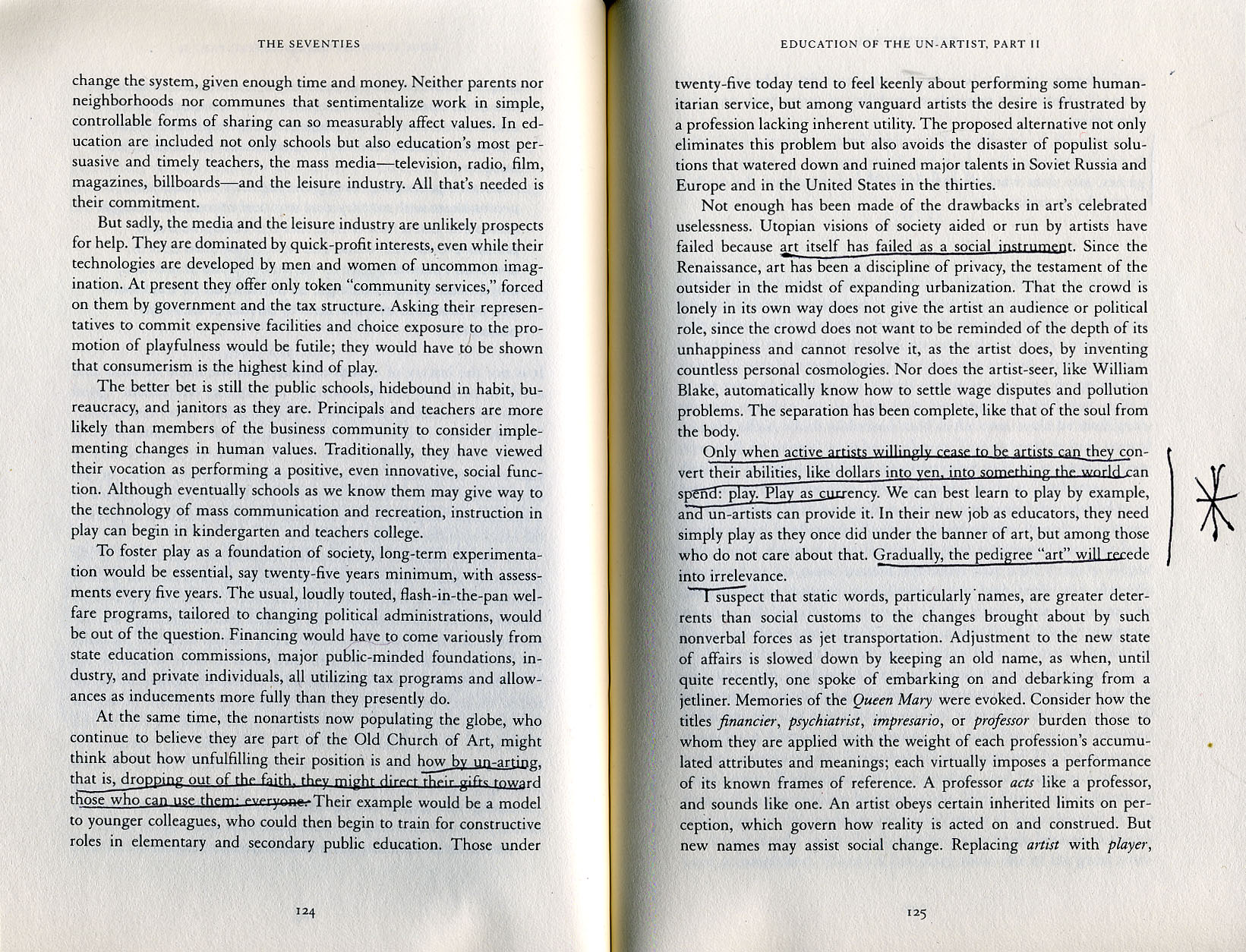
For some time now, my work has been circling the question: What if, as an artist, you decide to give up your artistic practice, disappear from the art scene, and leave the field of art altogether? Does this simply mean you have given up, that you have failed? Or would you merely be switching to a new line of work, changing your job? Or could there be, potentially, more to it than this? Could leaving art be, perhaps, a gesture of critique and (artistic) sovereignty? It will, indeed, come as no surprise if we say that today there are far more former artists in the Western world, than there are practicing artists. Given the large number of artists who graduate from our academies and the very few who eventually succeed in a professional career, the »ex-artist« is a very common phenomenon in our social environment – mind you, without being a particularly seductive subject for art critics or art historians.
Passion – Charlene Haddock Seigfried – Philosophy – Professionalization
“Has Passion a Place in Philosophy?” – Charlene Haddock Seigfried
…Against the present trend toward ever more obscure specialization, [Richard] Shusterman argues that philosophy should be understood as ‘concretely embodied practice rather than formulated doctrine.”
…
What today’s philosophers need to recover from the original pragmatists is their radical criticism of academic philosophy, specifically, their rejection of detached analysis and internal criticism as definitive of philosophy proper.
…
“[quoting The Oxford Companion to Philosophy]…this increasing technicalization of philosophy has been achieved at the expense of its wider accessibility – and indeed even to its inaccessibility to members of the profession.”
…
“[quoting William Adams Brown 1921]..like all professionals who live by their trade the philosopher feels the need of showing that there is some particular thing that he can do that nobody else can do, in order to justify the salary which he draws.” Having been divested of exclusive rights to rational reflections on religion, politics, history, law, the physical universe, and psychology, philosophers claim the history of philosophy itself as their special subject matter. The game interest “[again quoting Brown]…is the interest of doing a thing for the sake of showing how well you can do it, irrespective of the end accomplisihed by the doing of it…[I]t is the interest of thinking for thinking’s sake, of defining and redefining, analyzing and reanalyzing, controverting and recontroverting…for the sake of showing that you are cleverer than the other fellow at the game you are both playing.“
Obama’s Work Ethic – Leisure Rebellion
Obama’s Work Ethic – Harry Browne
…leisure-lovers of the world unite, and watch out for this guy’s moralizing work ethic.
…
Leisure should be a crucial political priority, especially in recession. There’s not enough work for everyone to do? Sure there is, if everyone worked less. Our preference for leisure, frankly confessed and proclaimed, can serve the common good, and point the way toward a more equitable distribution of hard-work, soft-work and no-work in our societies. A leisure rebellion in the US would also help to break the world’s most enduring stereotype of Americans: that they ‘live to work.’
Against University Uniformity And For The Provincial Institution – Localization – Place Based Education – Intra-diversity vs. Inter-diversity
This may rub my progressive friends the wrong way, but there is much to think about here. There is a powerful critique of universality to be made, and this piece does so, showing how the notion is related to the abstraction of (economic) exchange. There is something Baudrillardian about that line of thinking, although I’m sure Wilson would not embrace the comparison. The localization of education at the university level is not something progressives/liberals talk enough about (if at all).
Universal Uniformity in the University – James Matthew Wilson
If contemporary diversity leads all departments, all schools, and the character of all graduates to look roughly alike, it would seem reasonable to propose an alternative account of diversity that takes the word more seriously and makes it conducive to a substantive good that cannot be measured with a calculator…what if an institution were to commit itself not to attracting students and faculty from every possible state and a smattering of foreign lands, but to building up a faculty composed whenever possible of persons from a specific region and committed to educating the youth of that region? This used to be quite common, but in the impossible chase of the Ivies, even schools that stand no realistic chance of attracting a “world class” elite faculty nonetheless burn their local bridges in the attempt to do so. This reduces the cultural capital otherwise available to universities through nurturing and retaining their native population, and makes it difficult for an institution to manifest the particularities that naturally arise in a settled culture. Mobility and geographical cherry-picking homogenize more than civilize.
…
So, I ask, what if universities began hiring according to specific, exclusive, and perhaps even ungeneralizable criteria about what kind of knowledge is valuable? Currently, most scholars are more loyal to their profession and the standards and interests of their field of expertise than they are to their institution. They have to be, because the institution offers little of substance to which they might feel profound intellectual fidelity. Rather than seeking to have the best-available scholar in every field, schools might specialize more, and coordinate that specialization across departments and disciplines, reaching a provisionally local but robust consensus on the attributes proper to the life of learning.
…
…building upon a less widely “imported” faculty, and a newly circumscribed curriculum that makes substantive choices about what constitutes the essential knowledge of the liberally educated person of a particular institution, we may entertain the prospect of universities’ provisionally abandoning the attempt to establish a global, banal, and diluted consensus regarding the attributes of a good graduate’s character.
…
…yet schools restrict this celebration of “difference” to admissions criteria and superficial demographic festoons on an otherwise homogenous institutional coat rack.
…
…We would then realize real diversity between institutions, rather than a uniform diversity within them. That this would result in inferior and superior character formation at different schools would be an obvious consequence, but I am not sure why we would shy away from ambitious experiments in character and virtue, in an age where nearly everyone is convinced—for often opposed reasons—that universities are failing their students both intellectually and morally.
[All bold emphases mine.]
Susan Buck-Morss – Aesthetics Freed From Art
Aesthetics after the End of Art: An Interview with Susan Buck-Morss
But again, why is “art” privileged as the object of such experience? I really don’t know what the word means any more. Aesthetics, however, seems to me more important than ever. “Aesthetics after art,” you might call it.
Productivity as Religion – The Siesta
In Praise of the Spanish Siesta – Joe Robinson
At a time when productivity is the world’s largest religion, the siesta tradition lives on.
“We are an efficiency-oriented society,” he says. “It is perhaps the dominant value in this culture. The faster things get done, the better off we’re going to be. The idea of efficiency at all costs seems to be all-pervasive. It tends to invade our leisure. Unfortunately, socializing doesn’t have a ‘yield.’ It’s hard to develop relationships; those things take time.”
The Cult of Productivity – Slack – Anti-productivism
Let’s Be Less Productive by Tim Jackson
…Instead of imposing meaningless productivity targets, we should be aiming to enhance and protect not only the value of the care but also the experience of the caregiver.
The care and concern of one human being for another is a peculiar “commodity.” It can’t be stockpiled. It becomes degraded through trade. It isn’t delivered by machines. Its quality rests entirely on the attention paid by one person to another. Even to speak of reducing the time involved is to misunderstand its value.
Care is not the only profession deserving renewed attention as a source of economic employment. Craft is another. It is the accuracy and detail inherent in crafted goods that endows them with lasting value. It is the time and attention paid by the carpenter, the seamstress and the tailor that makes this detail possible…
Philosophical Dinner Party – Frieda Klotz – Everyday Philosophy – Plutarch
The Philosophical Dinner Party by Frieda Klotz
Plutarch thought philosophy should be taught at dinner parties. It should be taught through literature, or written in letters giving advice to friends. Good philosophy does not occur in isolation; it is about friendship, inherently social and shared.
…
Plutarch begins “Discussions” by asking his own philosophical question — is philosophy a suitable topic of conversation at a dinner party? The answer is yes, not just because Plato’s “Symposium” is a central philosophic text (symposium being Greek for “drinking party”); it’s because philosophy is about conducting oneself in a certain way — the philosopher knows that men “practice philosophy when they are silent, when they jest, even, by Zeus! when they are the butt of jokes and when they make fun of others.”
…
…it’s now more than ever that we need philosophy of the everyday sort. In the Plutarchan sense, friendship, parties and even wine, are not trivial; and while philosophy may indeed be difficult, we shouldn’t forget that it should be fun.
Open Engagement 2012, or a drop out drops in
What follows is a wholly incomplete account of my time in Portland during the Open Engagement conference. It may or may not be accurate or completely truthful. It is dedicated to my fellow travelers, and is especially dedicated to Abby (it may not be poetry per se, but still…):

Public sculpture near lecture hall.
eclipse watchers on the sidewalks
early dusk hummingbird escape
a graceful old farmhouse scratched by divorce and chicken feet
yakuza drinks with a Port Townsend farmer I swear keeps talking about gynecology (but is not)
an old friend rant, like falling from a bar stool – “ham and cheese sandwiches in my pocket!”
Cheerful Tortoise
beards and spectacles
aggressively unfashionable lesbians
fashionably unaggressive straight dudes
bloody mary truth serum
portable wardrobe sidewalk disintegration
confiscated fake id with threats of boyfriend reprisal
tales of mutton served to unsuspecting family members
Grain and Gristle
red velvet cake with herbaceous Italian dessert wine
crazy i-talian farmstand bitches
Native American salmon fisherman breaking down his catch over beer (I open one for him as his hands are slimy from the work)
DOC
opening remarks missed due to hangover
pickled beets greens mint soft boiled egg
bamboo mat is magic carpet then hiding place
alka seltzer + alka seltzer plus cold medicine
they talk and talk of social practice yet the farmer’s market overshadows
Woodsman Tavern
stacking veggie filled Rubbermaid totes for Gathering Together Farm
iced coffee in the rain
old haunts with new friends
new haunts with old friends
honey basil tequila lime
driving a Toyota Tacoma
lunch in the grass
radicchio feta hazelnuts
crows by the dozen carrying on as crows do
pea shoots and potatoes
drunk Florida women yelling from a car (see also i-talians)
deviled egg w/anchovy
anchovy butter w/cauliflower
cauliflower w/smoked almonds
almonds coated in salty sweet cocoa
Obama classmate from Hawaii describes him in a way that makes me like him
Robo Taco throat slash confusion
Ted Purves as phantom limb
Stephen Wright as mushroom shaman
who is sleeping with their grad students/who is not?
much note taking and unasked questions
I left it all with a heavy heart and a French goodbye (thanks Sal)…
Border Control – Fritz Haeg
We patrol our own borders, making sure nothing unworthy is allowed to enter and that everything inside is too precious for the rest of the world to participate in. When we do invite participation, it’s on our own terms, and we’ve already decided what will happen anyway….To be able to make the work that I am aiming to make – alive and engaged in a broader dialogue, straddling fields, disconnected conversations and discrete communities – I need to be prepared to make ‘not art’.
Anne Waldman – Field Poet – Outrider – Archeologist Of Morning
VIDA Interview with Anne Waldman: “From the Larynx”
I am interested in the magical properties of language — its sound and image, its logopoeia . I consider myself a field poet, an investigative poet, “an archeologist of morning” (Olson’s term). And to see the world, its exigencies, tragedies in a “new light” or a refreshed light through a heightened perception of language is what I try to do. Spiritual perhaps, but also a down-to-earth practice. A way into my own consciousness, into body, dreamscapes, other considerations of space, time, neuralinguistics, astronomy and so on – back and forth, up and down the spiral. And “lalita”- the “play”, delight in the particulars. And maybe we will leave a trace- who knows – poetry archives on the moon or Mars? I appreciate the fragments of Sappho!
…
“Outrider” is not “outsider”, but rides alongside the mainstream, intervenes upon it, but keeps her autonomy…Outrider is another rhizome, another complexity, not static, but in constant motion. Many experimental women have evolved new writing strategies and performances beyond the left-hand margin look and content-driven epiphany of the poem. Ambitious projects that eschew the master scriptures of shape and form which have been male gendered for centuries. There’s also reclamation back to older less theistic forms of practice. The outrider also seems socially, culturally engaged, involved with creating alternative infra-structures, aside the academic mainstream. Less careerist, if you will [emphasis mine].
Amateurs – Democracy – The Problems of Professionalization
Democracy Is for Amateurs: Why We Need More Citizen Citizens – Eric Liu
The work of democratic life — solving shared problems, shaping plans, pushing for change, making grievances heard — has become ever more professionalized over the last generation.
…
When self-government is dominated by professionals representing various interests, a vicious cycle of citizen detachment ensues. Regular people come to treat civic problems as something outside themselves, something done to them, rather than something they have a hand in making and could have a hand in unmaking.
…
…we need to radically refocus on the local. When the evolutionary biologist David Sloan Wilson launched the Binghamton Neighborhood Project, he broke down that city’s many paralyzing problems into human-scale chunks of action — turning an empty lot into a park, say, or organizing faith communities — and then linked up the people active in each chunk. Localism gives citizens autonomy to solve problems; networked localism enables them to spread and scale those solutions [emphasis mine].
…
Citizenship, in the end, is too important to be left to professionals. It’s time for us all to be trustees, of our libraries and every other part of public life. It’s time to democratize democracy again.
Richard Shusterman – Aesthetics – Art of Living
Breaking Out of the White Cube – Suzi Gablik interviewing Richard Shusterman
There’s so much room for art in the practice of living, in how we organize our lives and how we improve them, that the idea of confining art to what we hang on walls is a pathetic failure of theoretical as well as artistic imagination.
Gregory Pappas – Dewey’s Ethics – Democracy as Experience [Part VI – final]
“Morality is a social, creative, imaginative, emotional, hypothetical, and experimental process to ameliorate present situations.”
“What should be dethroned are not moral generalizations per se, but a way of using them that discourages moral sensitivity and precludes the genuine exercise of moral judgment…Dewey invites us to drop legalistic or absolutist models of moral conduct and to look instead to art as the paradigm of an activity that can steer between living aimlessly and living mechanically.”
“It is not under our direct control to create a more intelligent, aesthetic, and democratic way of life…but we can provide conditions for their emergence. We can only prepare the soil, and reconstruction must come from within everyday interactions. Continuous inquiry about indirect means and present conditions is the key to finding the way we can democratize experience.”
“With regard to democracy, what we believe and defend philosophically must be tested in the classroom, in the workplace, and everywhere there is human interaction.”
Wasting Time – On the Tyranny of Work
Wasting Time – Jonathan David Price
In our age, there is a covert moral position on the side of action. The belief that I am responsible not to waste time is tied up with the belief that my work can always be beneficial to myself or those around me or those who are affected, so long as my intentions are good and I try hard enough.
…
Philosophy, theology, poetry, ethics, the natural sciences, foreign languages, music, worship, novels, the civilizations of Greece and Rome, art, mathematics, cosmology, political theory, if all these are considered wastes of time for non-professionals, then by Jove I urge you to waste time. Waste it with panache. Waste years if necessary. These are bound up with what makes and sustains culture, and are part and parcel of active leisure. I know that already some of you are wasting time well. But in our age of transparency, I would encourage you to come out of the closet—or out from behind the bookshelf, as it were—as a time-waster. Join up with others and waste it like there is no tomorrow. Because if you don’t waste it well, there may not be a tomorrow, at least not one you would recognize.
Gregory Pappas – Dewey’s Ethics – Democracy as Experience [Part V]
“Having faith is a type of commitment, an insistence on a possibility, and a tendency to act upon it, fully aware of the risk involved in a particular context. Faith is necessary and important in all dimensions of life and not something confined to religion.”
“…determining the reasonableness of a faith in democracy is different from determining whether democracy is true or false, and different from validating a knowledge claim.”
“A failure to take the risk involved in having faith in democracy (and surrendering to skepticism and cynicism) is not altogether to avoid risk, but to take a different kind of risk, namely, the risk of losing things that might depend on believing in the possibility of democracy. One of the things lost may be democracy as a way of life. Democracy requires faith for its own realization.”
“The intelligent and aesthetic characters of democracies are mutually dependent. The community most capable of learning from experience is also the one that has all the features that define aesthetic activity, which for Dewey is the most inherently meaningful type of activity in experience. The democratic way of life is able to maintain the kind of balance and rhythm in its everyday doings and undergoings that, for Dewey, characterize aesthetic experience: a balance of tensions with rhythmic variety. Ideal activity is a merging of playfulness with seriousness that allows richness and flexibility without sacrificing stability. Democracy signifies for Dewey this possibility at the social level. The democratic community is also the aesthetic community because it is constituted by relationships that are neither fixed, routine, or mechanical, nor anarchical, capricious, or arbitrary.”
Doing Nothing – Jean-Yves Jouannais – Artists Without Works
“Can artists create art by doing nothing?” – Andrew Gallix
The artists he brings together all reject the productivist approach to art, and do not feel compelled to churn out works simply to reaffirm their status as creators. They prefer life to the dead hand of museums and libraries, and are generally more concerned with being (or not being) than doing. Life is their art as much as art is their life – perhaps even more so.
The Leisure Party Manifesto
We do not seek to overthrow the system but, rather, to underthrow it. [emphasis mine]
…
Leisure is not a promise that makes us press our noses to the grindstone; it is a basic human right. To work for the vague hope of a short respite is criminal extortion.
Lynn Stoddard – Educating for Human Variety
An alternative to Common Core – Lynn Stoddard
Does it make any sense to measure success by how early, or even, how well students can read, write and do math? Do not character and other human qualities count? Einstein said, “Not everything that can be counted counts, and not everything that counts can be counted.” If we want real progress in public education, we must place more value on the things that are harder to measure, like curiosity, creativity and character.
Gregory Pappas – Dewey’s Ethics – Democracy as Experience [Part IV]
“Dewey used philosophy to make his hope reasonable, which is different than seeking a foundation or a rationalization for a way of life.”
“A philosophy of democracy is an imaginative effort to articulate in a coherent fashion the most salient traits of the most worthwhile experiences and possibilities of human interaction for the purpose of ameliorative criticism. Democracy rests on experiencing and discriminating better and worse forms of interactions in daily life. It is precisely because meaningful and enriching relationships are hard to come by that we need to set them up as ideal and inquire into their conditions.”
“The art of listening needed in a democracy is a matter of embodied habits. Without a cadre of people with certain imaginative and emotional capacities there is no hope for democracy.”
“The recent interest on deliberation is a good corrective against narrow views of democracy, but political theorists must avoid the intellectualist temptation that has plagued the history of philosophy: the reduction of experience to the cognitive realm…How we experience each other in our everyday local and direct interactions is something more inclusive than how we talk and inquire together.”
“Intelligence for Dewey is not a faculty, but a general way of interacting…”
“You can guide but not reason someone into having the experiences that can validate democracy…the empirical philosopher must provide arguments, but she should also guide others (through descriptions and other means) to have the experiences that may confirm their hypotheses.”
“Dewey wanted to shift the focus of democracy to the present striving or democratization of experience instead of toward future results…There is no grandiose or ultimate war for the sake of which the piecemeal present battles are fought…Trying to transform everyday activity to make it richer and fuller relative to concrete present problems and possibilities is what we do in democracy as a way of life.”
“The reasonableness of an ideal way of life is to be tested in lived experience by trying to live it…we can test our hypotheses only by living them. Participation can only be tested by participating. There is, then, no theoretical justification of democracy that can replace the support provided in favor of democracy by living and embodying democratic habits in our everyday interaction.” [emphasis mine]
Art “Workers” – Life’s “Work” – Labor – Leisure – The Gratuitous
Why Work? – Christopher Hsu [Sounds awfully familiar – see this, this, or this for instance.]
Listening to artists and writers talk, you notice that the word you are hearing most often, after I and but and the, and so on, is work.
…In citing his work, an artist or writer associates himself with the non-gratuitous, unpleasant labor, the “toil and trouble” identified by classical economics…The word is meant to act in part as a good luck charm to ward off the evil spirits of vacuity, uselessness, solipsism, self-indulgence, depravity.
…
They conflate the second and third senses of work in an effort to push back at the idea of art as a gratuity, to demonstrate the worth of their product. “I am working on a series of works…” You can see where they are coming from. The problem is that art has never fit comfortably into a labor theory of value, and for that matter, any notion of objective value finds few takers under a marginalist, net-income-extracting model of economy. If the exchange value and standing of an object of art are determined instead by the symbolic capital bestowed on it by an arbitrary, conspiratorial “artworld,” what relevance has the labor-time inputted? It is out of their hands. They would be better off with a word like collateralize.
…
No, the ubiquity of work ultimately masks the artist’s most complex and vital relationship, which is to leisure.
Studying the Humanities
Sunday Dialogue – Studying the Humanities via NY Times
I die a little each time a fellow professor justifies our enterprise by saying, as Professor Greenberg does, that the liberal arts will help you succeed, “even flourish,” in the marketplace. It seems odd to say it’s worthwhile to contemplate Thoreau or Jesus or the French Revolution because doing so will positively affect your bottom line.
Indeed, I think it might not be such a bad idea to warn students that exposure to the liberal arts could make them unfit for the kind of work the marketplace values most highly. As if in compensation, however, humanistic learning may also make them indifferent to the kind of success the marketplace has to offer.
THOMAS PEYSER
Ashland, Va., May 2, 2012
Why Relying On Professional Artists Is A Bad Idea – Outsourcing Creativity
from The Outsourced Life – NY Times
The bad news in this case is the capacity of the service market, with all its expertise, to sap self-confidence in our own capacities and those of friends and family. The professional nameologist finds a more auspicious name than we can recall from our family tree. The professional potty trainer does the job better than the bumbling parent or helpful grandparent. Jimmy’s Art Supply sells a better Spanish mission replica kit than your child can build for that school project from paint, glue and a Kleenex box. Our amateur versions of life seem to us all the poorer by comparison. [emphasis mine]
Stephen Wright – Invisible Art – Quitting
“Behind Police Lines: Art Visible and Invisible” – Stephen Wright
I suspect that one reason for the artworld’s warm embrace of Rancière’s aesthetic theory is that it tells the artworld what it wants to hear about itself; it reinforces the glowing stereotype that the artworld fancies for itself – that is, as an inherently political and almost subversive place, whatever sort of predictable and conventional buffoonery it actually engages in.
…
And it may well be for this reason that ever more artists today are quitting the artworld, sacrificing their coefficient of artistic visibility in favour of a more corrosively dissensus-engendering capacity in the dominant semiotic order. For to see something as art according to the dominant performative paradigm of the contemporary artworld, is to acknowledge something terribly debilitating: that it is just art – not the dangerous, litigious, real thing. It is not my intent to deny that art can, on occasion, do what Rancière claims it can: for the artworld élite that likes that sort of thing, the concentrated, composed and self-reflective works one finds in museums have a disruptive value that is far from negligible. But deliberately circumscribing it within the policed structure of the artworld is to ensure that our relationship to art remains one of constantly renewed, constantly dashed hopes.
Dana Gioia – Professionalization – The Urgency of Poetry
“Can Poetry Matter?” by Dana Gioia is as relevant for art as poetry and as urgent today as it was in 1991. A must read. Really.
American poetry now belongs to a subculture. No longer part of the mainstream of artistic and intellectual life, it has become the specialized occupation of a relatively small and isolated group. Little of the frenetic activity it generates ever reaches outside that closed group. As a class poets are not without cultural status. Like priests in a town of agnostics, they still command a certain residual prestige. But as individual artists they are almost invisible.
…
…Decades of public and private funding have created a large professional class for the production and reception of new poetry comprising legions of teachers, graduate students, editors, publishers, and administrators. Based mostly in universities, these groups have gradually become the primary audience for contemporary verse. Consequently, the energy of American poetry, which was once directed outward, is now increasingly focused inward. Reputations are made and rewards distributed within the poetry subculture.
Gregory Pappas – Dewey’s Ethics – Democracy as Experience [Part III]
“The foundations of democratic respect are, for Dewey, a certain way of experiencing everything, not an exclusive and abstract regard for human rights or justice that is independent of nature. For the truly democratic character, ‘every existence deserving the name of existence has something unique and irreplaceable about it.’ This is the sort of natural piety that Dewey hoped for as a consequence of abolishing hierarchical ways of looking at the world.”
[quoting Dewey] “…the local is the ultimate universal, and as near an absolute as exists.”
“…a warning against taking the usual abstractions about democratic society as antecedent to the unique, direct, and qualitative relations people hold with each other in situations. It would be more accurate to say that a democratic society is one that is composed of democratic associations than to say that a democratic association is one that exists because of a democratic society.”
“…it is through and by the local that I can acquire this sense of connection with what is beyond it…Democracy must grow from within, that is, from what is local, spontaneous, voluntary, and direct. This includes neighborhood, family, classroom, workplace, and grass-roots movements…we must avoid sacrificing the quality of what is had locally merely for the sake of reach [emphasis mine].”
“Genuine listening, especially of those who speak against our beliefs, does more on behalf of participatory democracy than voting.”
“Local communities must be sustained by loyalty and solidarity while also remaining receptive to continuities within the larger context of a pluralistic society.”
 Lebenskünstler
leave a comment