Promote Non Art Reality – George Maciunas
Purge the world of bourgeois sickness, ‘intellectual’, professional & commercialized culture, PURGE the world of dead art, imitation, artificial art, abstract art, illusionistic art, mathematical art, – PURGE the world of Europanism [sic]! PROMOTE a revolutionary flood and tide in art. Promote living art, anti-art, promote Non Art Reality to be grasped by all peoples, not only critics, dilettantes and professionals. FUSE the cadres of cultural, social & political revolutionaries into united front & action.
– George Maciunas 1963
The Henry Flynt Special [Part I – AGAINST “PARTICIPATION” A Total Critique of Culture]
1998 thoughts for the next draft – Henry A. Flynt, Jr
[Thus begins a series of Henry Flynt postings – He is an outlier’s outlier. His concept of “brend” is woefully unknown/unappreciated (highlights of that later).]
Modern art is monumentally cognitively pretentious, as has been evident ever since Cubism. The preposterous mysticism of Malevich. Preposterous claims that evoking the idea of two-dimensional forms moving into three dimensions on the canvas alluded to our own movement in fourth-dimensional hyperspace. These metaphysical pretensions just get worse as we come up to the present.
…
Classical aesthetics was massively cognitively pretentious. I could only react to these pretensions with total contempt.
…
As a random example of avant-garde pretensions, one may consult George Brecht, “Something About Fluxus,” May 1964, unabridged version. He claims that the Fluxus school is defined by art or “activity” which is strange and new. But if we examine it with detachment, we see that there is nothing that intrinsically warrants being called strange or new. What Brecht means, described from a non-involved vantage-point, is that the works of his friends violate conventions of the context from which they spring–the gallery, the concert hall–by being diminutive and pointless. Whoop-de-doo!
…
From the Futurists to the Situationists, these artists were pictured contemporaneously and in hindsight as heroes, as “our leaders.” They indicted the old, they erected the new. They were slick enough to sell paintings that looked like puddles of vomit for a great deal of money, having proved that in the new time, there was no longer a distinction between the beautiful and the ugly. Thus, these shock troops of the new deserved our unconditional endorsement for their valiant stands. The words of their manifestos were like lightening bolts of truth in a murky age.
This phase of twentieth-century cultural history exposes the public as frightfully superficial and gullible. Somehow, the arbiters of taste were never bothered by the fact that the bottom line of the infinite revolution was a commerce in paintings – which were traditional product in every respect except that they were blatantly incompetent. (The artists who said “we had to do it to show how bad the world was” at least knew how bad their art was.)
Clearly, they never meant a word of it, about the infinite revolution. But it never bothered the pundits that artists were trifling with revolutionary claims and slogans. There was never a suggestion of holding the artists to account. It is shocking to realize how important posturing is in campaigning for social rewards. Somehow, it is implicitly understood that the “revolution” talk is fantasy; and it is palatable precisely because it changes nothing, precisely because it only gilds collectible objects. It was lying that brought the vanguard artists respect as heroes. The civilization has been carried up the mountain on the back of a lie. Are we to conclude that a white person is somebody who believes that saying ‘infinite revolution’ is an infinite revolution? [Liam Gillick anyone? – RS]
…
… Are people so stupid that they really believe that the Ramones will lead us to a perfect world, or even a universal revolution? Or does the audience know itself to be a privileged class which has long since agreed that all its joys will be lies?
Draining the Swamp of Art – John Zerzan – The Case Against Art
The Case Against Art – John Zerzan
Frequently compared to play, art and culture – like religion – have more often worked as generators of guilt and oppression. Perhaps the ludic function of art, as well as its common claim to transcendence, should be estimated as one might reassess the meaning of Versailles: by contemplating the misery of the workers who perished draining its marshes.
…
Today culture is commodity and art perhaps the star commodity. The situation is understood inadequately as the product of a centralized culture industry, a la Horkheimer and Adorno. We witness, rather, a mass diffusion of culture dependent on participation for its strength, not forgetting that the critique must be of culture itself, not of its alleged control.
…
The avant-garde has generally staked out wider claims, projecting a leading role denied it by modern capitalism. It is best understood as a social institution peculiar to technological society that so strongly prizes novelty; it is predicated on the progressivist notion that reality must be constantly updated.
But avant-garde culture cannot compete with the modern world’s capacity to shock and transgress (and not just symbolically). Its demise is another datum that the myth of progress is itself bankrupt.
…
Occasionally critics, like Thomas Lawson, bemoan art’s current inability “to stimulate the growth of a really troubling doubt,” little noticing that a quite noticeable movement of doubt threatens to throw over art itself. Such “critics” cannot grasp that art must remain alienation and as such must be superseded, that art is disappearing because the immemorial separation between nature and art is a death sentence for the world that must be voided.
…
Adorno began his book thusly: “Today it goes without saying that nothing concerning art goes without saying, much less without thinking. Everything about art has become problematic; its inner life, its relation to society, even its right to exist.” But _Aesthetic Theory_ affirms art, just as Marcuse’s last work did, testifying to despair and to the difficulty of assailing the hermetically sealed ideology of culture. And although other “radicals,” such as Habermas, counsel that the desire to abolish symbolic mediation is irrational, it is becoming clearer that when we really experiment with our hearts and hands the sphere of art is shown to be pitiable. In the transfiguration we must enact, the symbolic will be left behind and art refused in favor of the real. Play, creativity, self-expression and authentic experience will recommence at that moment.
Manifesto on Art – Fluxus Art Amusement – George Maciunas, 1965.
ART
To justify artist’s professional, parasitic and elite status in society,
he must demonstrate artist’s indispensability and exclusiveness,
he must demonstrate the dependability of audience upon him,
he must demonstrate that no one but the artist can do art.
Therefore, art must appear to be complex, pretentious, profound,
serious, intellectual, inspired, skillful, significant, theatrical,
It must appear to be caluable as commodity so as to provide the
artist with an income.
To raise its value (artist’s income and patrons profit), art is made
to appear rare, limited in quantity and therefore obtainable and
accessible only to the social elite and institutions.
FLUXUS ART-AMUSEMENT
To establish artist’s nonprofessional status in society,
he must demonstrate artist’s dispensability and inclusiveness,
he must demonstrate the selfsufficiency of the audience,
he must demonstrate that anything can be art and anyone can do it.
Therefore, art-amusement must be simple, amusing, upretentious,
concerned with insignificances, require no skill or countless
rehersals, have no commodity or institutional value.
The value of art-amusement must be lowered by making it unlimited,
massproduced, obtainable by all and eventually produced by all.
Fluxus art-amusement is the rear-guard without any pretention
or urge to participate in the competition of “one-upmanship” with
the avant-garde. It strives for the monostructural and nontheatrical
qualities of simple natural event, a game or a gag. It is the fusion
of Spikes Jones Vaudeville, gag, children’s games and Duchamp.
Mark T. Mitchell – The Art of Attention – Stewardship and Cosmopolitan Neglect
Liberal Education, Stewardship, and the Cosmopolitan Temptation – Mark T. Mitchell
When speaking of the proper care for the natural world, the word that best describes our efforts is stewardship. Stewards are care-takers. They lovingly guide, protect, and cultivate that which is under their care. In the language of stewardship the concepts of indebtedness, gratitude, love, and responsibility all find their proper places. But it is not only in the context of the natural world that the concept of stewardship has meaning. When we examine the topic of liberal education the idea of stewardship is indispensable. For as inheritors of a civilization, we are its stewards. And because the gifts of civilization are tender plants requiring constant nourishment, our task as stewards requires perseverance, courage, and, ultimately, faith that succeeding generations will take up the mantle when we are no longer able to bear it.
…
It is, in the end, impossible seriously to engage the great tradition without cultivating the habit (or is it the art?) of attention. Tocqueville notes that the habit of inattention is the greatest vice of democracy. This vice is exponentially more pervasive in an age where email, text messaging, Tweets, and YouTube are only a click away. Learning to attend carefully is, perhaps, one of our culture’s greatest needs. Paying attention requires self-control. We must learn to listen before we speak and think before we act. These habits are essential for self-government.
…
But with all this, there is at the heart of much writing about liberal education a sort of cosmopolitan temptation that, ultimately, does a disservice to the concept of stewardship. When proponents of liberal education describe it as the attempt to grasp the whole, they are partially right, but if we do not continue with the acknowledgment that the whole is grasped via particulars and that, as human creatures, we necessarily inhabit only a small and particular part of the whole, we are missing something crucial.
If a liberal education teaches a person to love abstraction, to relish the exchange of universal ideas of justice, charity, and beauty, yet to be inattentive to the neighbor down the street or the beauty of a well-tended garden, then something has gone wrong. Such an education is suited to abstract beings who naturally belong in no particular place and have none of the senses by which particular beauty or empathy can be experienced. Such an education is, in other words, not fit for human beings.
…
In other words, a liberal education should teach students how to be human beings and how to live in some particular place. If a course of education cultivates a hatred for home, it has failed. If it cultivates a dissatisfaction with the local, particular, and the provincial in favor of distant, abstract places where cosmopolitanism drowns out the loveliness and uniqueness of local customs, practices, stories, and songs, then the education has failed. To be well-educated is to be educated to live well in a particular place. It is to acknowledge the creatureliness of one’s existence and thereby to recognize our many debts of gratitude and the scale proper to a human life. A successful liberal education cultivates stewards who are disposed to love their places and who are equipped to tend them well.
MMUN – Defining Social Practice – Green Mountain Fury [Part II – The Kangaroo Court Responds]

“It is the right of the accused to be tried by a legally constituted court, not by a kangaroo court.”
– William O. Douglas (Williams v. United States, 341 U.S. 97, 71 S. Ct. 576, 95 L. Ed. 774 [1951])
Secretary-General Wick has responded to this post:
I would like to begin my address with a condemnation of a reckless communiqué delivered to myself and the secretariat last night by Randall Szott, the official spokesman for social practice in the rogue state of Vermont. Szott declares that our meeting today will amount to nothing more than a “mere rehearsal of old saws and art theoretical platitudes,” dooming social practice to becoming “an art-historical corpse.”[1] As will become apparent as I continue throughout this address, and as you continue throughout your day, the words of the tyrant Szott could not be further from the truth.
I would point out that designation as a “rogue state” is not new for Vermont. It is a common tactic of distraction employed by the powerful to further marginalize dissent. I would also point out that the esteemed moderator of the event himself, went “rogue” at the Open Engagement conference in 2010.
Your title as “acting Secretary-General” is certainly appropriate, Mr. Wick. You are clearly engaged in political theater when you pronounce the kangaroo court you’ve assembled to be “wonderfully diverse,” but we both know this is a lie. Although your citation of Simmel and your overview of the role of the four councils are both welcome, I again remind you that your PR announcement established from the get go that art is still the imperial eyes through which the process is overseen. You see, my MFA was in doing nothing not naiveté.
Kant didn’t just screw us with aesthetics, but ethics as well – Wisdom and the particular vs. Knowledge and the universal
Godless yet good – Troy Jollimore [I am happy to see Murdoch get some well deserved attention, but surprised that her friend and colleague, Mary Midgley ‘s work isn’t mentioned. See this for example. And what about Nel Noddings?]
This emphasis on being attentive to concrete reality tallies with the idea that it is the emotions (compassion and sympathy in particular), rather than abstract rational principles, that are doing the motivating when it comes to ethical behaviour. Together they embody a critique of moral views, such as Kant’s, which rely on inflexible ethical principles allegedly derived from logic itself. In the work of McDowell, this critique is developed into a position called ‘moral particularism’, which rejects altogether the idea that we might one day compose or possess an ethical rulebook that would define the right thing to do in any conceivable situation. After all, what can count as a moral reason in one context might fail to be a reason in another, or might even be, in certain contexts, a reason pointing in the other direction.
…
…However, more recent investigators tend to prefer a picture in which several distinct and perhaps incommensurable factors make contributions to a person’s happiness. This fits in well with the particularists’ view that evaluation is always a holistic matter. It is worth remembering, too, that Aristotle understood eudaimonia, which is frequently translated into English as ‘happiness’, as something considerably broader and less subjective than pleasure or momentary satisfaction. Instead, it has to do with the general quality of one’s life as a whole.
For particularists, then, individual perception and judgment are always necessary to decide difficult ethical questions: there is no theoretical ethical system that can do the work for us. Principles are useful, perhaps, but only as rules of thumb, practical guidelines that hold for the most part, but to which there will always be exceptions. At the foundational level, ethics is built not on a system of rules, but on individual human beings who possess character, judgment, and wisdom.
…
Particularism re-opens the door to the idea of wisdom. It is an idea that Kantian and utilitarian ethics — and, for that matter, the modern world in general — have great trouble taking seriously. Wisdom, as opposed to knowledge, might seem a somewhat quaint notion in the contemporary world. (Indeed at this point even the word ‘knowledge’ sounds quaint to many people, who prefer to talk about ‘data’ or ‘information.’) The modern desire to replace individual wisdom and judgment with more objective, scientific methods of decision-making and evaluation has had profound effects on many aspects of our lives. In the field of education, where I work, it has led to ever-increasingly complex systems of rules and standards for professional conduct, for assessing teaching effectiveness, for making promotion decisions, even for designing courses and course curricula. The prevailing attitude is that we need a system of rules and principles to make and justify every decision, because we cannot trust the individuals involved enough to leave it up to their good judgment — even when the individuals involved are highly trained experts and just the sort of people capable of discerning how rules and principles should be implemented, and when they should be ignored or adapted. Similarly, the current plague of standardised testing inflicted on students leads to the slighting of skills and traits that are difficult to quantify: artistic talents, creativity, and moral attributes, among many others. This prevailing attitude is one that many Kantians and utilitarians would applaud, and one that Aristotle would deplore.
…
I was not interested in art and it was not interested in me.
[found the fragments of a talk I was going to give once and spent a little time editing it]
The arguments stopped when the bar cleared out. Ideas abandoned – crushed limes amid melting ice and chewed up thin red straws. One could’ve measured things by the ferocity of hangovers or the days upon days of jackets reeking of ash. I’ve got notes somewhere. I could title them “Minutes of the outside looking in committee,” but that might mislead.
In the early years it was pizza, wine, French feminists, Asian philosophy, salads with feta cheese, Donna Haraway (and plenty of other cyborgian stuff), southern folk art, Gregory Bateson, and oodles of continental thinkers. The Zapatistas were a frequent topic thanks to a history graduate student and member of the “band” Stool Sample Sandwich. He took so long in the pursuit of his degree that he ran out of time and never got the degree. At this time, I had a concealed weapons permit and there was a particularly heated exchange around the appropriateness, or lack thereof, of an armed left.
Influence is a funny thing. A comment made in passing by a professor from that era has gnawed at me in a pretty profound way – “Derrida is a great reader, but he ought to take up camping.”
Even though I had been camping all the time, camped my way across the country, and continued to do so upon moving to San Francisco, I still found myself in a Thousand Plateaus reading group. My heart just wasn’t in it any more. Somewhere, amid the fog and redwoods, my love affair with theory began to dwindle. Or maybe it was the gambling bus I used to take to Reno. After taking advantage of the complimentary Heineken and casino credits, I would retreat to my hotel room and pull open the curtains for a view of the sun sinking behind the mountains. I would scribble away in my notebooks whose content slowly changed from extensive notes on books to something a more presumptuous person might call poems.
But there were still plenty of arguments to be had, only now the food was gone. It was gimlets, wet naps, and snack mix. Theory was fading fast. DJ Spooky played an important role. Funnily, it was at yet another casino that I saw him play a set followed by a really sad “mashup” of theory. He also recounted his numerous art world accomplishments and I remember thinking that theory had jumped the shark. I went to find the Bonnie and Clyde Death Car and tried to goad Baudrillard into gambling with me (he declined).
Perhaps as penance for my blind devotion to theory (It might have been an attempt to impress a poet I had a crush on too) I read poems. That I wrote. Out loud. In public.
Shortly after this, I skipped town for Ohio in search of new arguments and a second grad degree amid football jerseys and chain restaurants. Actually, I was looking to “do nothing” which being the greatest of academic sins (apparently), brought judgment raining down on me. The bars, the flea markets, and a few key allies gave me cover, but I’m pretty sure that it condemned me to hell, or maybe just academic purgatory…Somehow I thought that it would be “refreshing” for a hiring committee to receive an application to teach in an art program from someone who was not an artist, critic, or curator, and who had no portfolio, no publications, no exhibitions, someone who had an MFA in “nothing,” someone who survived (barely) on his wits alone…
My affinity for pancake breakfasts not in the gallery, but at the VFW post and for “installations” at thrift and antique stores did not win me any interviews. I was not interested in art and it was not interested in me.
So now I’m a cook.
The Weird and Neglected Angel of Tenderness – Gordon Marino
Try a Little Tenderness – Gordon Marino
If a primary aim in life is to develop into a caring and connected human being (admittedly, a big “if”), rather than, say, thinking of oneself as a tourist collecting as many pleasant and fulfilling experiences as possible, then surely a capacity for tenderness must play a role. Of course, that softening of the heart does not guarantee our humanity…
…
When it comes to the humanizing sentiments, we Americans place placards in public schools and in general harp on the significance of respect. While I have all the respect in the world for respect, it is a chilly sort of feeling — if it is a feeling at all. Respect is a fence that prevents us from harming one another. But strengthening the ties that bind and make us human requires something more pliant, more intimate. We need to be visited by that weird and neglected angel that is the feeling of tenderness.
Nietzsche on Leisure
The Gay Science – 329. Leisure and Idleness
…in the American lust for gold – and the breathless haste with which they work – the distinctive vice of the New World – is already beginning to infect Old Europe with its ferocity and is spreading a lack of spirituality like a blanket. Even now one is ashamed of resting and prolonged reflection almost gives people a bad conscience. One thinks with a watch in one’s hand even as one eats one’s lunch whilst reading the latest news of the stock market, one lives as one might always “miss out on something”. “Rather do anything rather than nothing” : this principle too is just a noose to throttle all culture and good taste. Just as all forms are visibly perishing by the haste of the workers, the feeling for form itself, the ear and eye for the melody of movements are also perishing. The proof of this may be found in the universal demand for gross obviousness in all those situations in which human beings wish to be honest with one another for once – in their associations with friends, women, relatives, children, teachers, pupils, leaders and Princes : One no longer has time or energy for ceremonies, for being obliging in an indirect way, for esprit in conversation, and for otium at all. Living in a constant chase after gain compels people to expend their spirit to the point of exhaustion in continual pretence and overreaching and anticipating others. Virtue has come to consist in doing something in a shorter time than another person. And so there are only rare hours of sincere intercourse permitted: in them, however, people are tired, and would not only like “to let themselves go,” but to stretch their legs out wide in awkward style. The way people write their letters nowadays is quite in keeping with the age; their style and spirit will always be the true “sign of the times.” If there be still enjoyment in society and in art, it is enjoyment such as over worked slaves provide for themselves. Oh, this moderation in “joy” of our cultured and uncultured classes! Oh, this increasing suspiciousness of all enjoyment! Work is winning over more and more the good conscience to its side: the desire for enjoyment already calls itself “need of recreation,” and even begins to be ashamed of itself. “One owes it to one’s health,” people say, when they are caught at a picnic. Indeed, it might soon go so far that one could not yield to the desire for the vita contemplative, (that is to say, excursions with thoughts and friends), without self contempt and a bad conscience. Well! Formerly it was the very reverse: it was “action” that suffered from a bad conscience. A man of good family concealed his work when need compelled him to labour. The slave laboured under the weight of the feeling that he did something contemptible: the “doing” itself was something contemptible. “Only in otium and bellum is there nobility and honour:” so rang the voice of ancient prejudice!
Human, All Too Human – 284
In favor of the idle. An indication that esteem for the meditative life has decreased is that scholars today compete with active men in a kind of hasty enjoyment, so that they seem to value this kind of enjoying more than the kind that actually befits them and, in fact, offers much more enjoyment. Scholars are ashamed of otium. But leisure and idlenessare a noble thing.
If idleness is really the beginning of all vices, it is at least located in the closest vicinity to all the virtues: the idle man is still a better man than the active man.
You don’t think that by leisure and idling I’m talking about you, do you, you lazybones?
Work vs. Play – Fewer Art Workers and More Art Players
Tennis with Plato – Mark Rowlands
…A life that is taken up with work and nothing else is a life where everything is done for the sake of something else. Value is never found in the here and now. The things that have value lie always just a little further down the road…
…
…If our lives are to mean anything, there must be something that’s valuable for what it is in itself and not for anything else it might get you. This, in the parlance of philosophers, is called intrinsic value. Most obviously, we should be able to find intrinsic value in the other people in our lives. If we focus just on our activities — on what we do — then it is clear that it will not be found in work (in my sense above, of things we do for something else) but only in play. It is play, and not work, that gives value to our lives.
…
…Far from belonging to another world of non-physical forms, intrinsic value belongs to this world. It is part of the fabric of things. And in certain forms of play, we are able to experience it directly, rather than to merely theorise about it. It is felt rather than cerebral. Play, in its purest form, is the embodied apprehension of intrinsic value — the form of the good — as it makes itself known in a person’s life.
…
…Children understand that the really important things in life are the things that are worth doing for their own sake. And all those other things: they are just unfortunate — inconveniences thrust upon us by an intransigent world. We all knew this once, but we forgot it because we chose to play a demanding game — the great game of growing up. It is a good game, one of the best. But it is also a jealous and dissembling one: dissembling because it refuses to recognise that it is a game, and jealous because it allows no other games. The ‘return to a second childhood’ is a way of rediscovering this thing that we once knew but had to forget.
Faith in the Human Touch – Julian Baggini
Joy in the task – Julian Baggini
[In a very roundabout way, this cuts to an important problem with “the critique” as commonly practiced in which students and instructors are asked in some way to talk about the work as if they were conducting a blind taste test. Forget that you know the person that made this painting, forget that you had dinner with them last night, cut all affective ties and speak solely of the work. Galleries perform a similar severing function, much like supermarket displays, turning the entire process of aesthetic experience into a branding exercise, with a carefully constructed history devoid of anything truly human.]
Surely we appreciate the handmade in part because it is handmade. An object or a meal has different meaning and significance if we know it to be the product of a human being working skilfully with tools rather than a machine stamping out another clone. Even if in some ways a mass-produced object is superior in its physical properties, we have good reasons for preferring a less perfect, handcrafted one.
…
…We live in a world of humans, other animals and things, and the quality of life depends on the qualities of the relationships between them. Mass production, like factory farming, weakens, if not destroys, these relationships. This creates a kind of alienation, where we feel no genuine, human contact with those who supply us with what we need.
We are not simply hedonic machines who thrive if supplied with things that tick certain boxes for sensory pleasure, aesthetic merit, and so on. We are knowing as well as sensing creatures, and knowing where things come from, and how their makers are treated, does and should affect how we feel about them. Chocolate made from cocoa beans grown by people in near slave conditions should taste more bitter than a fairly traded bar, even if it does not in a blind tasting. Blindness, far from making tests fair, actually robs us of knowledge of what is most important, while perpetuating the illusion that all that really matters is how it feels or seems at the moment of consumption.
This might seem a simple, even platitudinous point. But it has profound political implications. For if it is true, then the whole way in which efficiency is usually measured is fundamentally flawed. Take agriculture. Proponents of organics and other non-intensive, less petrochemically dependent forms of farming are often drawn into the game of defending their approach only by measurable, objective results. So the battle becomes a statistical debate over yield, water usage, carbon footprint, soil erosion, and so forth. The trouble is that the kind of human-scale farming that people like does not always win when judged by these metrics.
…it is legitimate to prefer forms of trade and artisan production that maintain links between individuals, communities, land, and animals.
…because what matters is not just the result, but the process by which you get there. Humans are imperfect, and so a world of perfection that denies the human element can never be truly perfect after all.
The Humanities as Soul-Making – Scott McLemee reviews Andrew Delbanco
At the same time, College is written in defense of a specific mode of higher learning that Delbanco values and wants to see prevail: the humanities regarded as a practice of soul-making, a secular encounter with the possibility of transcending the particular view of the world you happen to have acquired through the accident of being born in a particular kind of body in a given society at a certain time. He quotes a remark from Emerson’s journals about the teacher’s effort to “get the soul out of bed, out of her deep habitual sleep.”
…
This isn’t just a plea for the humanities to keep its place at the table, though College is certainly that. Nor is Delbanco exactly making an argument for the liberal arts as the medium through which new, socially critical ideas can take hold and be propagated, a la Dewey—despite his clear belief that an education that has not produced an accountable, critical mind has failed. Rather, he’s concerned about the deeply anti-democratic implications of what is happening—the undoing of Emerson’s vision of scholarship and serious discussion coming down from the ivory tower and joining the fray, rather than polishing the manners of a happy few.
The real question is: How good does art have to be to qualify as karaoke?
How Good Does Karaoke Have to Be to Qualify as Art? – Dan Kois
“Karaoke makes regular people rock stars, and rock stars regular people,” explained Caryn Brooks, the communications director for Portland’s mayor. Sometimes the singers are actual rock stars. Brooks has a vivid memory of the time in the late ’90s when, at the original Chopsticks, she saw Elliott Smith sing Billy Joel’s “It’s Still Rock and Roll to Me.”
…
…We looked at Brophy, who shrugged. A tall young man in a puffy jacket swayed up onto the stage, then kicked into the lyrics — but instead of imitating Jack White’s rock ’n’ roll keen, he sang in a rhythm-and-blues croon. The song was instantly transformed from dirty garage rock to bedroom soul. It sounded incredible, as if the song were written that way in the first place. When it was over, Justin bowed, accepting our applause, then replaced the microphone in its stand and walked out the door, never to return.
…
“Here’s the important thing to remember about Portland,” she said. “No one’s here to get rich. Unlike everywhere else in America. There’s a critical mass here of people here following their passions. Oh, it’s my turn, hold on.” She polished off her beer, jogged up to the stage and began what was, by a wide measure, the most amazing song I heard in my Portland karaoke odyssey: “Prisencolinensinainciusol,” a 1972 epic written in gibberish by the Italian performer Adriano Celentano, supposedly to mimic how English sounds to the Italian ear. It is like four minutes of “Jabberwocky” with a Continental accent and a mod beat. The karaoke version is a Baby Ketten original, of course. Addie nailed every syllable, then high-fived her fellow Kettens all the way back to our table. “So, yeah,” she said. “People from Portland do stuff like that.”
Portland isn’t just the capital of karaoke, I was realizing. The Japanese influence, the small-business climate and the abundance of bands don’t really matter. Portland is the capital of America’s small ponds. It’s a city devoted to chasing that feeling — the feeling of doing something you love, just for a moment, and being recognized for it, no matter how obscure or unnecessary or ludicrous it might seem to the straight world. It is the capital of taking frivolity seriously, of being silly as if it’s your job.
All we have to do is look around: toward a local social practice syllabus – Or, an idiosyncratic “arty party” field guide to Vermont.
[What follows below is my sketch of a syllabus I felt obligated to offer after ranting on facebook about the state of social practice education. But first, the rant…]
Morning rant:
So, yesterday I saw a status update soliciting ideas for a social practice syllabus and it continues to blow my mind how unbelievably predictable the suggestions were. Foucault, Bishop, de Certeau, Nancy, Mouffe, Jackson, Habermas, Rosler, yadda yadda yadda…
What does it say about the state of education that there is such homogeneity? Sure, we can agree on some common/core texts,but isn’t *anyone* else suspicious about this? Can we really believe that the same laundry list of thinkers passed around from grad school syllabus to grad school syllabus enriches our understanding of social practice? Is everyone so (ahem) lazy? And how can academics otherwise inclined to be critical of universal narratives so readily agree on one for social practice? The global sameness of suburbanization is problematic, but reading (always *reading*) name brand theorists from school to school is essential?
I meet person after person in the field that have a really narrow point of reference clearly gleaned from “syllabus syndrome.” And why is it almost always readings? Or activist and art projects? Why not parents, neighbors, bakers, mechanics, baristas, programmers, bar tenders, clergy, restaurateurs? Do non-academics (that are not activists) have *anything* to offer social practice (other than as a grist mill for “collaboration”)? Should we tell folks to just read through AAAARG.org, check out the Creative Time Summit videos and call it a day?
All we have to do is look around: toward a local social practice syllabus.
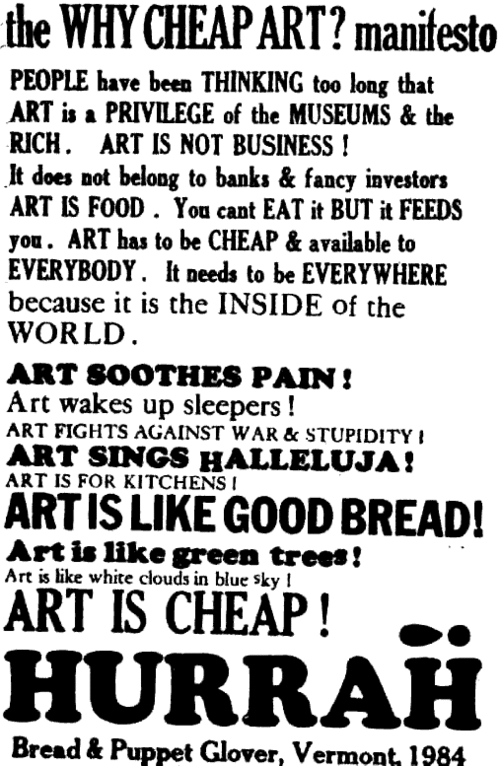
Let us begin, ironically enough, with quotes from three non-Vermonters:
“The concepts and insights of the ecologists are of great usefulness in our predicament, and we can hardly escape the need to speak of “ecology” and “ecosystems.” But the terms themselves are culturally sterile. They come from the juiceless, abstract intellectuality of the universities which was invented to disconnect, displace, and disembody the mind. The real names of the environment are the names of rivers and river valleys; creeks, ridges, and mountains; towns and cities; lakes, woodlands, lanes roads, creatures, and people.” – Wendell Berry
“Our task is to build cultural fortresses to protect our emerging nativeness. They must be strong enough to hold at bay the powers of consumerism, the powers of greed and envy and pride. One of the most effective ways for this to come about would be for our universities to assume the awesome responsibility to both validate and educate those who want to be homecomers — not necessarily to go home but to go someplace and dig in and begin the long search and experiment to become native.” – Wes Jackson
“The word ‘topophilia’ is a neologism, useful in that it can be defined broadly to include all of the human being’s affective ties with the material environment. These differ greatly in intensity, subtlety, and mode of expression. The response to environment may be primarily aesthetic: it may vary from the fleeting pleasure one gets from a view to the equally fleeting but far more intense sense of beauty that is suddenly revealed. The response may be tactile, a delight in the feel of air, water, earth. More permanent and less easy to express are the feelings that one has toward a place because it is home, the locus of memories, and the means of gaining a livelihood.” – Yi-Fu Tuan

What is social practice? An immediate answer might be “who cares?” A nicer way to put that might be “why start with a definition?” Perhaps, we should just start looking around at what people are doing here, right next to us. What threads connect these actions? What connects them to each other and to this place? Is social practice something that happens elsewhere? In art school? In big cities? By people with degrees? In some abstract, placeless, uprooted, cosmopolitan “everywhere?”
Another answer to that first question might be “haven’t we got it all wrong?” Or why start with social practice in the first place? Might the term be just a “juiceless” invention akin to how Wendell Berry characterizes “ecology?” What if we started with a homecoming? What if we began by building “cultural fortresses” as Wes Jackson suggests here in the Green Mountain State? What if we walked The Long Trail and sailed Lake Champlain to begin the “long search and experiment to become native?”
Contemporary art sometimes deals with the idea of site-specificity (sometimes art is made for a specific location and not for display in a relatively generic gallery space) and this course intends to be site-specific itself. Or to borrow a term of winemaking, this course hopes to explore social practice through the “terroir” of Vermont (The Viticulture FAQ & Glossary defines terroir as “The total, inter-related environment wherein a grapevine is cultivated for the purpose of making wine. Key factors include, but are not limited to, cultivar type, soil, climate, vineyard location, planting density, training system, pruning philosophy & the cultural and social milieu wherein the whole enterprise takes place.”). Through this we might cultivate our own “topophilia” as Yi-Fu Tuan describes above.
But let’s circle back to that first question. Here is how a friend (Ted Purves) of mine defines it for the institutional needs of his art school:
“The field focuses on topics such as aesthetics, ethics, collaboration, persona, media strategies, and social activism, issues that are central to artworks and projects that cross into public and social spheres.
These varied forms of public strategy are linked critically through theories of relational art, social formation, pluralism, and democracy. Artists working within these modalities either choose to co-create their work with a specific audience or propose critical interventions within existing social systems that inspire debate or catalyze social exchange.”
As it stands now social practice is mostly a variation on that theme, although sometimes it is called by other names (socially engaged art, relational aesthetics, new genre art). And it also is institutionally confined to art schools, departments, and programs. Another important approach this course takes is to break social practice free from art and academia. This means finding issues of community, collaboration, democracy, ethics, and aesthetics (to name a very few of its themes) at play in the lives of a wide range of people beyond the customary triumvirate of artists, activists, and academics. We will look at parents, neighbors, bakers, baristas, bartenders, clergy, restaurateurs and all sorts of other folks to see what, if anything the idea of social practice might do to connect, or understand, their activities.
This course takes several books as “spirit guides” for its structural sensibility. Of course reading them would help contextualize things, but the titles themselves might be enough: Making It Up as We Go Along by Chris Mercogliano and We Make the Road by Walking by Myles Horton and Paulo Freire
What follows below then is a set of suggestions as to where we might begin “making it up” and where to begin to “make the road by walking.” It will be left to students to find the blind spots, dead ends, outright stupidities, and to co-create our experience together in the classroom and beyond. There is some stuff specifically envisioned as “art,” but not much. There is some “theory,” but really just a few links to thinkers associated with Vermont (ex. Dewey, Miller, and Bookchin). There is still a huge gap to be filled – everyday people (of which many of the people highlighted are, but in some ways they are still exceptional in that they are not working stiffs, or stay at home moms. So a constant focus would be to look at home and next door, not just on the web, at a museum or nonprofit, or in the library.

Stuff to read, listen to, or watch
A Citizen’s Guide To Vermont Town Meeting
Weekly Standard: Our Town Meetings
The Vermont Papers: Recreating Democracy on a Human Scale
by Frank Bryan, John McClaughry
Vermont and the Imaginative Geographies of American Whiteness – Robert M. Vanderbeck
Decentralizing Educational Authority [one of many essays found at Paths of Learning – a repository of work by Ron Miller]
Tal Birdsey, Head Teacher, North Branch School – Ripton, VT
A ROOM FOR LEARNING: The Making of a School in Vermont
Art, community and agriculture are one at Fable Farm where workers read and tell stories as they plant and dig, is a community-supported vegetable farm near Silver Lake in Barnard [see Fable Farm link below also]
Gov. Shumlin Sends Chick-fil-A a Message for Eat More Kale
Chicken Chain Says Stop, but T-Shirt Maker Balks
Back to the Land: Communes in Vermont
Author Traces History Of The Back-To-The-Land Movement
Life on a Vermont commune: Poet Verandah Porche remembers back-to-the land living
Learn how Helen and Scott Nearing became completely self-sufficient while homesteading in Vermont.
Living The Good Life with Helen and Scott Nearing [Bullfrog Films clip]
The (written) philosophy of George Schenk [the embodied is below – see American Flatbread]
Murray Bookchin: social anarchism, ecology and education
Murray Bookchin, GRUMPY OLD MAN – Bob Black
John Dewey and informal education
Interview with the Luddite – Kirkpatrick Sale is a leader of the Neo-Luddites.
The Frog Run: Words and Wildness in the Vermont Woods – John Elder
Of paleontology and excellence in Vermont architecture
Stuck in Vermont 87: Warren 4th of July Parade

Stuff to visit, look at, and discuss
ReSOURCE:
ReSOURCE retail shops provide job and life-skills training, essential household items to families and individuals in crisis, and prevent tons of material from ending up in our landfills each year. These stores also find new homes for major appliances, computers, electronics, furniture, and industrial surplus materials, which are used by the community as arts, crafts, and educational supplies
The Clothes Exchange:
The Clothes Exchange is a mission driven social enterprise dedicated to turning clothing into cash for community benefit…For every event, The Burlington Clothes Exchange selects a new nonprofit to partner with who receives event proceeds; in 2011 our May event raised $70,000 for Spectrum and 9 other local nonprofits. In total, The Exchange has raised more than a quarter of a million dollars for nonprofits in Chittenden County.
Outright Vermont:
Outright Vermont (Outright) was founded in 1989 following the release of a 1988 national youth risk survey showing that gay and lesbian youth in particular had very high rates of depression and suicide. A group of community activists gathered to form Outright, which began as a “once a week” support group. Our Friday Night support group has continued ever since, every Friday over the past 20 years. Today, Outright is a lesbian, gay, bisexual, transgender, queer and questioning (LGBTQQ) ‘queer’ youth center and statewide advocacy organization.
The Mission of Outright is to build safe, healthy, and supportive environments for gay, lesbian, bisexual, transgender, queer, and questioning youth (ages 13-22). Our goal is to make Vermont the safest, most supportive and empowering state for queer youth in the United States of America.
RU12?:
RU12? was founded in 1999 by two students at the University of Vermont who believed that Vermont needed a multi-generational queer space open to people of all ages, races and genders.
RU12? is now the largest LGBTQ organization in Vermont, and the only LGBTQ community center in the state. RU12? is located in the Champlain Mill (20 Winooski Falls Way) in Winooski.
RU12? has many programs and services including the SafeSpace Anti-Violence Support Line, a HIV Prevention program that includes HIV testing, social/support groups, programming for LGBTQA Families, LGBT Elders, and the Transgender Community Wellness Program, a drop-in center and meeting space, lending library, David Bohnett CyberCenter, and more.
The Vermont Youth Conservation Corps:
The Vermont Youth Conservation Corps is a nonprofit youth, leadership, service, conservation, and education organization that instills in individuals the values of personal responsibility, hard work, education, and respect for the environment. This is accomplished by using conservation projects as the vehicle for learning in an intense environment.
Each year, the VYCC hires young people ages 16-24 who work and study together under adult leadership to complete high-priority conservation projects such as state park management, trail maintenance, and backcountry construction. Through the performance of this important work, young people expand their job and leadership skills and develop personal values, ethics, and an awareness of social, political, and environmental issues. All VYCC jobs are characterized by comprehensive and intensive training, close supervision, and extensive opportunities for individual learning and personal growth.
Center for Whole Communities:
Few places in America regularly bring together leaders of different race, class, profession and ideology to find shared purpose and renew their collective strength. Center for Whole Communities is a land-based leadership development organization. We foster the innovative and collaborative responses from different sectors of the environmental and social movements that are necessary to address the complexity of today’s challenges. While nurturing in our alumni multi-disciplinary responses to challenges such as climate change and building economically competitive and equitable communities, our leadership programs directly confront the fragmentation that exists in American society around politics, race, class and privilege.
350.org:
350.org is building a global grassroots movement to solve the climate crisis. Our online campaigns, grassroots organizing, and mass public actions are led from the bottom up by thousands of volunteer organizers in over 188 countries.
350 means climate safety. To preserve our planet, scientists tell us we must reduce the amount of CO2 in the atmosphere from its current level of 392 parts per million to below 350 ppm. But 350 is more than a number—it’s a symbol of where we need to head as a planet.
350.org works hard to organize in a new way—everywhere at once, using online tools to facilitate strategic offline action. We want to be a laboratory for the best ways to strengthen the climate movement and catalyze transformation around the world.
Women’s Center At UVM:
The Women’s Center is a place to build community, make new friends, access all kinds of resources and services, and learn more about the work that we do in service of building an inclusive and safe campus.
If you’re looking to get involved or are struggling with a personal issue, the Women’s Center is here to help you out. We provide advocacy services, empower women and their allies to use their voices, raise awareness about the critical issues facing women, and highlight their many accomplishments. Stop by to check our our resources & programs!
Intervale:
Our mission is to strengthen community food systems. Since 1988, we’ve been dedicated to improving farm viability, promoting sustainable land use and engaging our community in the food system. We’re helping to build a community food system that honors producers, values good food and enhances quality of life for Burlington and beyond!
Rural Vermont:
Our Vision is for a Vermont local food system which is self-reliant and based on reverence for the earth. It builds living soils which nurture animals and people with wholesome, natural products supporting healthy, thriving farms and communities. These communities in turn work to encourage and support current and future farmers, continuing our Vermont heritage. This abundant and generous way of life celebrates our diversity and interdependence.

NOFA VT:
The Northeast Organic Farming Association of Vermont is a nonprofit association of farmers, gardeners, and consumers working to promote an economically viable and ecologically sound Vermont food system for the benefit of current and future generations.
NOFA Vermont was founded in Putney in 1971, making it one of the oldest organic farming associations in the United States. Today, we are proud to have over 1300 members throughout the state and to certify over 580 farms and processors to the USDA National Organic Program Standards. We are passionate about increasing the acreage of certified organic land in Vermont while also increasing the access of local organic food to all Vermonters. All our programs strive to meet these goals, whether it involves working with schools to bring local foods into the cafeteria or providing business planning services to farmers to ensure their businesses stay viable. Whether you are a Vermonter who gardens, farms, eats local food, or enjoys our rural communities, NOFA Vermont welcomes you.
Fable Farm:
Fable Farm is a Community Supported Agriculture (CSA) Organic Farming Project located in Barnard, Vermont in the Upper Valley Region of the Green Mountains. During the growing season, Fable Farm cultivates a mosaic of farmland peppered throughout our hillside village. We also host weekly community gatherings during pickup hours for Fable Farm CSA members which are open to the public.
Cedar Circle Farm:
Growing for a sustainable future. Annuals & perennials, certified organic bedding plants, vegetables & berries. Our educational mission is to raise public awareness about the importance of local organic agriculture, increase access to quality organic produce for low-income people, and establish models for farm-appropriate alternative energy strategies, and train next-generation farmers. We cultivate 40-acres using certified organic practices on conserved land along the Connecticut River in East Thetford, Vermont, just minutes from Norwich, Vermont, and Hanover, New Hampshire.
A family friendly public farm, we offer a cafe’, farmstand, workshops, festivals, guided farm tours, teaching gardens, a self-guided farm tour, wagon rides, and pick your own berries, pumpkins, herbs and flowers.
Bread and Butter Farm:
Burger Night started innocently in 2011 as a way for us to promote that we were raising grass-fed beef. We thought it sounded like fun to grill some burgers on a Friday afternoon for our Farm Store customers to let them try out the beef. The very first event we held, 150 people showed up! We were blown away. It hasn’t stopped since. We have been amazed with the response and have done everything we can to keep up with the lively demand, serve the highest quality, delicious food, and provide a great space for the community gathering that is a great support for our community farm.
At Burger Night we serve a full meal that comes almost entirely from our farm. We raise the cows who provide the beef (look around, they are grazing all summer – they move around a lot to pastures near to the barn and event, and then some very far flung fields), we bake the buns, we grow the veggies for the salads, we bake the cookies for dessert (we haven’t figured out how to produce chocolate yet…). Our own Chris Dorman brings amazing bands each week to liven up the event. We love the connection between food and music and Burger Night has become a perfect combo!
Our farm is a great place for everyone to come and participate in a meal on a real, working farm. We take pride in knowing that kids are running around free playing in the gardens, in the fields, on the mulch piles and hay bales and having a blast outdoors.
Numina Wilderness School:
Numina is a group of Addison County, VT educators who are dedicated to finding each person’s spark of genius or divinity, the “numen” in Latin, and encouraging it to flame. Numina Wilderness School brings that fire alive in Nature through Mentorship, After-School and Day-long ongoing programming for kids and adults.
Mission: To teach people of all ages how to understand nature while helping them find connection to their calling in this life. We do that by introducing people to their natural neighbors. The Plants, Animals, the four directions, the night, the stars, fire, themselves, each other and all things natural.
The Walden Project:
The Walden Project is a public school program serving students in grades 10-12. Run out of Vergennes Union High School with support and guidance from The Willowell Foundation, The Walden project provides students a rigorous curriculum that emphasizes writing, philosophy, environmental studies, while supporting student centered-inquiry. The program is modeled on Henry David Thoreau’s sojourn to Walden Pond where he immersed himself in his ecology to deepen his sense of self, society, and the natural world. To that end, students are encouraged to follow and pursue their own areas of interest with support and guidance from the staff.
The Walden Project is not school in the traditional sense. It is a community of students and teachers who use this former farmland for what the founder calls a “great, living template for education.” They spend three days a week outdoors, through fall, bitter winter, and spring. On Tuesdays, for Field Sociology class and writing, the students visit government offices, nonprofit organizations, and other institutions in Burlington, a college town of 40,000 located 20 miles away. On Fridays, they work at internships in their areas of interest, such as Web design or photography.
The Schoolhouse Learning Center:
The Schoolhouse Learning Center is an accredited elementary school and licensed childcare center that has provided quality programs for over 40 years. Schoolhouse programs nurture each child’s innate curiosity and encourage independence of mind and resourcefulness. Families are invited to be a part of Schoolhouse programs and are a vital part of the community. Our educational philosophy and values are founded upon five Core Concepts: Trust, Sharing, Responsibility, Respect and Belonging.
The Bellwether School:
We view education from a holistic perspective which means, first, we are concerned with the whole child – emotional, social, physical, moral, spiritual, artistic and creative as well as intellectual dimensions of their development – and second, that every child’s life is connected to wider contexts of experience – peers, family, community, culture, and the natural world.
Like all progressive educators, we see children as natural learners and honor that principle. We recognize that children come to the classroom with many gifts, multiple intelligences and languages, full potential, uniqueness, and natural curiosity. We strive to design a learning environment and to use teaching practices that support children’s characteristic ways of exploring, discovering, and constructing their knowledge of the world. Teachers draw forth the intrinsic motivation of each child so that learning becomes an interactive process that values imagination, creativity, and joy, fostering a love of learning. Instead of dividing up the mind and the body, science and the humanities, action and thought, intelligence and emotion, holistic education seeks to bring these together. In this way, we foster the values of both independence of each learner and interdependence of all subjects as well as all aspects of life. Holistic education seeks to foster a sense of connection to both the natural world and the human community; we feel this approach cultivates social as well as ecological responsibility, a compassionate sense of wonder, and genuine self-understanding.
Yestermorrow Design/Build School:
Yestermorrow Design/Build School in Warren, Vermont offers over 150 hands-on courses per year in design, construction, woodworking, and architectural craft including a variety of courses concentrating in sustainable design and green building. Operating as a 501(c)(3) non-profit organization since 1980, Yestermorrow is one of the only design/build schools in the country, teaching both design and construction skills. Our 1-day to 3-week hands-on courses are taught by top architects, builders, and craftspeople from across the country.
A crucial aspect of our continued success derives from the supportive spirit of the community around us.
In turn, we are committed to improving and contributing to our local community. We do this through offering our time and skill in building a variety of projects in collaboration with local non-profits, schools, and other organizations that contribute to the well being of our community. Our mission is best met when we can pair our efforts with those who can most benefit from them.
There are numerous examples of work the school created over the years throughout the Mad River Valley and beyond. Some of the more notable ones include the Wheeler Brook picnic pavillion, the “Snail” bus shelter in East Warren, the bandstand at the farmers market in Waitsfield, the play structure at the Verd-Mont trailer park, and a trail shelter for the Mad River Path. Aside from the more visible examples of our work, we regularly create cabinetry, concrete countertops, small cob walls and buildings, timber frames, decks, renovations, treehouses and other building projects that may not be obvious to the general public. Additionally, we create structures that are trucked from the school to their final destination. Click here to view a slideshow of many of our community projects.

Cochran’s Ski Area:
In the summer of 1998, Cochran’s Ski Area became a non-profit organization with a mission “to provide area youth and families with affordable skiing and snowboarding, lessons and race training, in the Cochran tradition.” Cochran’s is the nation’s first IRS 501 (c)(3) tax-exempt ski area. “No child will be denied the opportunity to ski or ride”.
Vergennes Laundry:
Located in a former Laundromat, Vergennes Laundry in Vermont is an example of community enterprise at its best. Julianne Jones raised the seed money through Kickstarter and offers $500 memberships, redeemable in pastries.
Jones and her French husband, Didier Murat, opened Vergennes Laundry in 2010, creating an all-white interior featuring concrete, wood, and white-painted paneled walls that allow the food and the customers (and the wood-burning bread oven) to dictate the atmosphere. Jones was inspired by Scandinavian design when she created the interiors, “especially Aalto; and on the French side, Prouvé, Perriand, and le Corbusier (all through my architecture studies at Middlebury and in Copenhagen).” The bakery was built by hand: Murat made the counters, the cases, the shelving, and the wooden tables, while Jones’ mother sewed the aprons and napkins out of rustic linen.
pane e salute:
(the same people also do: la garagista and arlette & janvier studio/due)
osteria pane e salute is a farm restaurant founded sixteen years ago on SlowFood principles. Our kitchen is inspired by our landscape with a focus on local, homegrown, and natively wild. Our wine list is also inspired by terroir with the mission to compile a living archive of regional, indigenous Italian varietals. When you come to dine with us, we intend for you to savor your dishes, wine, and company. Our aim is to preserve the experience of sharing a meal and the elegance of hospitality, and to take the time to appreciate both. Our restaurant is not designed for those in a hurry. We invite you to enjoy your evening with us…
American Flatbread:
American Flatbread began as a gift to friends and a leap of faith. It probably began in Gladys Ford’s kitchen, where her grandson George watched as she cooked with a wood fire.
One summer night, George built his first primitive wood fired oven of field stone from his land. He guessed it wouldn’t be capable of baking a loaf of bread so he attempted to make a flatbread. The original stone oven raised more questions than it answered: would it get hot enough? would the bread stick? would the food taste good?
To everyone’s surprise, it worked, and the bread was good.
Larger ovens followed. In 1987, a ten-ton oven was built on the outdoor patio at Tucker Hill Lodge, and we baked under the stars. The following year, a new oven was built which incorportated ideas from the traditional clay ovens of rural Quebec, most notably the earthen dome signature to American Flatbread ovens today.
American Flatbread is a return to bread’s roots. We have reached back to the very beginning of bread baking and used the same artisan methods: simple, wholesome ingredients shaped by hands of thoughtful caring people, baked in a primitive wood-fired earthen oven.
The nature of the bread we eat — from the way the grain is grown, harvested, milled, mixed, and baked to how it is administered and policed; from how it is hoarded or shared to whether its production enriches or enslaves — will shape our own nature and the destiny of our culture.
It is the mission of American Flatbread to provide good, flavorful, nutritious food that gives both joy and health, and to share this food with others in ways sustainable to all.
Old Brick Store:
The Old Brick Store is a mission driven community supported enterprise. Our mission is to provide Convenience with a Conscience. We want to be more than just a convenience store—we want to be a full service grocery store, offering all the essentials to our neighbors. We offer fresh produce, fresh bread, local meats and cheeses, sustainable products and organic products, as well as conventional options.
The Adamant Cooperative:
The Adamant Co-op doesn’t fit neatly into any category. Since its founding in 1935 it has served the surrounding area as grocery store, post office, art studio and home of the infamous Black Fly Festival. The Co-op is the hub of a vibrant community, joining us together as we stop for conversation while picking up our mail, volunteer in staffing the store, leave notes for each other in the community box, pick up a gallon of milk, or indulge in a quick chocolate fix. Surrounded by waterfalls and ponds, and next to the Adamant Music School and QuarryWorks Theatre, the Co-op is a wonderful destination for a meandering bike ride or drive.
The Co-op sells basic groceries and an eclectic combination of foods to suit the varied tastes of the neighborhood: an impressive selection of wines, one of the best selections of chocolates west of Switzerland, fresh baked cakes and pastries, Or scrumptious take out meals, and a wide array of local products such as syrup and honey, home made pickles, prize winning eggs from farms down the road, jams, and local seasonal produce. You’ll find a request clipboard hanging from a wooden supporting beam–if we don’t have it, just ask.
Janet Macleod’s studio is above the store and she is always glad to show visitors around.
In summer our screen porch is a wonderful place to sit and watch the local goings on, check email with our free WiFi, or attend one of our Friday Night Cookout & Music evenings. Sodom Pond, across the road, (yes Sodom, the village was once so named, inspired by the disreputable goings on at the old quarry) is home for a rich bird, beaver and turtle population.
Barnard General Store:
The Barnard General Store was established in 1832 and stands as one of the longest running General Stores in Vermont. The Barnard Community Trust has been formed as a local, non-profit organization committed to finding a way to save our much loved and much needed Barnard General Store. Our larger mission is to promote and enable the Town of Barnard to maintain and enhance its rural quality of life in a positive and sustainable way.
Woodstock Farmer’s Market:
The Farmers’ Market is a very busy, crazy, year round market of fantastic food. We’re really hard to describe—we serve our local community great food that ranges from take-out prepared dinners and lunches to regular stuff like milk and eggs to fresh organic produce to fresh meats and everything in between. Our vision for the Market has always been to make great food accessible to everyone. We all love food and love to cook but we’re not snobby about it. In fact, we don’t consider ourselves “gourmet,” because it implies exclusivity, and we believe that anyone can create great food. Most of the time one just needs a little help…a recipe perhaps; the best, freshest ingredients you can find; or just an outgoing and friendly staffer to help out with an idea.
I think what sets us apart is that we really take this job of “bringing the food to the people” very seriously. We’re concerned about the process: what we charge for our products, what ingredients we use in our food, how clean we are, who our vendors and farmers are, where our fruits, vegetables and ingredients come from and how we treat each other and our guests.
And what’s really cool about the Market is that each and every person in a decision- making capacity lives and breathes food and service. From Brandon, our produce leader, who has been a restaurant chef for most of his professional life, to Melanie in our Grocery Department, who is our Tex-Mex expert, growing up in a food-loving family in El Paso. It’s a simple passion for food and you can feel it every time you step into the store.
Even more important these days though is actually knowing where your food comes from…and we make it point of making sure our guests know. From smart local buying to great signage, you know and trust that we are the preeminent farm to table grocer. We love supporting our local food chain and think it’s one of the most important things we can do for our community.
Maglianero:
Through Maglianero we’re creating an experience with both local
prominence and global relevance. In our hometown of Burlington,
Vermont, USA, we are developing, testing, and sharing the ideas that serve the continuum of needs of the Modern Mobility Movement:
Farm-direct, hand-crafted coffees-the fuel for the ride.
A café/collaborative space/commuter hub-the center of community
interaction, education, and creativity.
A responsibly-sourced, durably crafted and built, commuter-centric cycling apparel brand-stylish, functional, year round protection from the elements.
Cobb Hill Cohousing:
Cobb Hill is a community of people who want to explore the challenge of living in ways that are materially sufficient, socially and ecologically responsible, and satisfying to the soul.
Situated in rural Hartland, Vermont, we try to practice sustainable land management—ecological farming and forestry, energy efficiency, and minimization of waste. We are also developing the skills of community: sharing, responsibility, compassion, communication, consensus building, conflict resolution, appreciation of diversity and love. We believe that these skills are necessary to bring the larger society to sustainability and sufficiency, and we want to learn them to the best of our ability.
Some of our Enterprises:
- Cedar Mountain CSA & Dairy
- Cobb Hill Cheese
- Cobb Hill Frozen Yogurt
- Cobb Hill Sheep
- Cobb Hill Maple Syrup
- Cobb Hill Honey
- Cobb Hill Mushrooms
- Cobb Hill Laying Hens
Longhouse:
Longhouse, Publishers & Booksellers, was established in 1971 by the poet and editor, Bob Arnold. Joined by Susan in 1974, we have published hundreds of folders, chapbooks, broadsides, anthologies and small edition books by mimeograph, letterpress, photocopy and off-set…Integrating our bookselling and publishing business with a working and family life, Bob Arnold makes a living as a stonemason as shown in his authored book On Stone published by Origin Press. We also provide building and landscaping/caretaking services including dog & cat boarding!
Unitarian Church of Montpelier:
Originally called the Church of the Messiah, the Unitarian Church of Montpelier has been a Unitarian church since it was built in the mid-1800s.
The church was designed by Thomas Silloway, the architect of the present Vermont State House and many Universalist churches around New England. Dedicated on January 25, 1866, the church is the oldest standing church in Montpelier, and is the only church in Montpelier that has its original organ, a Stevens tracker organ. The building and the organ are used regularly for services and concerts. Many community organizations hold public events and meetings at the church.
All Souls Interfaith Gathering:
All Souls Interfaith Gathering is a seeker’s destination, a safe haven for exploring spiritual and human values. Our commitment is to express love toward all through lifting spirit in music, inspirational words, community service and environmental stewardship.
We are a nondenominational community that welcomes everyone – at whatever point a person may be in his or her spiritual journey. Our goal is to offer each person an opportunity to forge a personal connection with the Divine Source – by any name He or She is called.
Our journey together began on April 11, 1999. At that time the pattern for our Sunday Evensong Service began to unfold. Music plays a major role in “Evensong” because we believe that it provides a special spiritual connection. Along with music, the services combine spiritual readings and reflections on world issues and personal values, as well as Christian, Jewish, Islam, Buddhists, Hindu, Taoist and Native American beliefs and sacred texts.
Spiritual healing is quietly woven throughout the Evensong Service, Healing and Prayer services, classes, and in one-on-one conversation and counseling.
The Bread and Puppet Theater:
The Bread and Puppet Theater was founded in 1963 by Peter Schumann on New York City’s Lower East Side. Besides rod-puppet and hand puppet shows for children, the concerns of the first productions were rents, rats, police, and other problems of the neighborhood. More complex theater pieces followed, in which sculpture, music, dance and language were equal partners. The puppets grew bigger and bigger. Annual presentations for Christmas, Easter, Thanksgiving and Memorial Day often included children and adults from the community as participants. Many performances were done in the street. During the Vietnam War, Bread and puppet staged block-long processions and pageants involving hundreds of people.
In 1974 Bread and Puppet moved to a farm in Glover in the Northeast Kingdom of Vermont. The 140-year old hay barn was transformed into a museum for veteran puppets. Our Domestic Resurrection Circus, a two day outdoor festival of puppetry shows, was presented annually through 1998
Eat More Kale:
Bo Muller-Moore is a father, former teacher and runs a small business out of his home in Montpelier, Vt. He makes shirts that have simple messages — ‘Cheese’ was the first he made, then he was asked by a local farmer to make another that said ‘Eat More Kale.’
The River of Light Lantern Parade:
The River of Light is Waterbury’s Community Lantern Procession. In December 2010, artists Gowri Savoor and Angelo Arnold worked with school art teacher MK Monley and the pupils of Thatcher Brook Primary School in Waterbury, VT to create over 150 willow and tissue paper lanterns for our inaugural event. Spectators of all ages lined the parade route in support of the parade which was led by Burlington’s street Samba band, Sambatucada. The procession was also joined by artists from Central Vermont, who created larger-scale lanterns during a special one-day workshop. And of course none of this would have been possible without our crew of hard-working volunteers.
Warren 4th of July Parade:
Some say Warren, Vermont’s 4th of July is the ‘greatest independence day celebration anywhere’. It’s hard to argue when all of the Mad River Valley gets together to celebrate some serious independence, Vermont-style. Always on the 4th of July, this full day of festivities, quixotic parade, buddy badge contest, music, and food is recommended for ages 1 month to 110 years old!
The Tunbridge World’s Fair:
The Tunbridge World’s Fair is an annual event held in mid-September in Tunbridge, Vermont. The annual fair continues to this day with demonstrations of farming and agricultural traditions and culture, working antique displays, horse and ox pulling, horse racing, cattle and horse shows, junior exhibits, floral and 4-H exhibits, contra dancing, gymkhana, and many free shows.
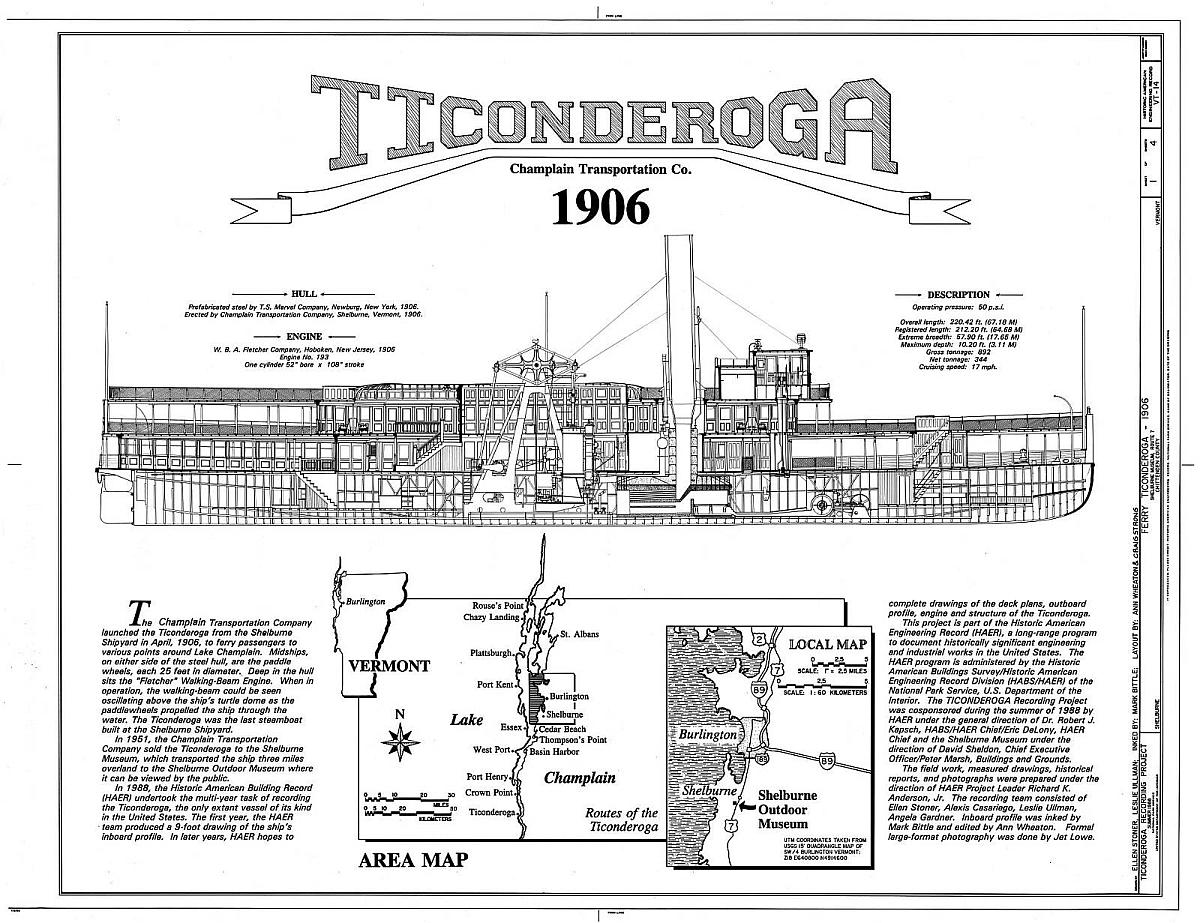
Shelburne Museum:
Located in Vermont’s scenic Lake Champlain Valley, Shelburne Museum is one of the finest, most diverse, and unconventional museums of art and Americana. Over 150,000 works are exhibited in a remarkable setting of 39 exhibition buildings, 25 of which are historic and were relocated to the Museum grounds.
Impressionist paintings, folk art, quilts and textiles, decorative arts, furniture, American paintings, and a dazzling array of 17th-to 20th-century artifacts are on view. Shelburne is home to the finest museum collections of 19th-century American folk art, quilts, 19th- and 20th-century decoys, and carriages.
Electra Havemeyer Webb (1888-1960) was a pioneering collector of American folk art and founded Shelburne Museum in 1947. The daughter of H.O. and Louisine Havemeyer, important collectors of European and Asian art, she exercised an independent eye and passion for art, artifacts, and architecture celebrating a distinctly American aesthetic.
When creating the Museum she took the imaginative step of collecting 18th- and 19th-century buildings from New England and New York in which to display the Museum’s holdings, relocating 20 historic structures to Shelburne. These include houses, barns, a meeting house, a one-room schoolhouse, a lighthouse, a jail, a general store, a covered bridge, and the 220-foot steamboat Ticonderoga.
Mrs. Webb sought to create “an educational project, varied and alive.” What visitors experience at Shelburne is unique: remarkable collections exhibited in a village-like setting of historic New England architecture, accented by a landscape that includes over 400 lilacs, a circular formal garden, herb and heirloom vegetable gardens, and perennial gardens.
The Museum’s collections, educational programs, special events, workshops, activities, and special exhibitions constantly offer new perspectives on four centuries of art and material culture, assuring visitors a museum experience unlike any other.
Rokeby Museum:
Perched on a hill overlooking the Champlain Valley, Rokeby Museum provides an intimate record of two centuries of Vermont family life and agriculture. The house and farm nurtured and survived the growing up and growing old of four generations of Robinsons—a remarkable family of Quakers, farmers, abolitionists, authors, and artists.
Today, listed as a National Historic Landmark, the site tells two stories simultaneously — of the Robinsons in particular, and more broadly, of Vermont and New England social history from the 1790s to 1961.
Rokeby Museum is one of the best-documented Underground Railroad sites in the country. It was designated a National Historic Landmark by the National Park Service in recognition of its outstanding history in 1997.
Rowland Thomas and Rachel Gilpin Robinson were devout Quakers and radical abolitionists, and they harbored many fugitive slaves at their family home and farm during the decades of the 1830s and 1840s. Among the thousands of letters in the family’s correspondence collection are several that mention fugitive slaves by name and in some detail.
Labor of Love:
Vermont Works for Women is proud to present Labor of Love, an exhibit of photos and interview excerpts that recognizes and honors 29 women who are passionate about their work, who are an inspiration to others, and who exemplify excellence in their field. The honorees – who are an inspiration to others and who exemplify excellence in their fields – come from all parts of Vermont. They are farmers, doctors, tattoo artists, college presidents, electricians, and general store clerks. They hail from Newport to Vernon. They are young and young-at-heart, well-known and not.
The Liberal Arts as a Way of Life – In Search of Public and Private Virtue
Are the Liberal Arts Useful? – Samuel Goldman
What’s more, the political argument tends to mistake serious practice in the liberal arts for the completion of courses. There is much to be learned about politics from Cicero and Tocqueville, to mention only two names. But learning what they have to teach requires a lifetime of careful reading. A course in Western Civ just won’t cut it.
…
Like the first position, this argument contains much truth. But it doesn’t shed much guidance on how much of their limited resources individuals, families, and governments should devote to formal instruction in the liberal arts. Perhaps reading Homer or Shakespeare does make one a better father. But is it essential to get a degree in Classics or English to achieve those benefits? Again, the focus is on the liberal arts as a permanent feature of one’s life. Formal instruction at the college level is not a sufficient condition of that commitment–and may not even be a necessary one.
[from the LeisureArts archive] – A David Robbins Trifecta – The Art/Life Conundrum Solved!
[This is a three in one post of material (in reverse order) I did for LeisureArts on David Robbins. Although I might choose another word than “production,” I think Robbins asks a question that still needs much contemplation – “who are we when we pursue a larger field of production, some of which is art?”]
An initial stab at a semiotic square [David Robbins]
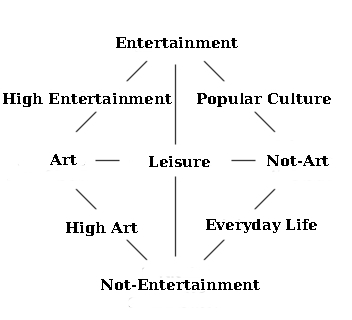
Note that “High Entertainment” is a category Robbins describes as “…works and artifacts that retain fine art’s complex ambitions for the culture while eschewing the specialized language of fine art in favor of mass accessibility – [it] can be manifested in games, toys, fashion, public sculpture, books, hoaxes, indeed in any product that has contact with the public.” p. 311
Art/Life – David Robbins – LeisureArts

The old art/life distinction.

The “triangulation” theory of David Robbins.
This notion is worked out in various ways throughout his book The Velvet Grind, but the essay “On Talent” spells things out pretty directly:
That something might stand outside art and report on it, comment on it, editorialize about it in an iconic language of its own – this was, and apparently still is, disorienting. The reason, I submit, is that it instantiates a complication of the modernist dialogue between life and art. Talent suggests that the old binary model has been superseded by a triangulated model whose points are life, art, and entertainment – a competing communication system no less madly self-sustaining, self-referential, and self-celebratory than art. “Showbiz” adds another category that’s neither Art nor Life. p.24
Robbins’s triangulation is an important step to finding new forms and languages for what he calls “imaginative practice” – creative, funny, thoughtful forms of invention that are not art. We at LesiureArts find Robbins incredibly useful [We hope to write more, but being the slackers that we are, this might be as far as we get]. He also writes about inventing experience which he distinguishes from producing culture. This is a welcome relief from all of the talk about cultural production, as invented experience resonates nicely with John Dewey’s aesthetic theory which is in dire need of being read by the legions of curators and artists who are reinventing the wheel of experience based practices.

The LeisureArts modified model.
As we mentioned, the triangulation theory is an important step, but LeisureArts is interested in expanding the terrain of inventive practices and theory to cover a host of other activities that Robbins’s triangle can’t account for. That leads to the above modification. In leisure, we have a broad field of activities that fall in between the various oppositions, some closer to one vertex or the other, but the field itself exists in a kind of equipoise (ideally). Adding leisure to the model allows for the inventiveness of car customizers, tea cozy makers, coat hanger collectors, home cooks, and others to mingle on equal footing with so called “high” forms of culture be it entertainment or art.
David Robbins – The Velvet Grind
Some excerpts:
…the pertinent question is no longer “what infinite variety of materials, strategies, concerns might we include in the context of art?” It isn’t “what might we map onto the coordinates of art?” These were the questions of modernism. The more contemporary question – tomorrow’s question – is “who are we when we pursue a larger field of production, some of which is art?” (p.29)
The maximum site of invention, now, is one that forces the culture of criticality into direct and continuous contact with its strongest and most radical cultural alternative, the culture that thrives despite art’s low regard for it, the culture, ladies and gentleman, that actually expresses respect for lives conventionally led, the culture that doesn’t need art: entertainment. (p.167)
Adorno the Grumpy Puritan – Richard Shusterman on Art and Pleasure
Come back to Pleasure – Richard Shusterman
Up until modern times, to identify art with the pursuit of pleasure was not at all a way of trivializing art. For pleasure was anything but a trivial matter, not even for philosophers. The ancients (most notably the Cyrenaics and Epicureans) often defined pleasure as the prime good and usually saw it as an essential component of happiness. Even Plato, to make his case for philosophy’s superiority to art and other practices, needed to argue for its superior joys. Looking back on the ancients at the very dawn of modern thought, Montaigne confirms the primacy of pleasure. “All the opinions in the world agree on this — that pleasure is our goal — though they choose different means to it”. Even, he adds, “in virtue itself, the ultimate goal we aim at is voluptuousness”.
…
The pleasures of meaning and expression point to another crucial dimension of art’s enjoyment which is often obscured — its deeply social dimension. Too often it is assumed that art’s enjoyment is subjective, hence essentially private and narrowly individualistic. But even if one feels one’s aesthetic pleasure in one’s own mind and senses, this in no way precludes the shared character of our enjoyment, nor the fact that our enjoyment is heightened by our sense of its being shared. Whether in the theatre, the concert hall, the museum, or the cinemateque, our aesthetic experience gains intensity from the sense of sharing something meaningful together, of communicating silently yet deeply by communally engaging the same potent meanings and visions of beauty, and experiencing shared pleasures. Art’s power to unite society through its enchanting pleasures of communication is a theme that resounds from Schiller to Dewey, who boldly claims that “art is the most effective mode of communication that exists”. By creating and reinforcing group solidarity through the sharing of communicative pleasures, art’s entertainment performs a crucial social function whose evolutionary role in the development of human culture and society should not be overlooked.
…
With this sacralization of art comes the rigid hierarchy of high and low (a counterpart of the sacred/profane distinction). Entertainment is automatically relegated to the sphere of profane lowness, no matter how aesthetically subtle, sophisticated, and rich in meaning it may be. Even in the realm of high art, Hegel introduces a rigid hierarchy of art styles and art genres, based on their level of spiritual truth and their remoteness from materiality. The plastic arts of architecture, sculpture, and painting lie at the bottom of the ladder because of the physicality of their media. Poetry, in contrast, stands at the top because, through its ideal medium of language, it approaches the spirituality of pure thought.
…
I close with a cautionary reminder. Advocating art’s pleasures should not mean substituting them for the pleasures of life while also neglecting those victims of injustice whose lives know more misery than joy. Nor should we forget that even arts of radical social protest gain power from the zest of righteous anger and the thrill of common struggle, pleasures that enhance or complete (in Aristotle’s sense) the activity of protest. To think that prizing pleasure means condemning art to frivolity and narcotic escapism is one more fallacy based on presuming all pleasures to be uniform and shallow, but it also rests on the trite but deadly dogma that opposes art to life.
[from the LeisureArts archive] – The “as art” gaze
[I would obviously state some things differently and use some modified examples, but this post is still mostly on the mark and relevant to many ongoing conversations I’m currently having]
Baudrillard – “as art” relational art – Kaprow [September 2006]
In The Mirror of Production, Jean Baudrillard writes about the colonial intellectual impulses of the West. Concerning the criticality of Western culture he notes:
“…it [Western culture] reflected on itself in the universal, and thus all other cultures were entered in its museum as vestiges of its own image. It ‘estheticized’ them, reinterpreted them on its own model, and thus precluded the radical interrogation these ‘different’ cultures implied for it.”
Continuing:
“Without bias, they have attempted to ‘relocate’ these ‘works’ [so called primitive art] into their magical and religious ‘context.’ In the kindest yet most radical way the world has ever seen, they have placed these objects in a museum by implanting them in an esthetic category. But these objects are not art at all [Emphasis ours]. And, precisely their non-esthetic character could at last have been the starting point for a radical perspective on (and not an internal critical perspective leading to a broadened reproduction of) Western culture. ”
This critique can easily be applied to the critical appropriation of any number of new “art” practices, most notably relational art. We see quite clearly how a variety of activities and modes of research that began to stray from the flock were quickly recuperated under the banner of “relational aesthetics.” This needn’t apply necessarily to the stars of the movement (Liam Gillick and Rirkrit Tiravanija are obvious) as their work was never really intended to offer a radical perspective on anything, but Oda Projesi (who are not nearly as gallery friendly, and don’t engage in the same sort of faux art institutional critique) has certainly become a bit of a flashpoint. The debate surrounding them provides an interesting model as Claire Bishop begs to read their activities “as art,” making sure they are safely inscribed within the known parameters of self-criticality that the museum Baudrillard describes above tolerates. Maria Lind, however, prefers to read their actions without preemptively applying critical classifications.
Allan Kaprow in his essay “The Real Experiment”describes the “as art” impulse as well:
“‘Look,’ I remember a critic exclaiming once as we walked by a vacant lot full of scattered rags and boxes, ‘how that extends the gestural painting of the fifties!’ He wanted to cart the whole mess to a museum. But life bracketed by the physical and cultural [emphasis ours] frames of art quickly becomes trivialized life at the service of high art’s presumed greater value. The critic wanted everyone to see the garbage as he did through art history, not as urban dirt, not as a playground for kids and home for rats, not as rags blowing about in the wind, boxes rotting in the rain.”
We see here the application of the art historical gaze, the “as art” gaze. And not unlike the “male gaze” (although obviously the parallel is in how it operates, not in its social effects) it becomes a way of subjugating the world to a particular critical regime and seeks to infiltrate the self-perception of others, so that they see themselves and their activities through the “as art” lens.
We return in closing to Baudrillard’s critique of Marxist anthropology which can be seen to possess the same impulse to universalize its history, its criticality:
“…because the system of political economy tends to project itself retrospectively as a model and subordinates everything else to the genealogy of this model…Thus in the strict sense, it analyzes only the conditions of the model’s reproduction, of its production as such: of the separation that establishes it…By presupposing the axiom of the economic, the Marxist critique perhaps deciphers the functioning of the system of political economy; but at the same time it reproduces it as a model.”
It is evident that the “as art” perspective functions to accept as a given the art model, thus binding itself to merely reproducing the logic of art production rather than challenging it in any substantive way. It presupposes the axiom of the artistic, and shields itself from the messiness of rotting boxes, leaving us in the “internal critical” hall of mirrors, trapped in the “as art” aesthetic fun-house.
Susanne Langer – An Adventure in Understanding
“…between the facts run the threads of unrecorded reality, momentarily recognized, wherever they come to the surface… the bright, twisted threads of symbolic envisagement, imagination, thought-memory and reconstructed memory, belief beyond experience, dream, make-believe, hypothesis, philosophy – the whole creative process of ideation, metaphor, and abstraction that makes human life and adventure in understanding.” – Susanne Langer Philosophy in a New Key
& then you disappear – Stephen Wright [Part I] – Apprehension vs. Invisibility
Stephen Wright – & then you disappear
Exhibit A:
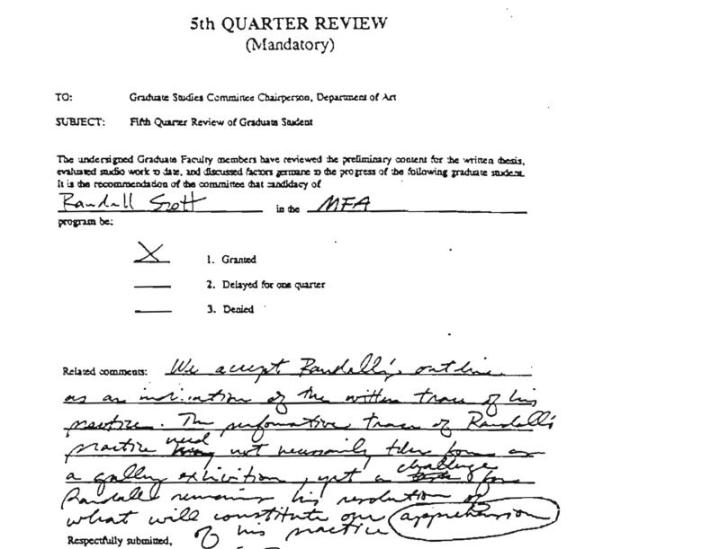
The comments above are from a procedural document on the road to obtaining my MFA (2000) and read:
We accept Randall’s outline as an indication of the written trace of his practice. The performative trace of Randall’s practice need not necessarily take form as a gallery exhibition, yet a challenge for Randall remains his resolution of what will constitute our apprehension of his practice.
Exhibit B:
Q. “What is the difference between ignorance and apathy?”
A. I don’t know and I don’t care.
Exhibit C:

Exhibit D:
The Case for Shiftlessness – Ted Rall – Zero Work
You’re Not Underemployed. You’re Underpaid. – Ted Rall
It’s time to separate income from work.
…
The solution is clear: to guarantee everyone, whether or not he or she holds a job, a minimum salary sufficient to cover housing, transportation, education, medical care and, yes, discretionary income. Unfortunately, we’re stuck in an 18th century mindset. We’re nowhere close to detaching money from work. The Right wants to get rid of the minimum wage. On the Left, advocates for a Universal Living Wage nevertheless stipulate that a decent income should go to those who work a 40-hour week.
Ford proposes a Basic Income Guarantee based on performance of non-work activities; volunteering at a soup kitchen would be considered compensable work. But even this “radical” proposal doesn’t go far enough.
Whatever comes next, revolutionary overthrow or reform of the existing system, Americans are going to have to accept a reality that will be hard for a nation of strivers to take: we’re going to have to start paying people to sit at home.
Lebenskünstler – Why Should I Work?
The Easyjet set vs. the Lebenskünstler – Seymour Gris
Going back to the 1970s – or maybe even to the 1910s – there has existed a decadent, artistic underground here which has placed little value on “making it” for the sake of making it. The king of decadent Berlin is the “poor but sexy” Lebenskünstler, an archetype who has had a huge influence on culture and nightlife here till this day. The Lebenskünstler cares little about his next record deal or art opening or publishing deal. Instead, life is his art. Only “now” matters and how you can make the most out of each moment. Screw success and any concept of “the future” because for decades Berliners – think of WWII, the Cold War etc. – have felt there is NO tomorrow (and they are right of course – we will all die).
The Lebenskünstler‘s dilettantish self-expression might have no audience other than his circle of friends or 30 people in some tiny Kleinkunst venue. Or he might just express his sense of existential freedom by taking off his clothes in a public park because it feels good. He feels no guilt due to lack of achievement.
…
…And yet, compared to much of the rest of the world, the likes of Robert make it clear that the Lebenskünstler are still alive and kicking: dreamers from around the planet, living in their personal utopia of a life made of ‘meaningful experiences’, art and creative endeavours and, who, rather than complain that “no one seemed to be working”, ask themselves…”Why should I work?”
Cyndi Lauper – Criticality vs. Pleasure, or Being Awesome is Better Than Being Cool
‘Cyndi Lauper: A Memoir’ – David Hajdu
There seems little doubt that Lauper would be held in higher esteem if she spoke so directly not to girls and the women they become but to the men who dominate the critical establishment in pop and rock — or if she hung out with artists and writers like Robert Mapplethorpe and William Burroughs instead of the pro wrestlers Captain Lou Albano and Hulk Hogan, or if her music weren’t so catchy and pleasurable, or if she wore plain black clothes instead of the Day-Glo outfits she concocted from the racks of Screaming Mimi’s in the East Village. That is, if she acted more like a radical instead of being one, by exulting in the value of juvenile pleasure.
Mystical Anarchism – Simon Critchley – Invisibility
Mystical Anarchism – Simon Critchley [I think there is quite a bit of misguided optimism for the art world, particularly the examples Crichtley cites (Gillick and Parreno?!?!), but this is an interesting read.]
…We should note the emphasis on secrecy, invisibility, and itinerancy, on small-scale communal experiments in living, on the politicization of poverty that recalls medieval practices of mendicancy and the refusal of work. What is at stake is the affirmation of a life no longer exhausted by work, cowed by law and the police. These are the core political elements of mystical anarchism.
…
Politics is perhaps no longer, as it was in the so-called anti-globalization movement, a struggle for and with visibility. Resistance is about the cultivation of invisibility, opacity, anonymity, and resonance.
Escape, Invisibility, and Professional Suicide in Art – A brief foray into science fiction and a detective story
[Someone suggested I read the article After OWS: Social Practice Art, Abstraction, and the Limits of the Social by Gregory Sholette. It is in e-flux‘s journal, which I generally find to be a complete waste of time (and not in a good way like Gallery Girls). Surely e-flux aspires to be as stultifying and obscurantist as October, but since it was Gregory Sholette, and the person suggesting the link seemed reliable, I acquiesced.]
Scene 1: The dark star of suicide, or the infinite density of nothingness
“…After all, instructors can hardly follow Wright’s prescription simply by refusing to engage with art’s institutional frame, at least not until before that glorious moment when all delimiting social divisions are swept away in the ecstasy of revolution. Prior to that day of liberation, any failure to reproduce one’s own academic field simply amounts to professional suicide….”
There are several ways to approach the above quote from Sholette. The first is to adopt his own astronomical metaphors and propose that rather than “dark matter,” perhaps “black hole” might be more apt. That is, one can think of art as a star that exploded long ago and we mistakenly believe that the originating object still exists because the light from it still shines so brightly. This would mean that what we call “the art world” now is just the Baudrillardian death throes of a distant star and we are trapped in its immense gravitational pull, destined to be sucked into the black hole as it were. The “ecstasy of revolution” then is the event horizon of said black hole and suicide therefore is nonsensical in this scheme…
Or what of this alternative? Maybe it is “suicide” to reproduce one’s academic field. Or the becoming-professional of art is its own kind of death? And to perpetuate that is a far worse fate than walking away. Kaprow certainly appeared to think so (although yes he was an established artist with tenure!) when he implored, “Artists of the world, drop out! You have nothing to lose but your professions!”
Scene 2: Why is “dark matter” so damn visible? And who is buying all that stuff at Dick Blick? And why did part of the “missing mass” go missing?
When I first encountered Sholette’s “dark matter,” I had high hopes (see this). But the “dark matter” of 2003 and the “dark matter” of 2005 changed ever so subtly from the “dark matter” of 2011. There are myriad explanations – was it Professor Plum in the Study with the candlestick? Or, more likely, an editorial decision?
The missing mass of 2003:
“Like its astronomical cousin, creative dark matter also makes up the bulk of the artistic activity produced in our post-industrial society. However, this type of dark matter is invisible primarily to those who lay claim to the management and interpretation of culture – the critics, art historians, collectors, dealers, museums, curators and arts administrators. It includes informal practices such as home-crafts, makeshift memorials, amateur photography (and pornography), Sunday-painters, self-published newsletters and fan-zines, Internet art galleries — all work made and circulated in the shadows of the formal art world. Yet, just as the physical universe is dependent on its dark matter and energy, so too is the art world dependent on its shadow creativity. It needs it in much the same way certain developing countries depend on their shadow or informal economies.”
The missing mass of 2011:
“Like its astronomical cousin, creative dark matter also makes up the bulk of the artistic activity produced in our post-industrial society. However, this type of dark matter is invisible primarily to those who lay claim to the management and interpretation of culture – the critics, art historians, collectors, dealers, museums, curators, and arts administrators. It includes makeshift, amateur, informal, unofficial, autonomous, activist, non-institutional, self-organized practices – all work made and circulated in the shadows of the formal art world, some of which might be said to emulate cultural dark matter by rejecting art world demands of visibility, and much of which has no choice but to be invisible. While astrophysicists are eager to know what dark matter is, the denizens of the art world largely ignore the unseen accretion of creativity they nevertheless remain dependent upon.”
What you may note is that in 2011 some of the missing mass has gone missing. The specificity of “home-crafts, makeshift memorials, amateur photography (and pornography), Sunday-painters, self-published newsletters and fan-zines” has been tidied up into “makeshift, amateur, informal, unofficial, autonomous, activist, non-institutional, self-organized practices.” And this revision sets the stage for the disappointment I mention here. Sholette’s book becomes then not so much a radical questioning of the creative economy, but a somewhat conventional questioning of the creative economy. By this, I mean that despite providing tantalizing hints of his admiration of, and insight into, the dark matter of anti/non professional creative practices and subcultures, very little light is cast. Instead, Sholette proceeds, despite his protestation, to celebrate if not avant-garde strategies in some strictly defined historical sense, then vanguard strategies in which insightful political/intellectual/artistic leaders employ strategies of intervention and subversion.
So dark matter turns out to be not all that dark after all – Temporary Services, Red 76, The Yes Men, 16 Beaver, Critical Art Ensemble, etc. While none of these figures are “stars,” neither are they particularly invisible. It is certainly within Sholette’s purview to limit his discussion to the strains of dark matter he is most comfortable with, and the groups and people he does write about certainly deserve attention. But there is something symptomatic here, something that art/intellectual types seem perpetually trapped by – the allure of their own radiance.
Perhaps what Sholette describes in his final chapter as “isolated flashes of defiance” are not only found in the places he is so accustomed to looking – among his academic professional and activist peers and among the most obvious forms of resistance. It seems that Sholette, and even Stephen Wright, too often look for the “invisible” in the didactically resistant. One certainly wonders why they always seem to find activist/intellectual/artist types and not people more like Kaprow’s unartist:
“…the idea of art cannot easily be gotten rid of (even if one wisely never utter the word). But it is possible to slyly shift the whole un-artistic operation away from where the arts customarily congregate, to become, for instance, an account executive, an ecologist, a stunt rider, a politician, a beach bum. In these different capacities…[art] would operate indirectly as a stored code that, instead of programming a specific course of behavior, would facilitate an attitude of deliberate playfulness toward all professionalizing activities well beyond art.”
Sholette recognizes that “creative dark activity refuses to be productive for the market,” but its final act of refusal may well be in refusing to be productive for him. I guess I just wish he spent more time with Kaprow’s “beach bum” or even his own “river rafters” than with Bruce High Quality Foundation – it might illuminate how to go on living after “professional suicide.”
 Lebenskünstler
leave a comment