Creating art by doing nothing – Félicien Marboeuf and rejecting the productivist approach to culture – “My art is that of living”
“Can artists create art by doing nothing?” – Andrew Gallix
More than 20 artists will pay homage to Félicien Marboeuf in an eclectic exhibition opening in Paris next week. Although he’s hardly a household name, Marboeuf (1852-1924) inspired both Gustave Flaubert and Marcel Proust. Having been the model for Frédéric Moreau (Sentimental Education), he resolved to become an author lest he should remain a character all his life. But he went on to write virtually nothing: his correspondence with Proust is all that was ever published – and posthumously at that. Marboeuf, you see, had such a lofty conception of literature that any novels he may have perpetrated would have been pale reflections of an unattainable ideal. In the event, every single page he failed to write achieved perfection, and he became known as the “greatest writer never to have written”. Heard melodies are sweet, but those unheard are sweeter, wrote John Keats.
…The artists he brings together all reject the productivist approach to art, and do not feel compelled to churn out works simply to reaffirm their status as creators. They prefer life to the dead hand of museums and libraries, and are generally more concerned with being (or not being) than doing. Life is their art as much as art is their life – perhaps even more so.
…
…Jouannais celebrates the skivers of the artistic world, those who can’t be arsed. “If I did anything less it would cease to be art,” Albert M Fine admitted cheekily on one occasion. Duchamp also prided himself on doing as little as possible: should a work of art start taking shape he would let it mature – sometimes for several decades – like a fine wine.
3:am cult hero: félicien marboeuf – Andrew Gallix
With his bovine-sounding surname, Félicien Marboeuf (1852-1924) seemed destined to cross paths with Flaubert. He was the inspiration for the character of Frédéric Moreau in L’Education sentimentale, which left him feeling like a figment of someone else’s imagination. In order to wrest control of his destiny, he resolved to become an author, but Marboeuf entertained such a lofty idea of literature that his works were to remain imaginary and thus a legend was born. Proust — who compared silent authors à la Marboeuf to dormant volcanoes — gushed that every single page he had chosen not to write was sheer perfection.
Or did he? One of the main reasons why Marboeuf never produced anything is that he never existed. Jean-Yves Jouannais planted this Borgesian prank at the heart of Artistes sans oeuvres when the book was first published in 1997. The character subsequently took on a life of his own, resurfacing as the subject of a recent group exhibition and, more famously, in Bartleby & Co., Enrique Vila-Matas’ exploration of the “literature of the No”. Here the Spanish author repays the debt he owes to Jouannais’s cult essay (which had been out of print until now) by prefacing this new edition.
Marboeuf has come to symbolize all the anonymous “Artists without works” past and present. Through him, Jouannais stigmatizes the careerists who churn out new material simply to reaffirm their status or inflate their egos, as well as the publishers who flood the market with the “little narrative trinkets” they pass off as literature on the three-for-two tables of bookshops. In so doing, he delineates a rival tradition rooted in the opposition to the commodification of the arts that accompanied industrialization. A prime example is provided by the fin-de-siècle dandies who reacted to this phenomenon by producing nothing but gestures. More significantly, Walter Pater’s contention that experience — not “the fruit of experience” — was an end in itself, led to a redefinition of art as the very experience of life. A desire to turn one’s existence into poetry — as exemplified by Arthur Cravan, Jacques Vaché or Neal Cassady — would lie at the heart of all the major twentieth-century avant-gardes. “My art is that of living”, Marcel Duchamp famously declared, “Each second, each breath is a work which is inscribed nowhere, which is neither visual nor cerebral; it’s a sort of constant euphoria.”
of things too important to be left to “professionals” – Amateurs and culture
Amateurs: Wherein I am advised to ‘get some’ – Steven Poole
It may be ironic that a professor of “language studies” uses the term “amateur” as an insult, since he no doubt knows that for most of its life it meant someone who did something for love (Latin amo) rather than for money, and only acquired its dismissive sneer during the bureaucratic twentieth century. George Orwell, of course, was an “amateur” in the field of analysing political language, and even recommended that more of his regular work, book-reviewing, be done by “amateurs”:
Incidentally, it would be a good thing if more novel reviewing were done by amateurs. A man who is not a practised writer but has just read a book which has deeply impressed him is more likely to tell you what it is about than a competent but bored professional. That is why American reviews, for all their stupidity, are better than English ones; they are more amateurish, that is to say, more serious.
Of course, “amateurs” are not everywhere to be celebrated. I would not like to have root-canal surgery performed on me by an amateur dentist. Not everyone has a valid opinion on medicine. On the other hand, we are all language-users. Very many of the “amateurs” who have attended my talks on Unspeak think in careful and sophisticated ways about language, and their opinions are not to be dismissed simply because they haven’t had the right sort of academic training. My view, indeed, is that the analysis of language in politics is too important to be left to “professionals” who murmur among themselves in the diagrammatic glades of “discourse analysis” and other subdisciplines. Professor Salkie surely knows, to be blunt, that nowadays, “amateur” is most often the kneejerk insult of the salaryman who desires to protect his own turf.
“the nebula of “offroad conceptualists” who have withdrawn from the artworld attention economy into the shadows, never performing what they do as art.” – Stephen Wright on “art without qualities”
[Stephen Wright is one of the last truly vibrant theorists left in the art world. Although maybe that is because he spends so much time outside the art world. And maybe his early years in the Pacific Northwest gifted him with the temerity of a cryptozoologist (escapologist). He is relentlessly innovative with turns of phrase and new memes, not in some pointlessly entrepreneurial attention seeking way, but as a matter of necessity – because the things he is trying to describe are outside “accepted formal parameters of art” (as he quotes Raivo Puusemp saying in this post). Wright, if not a member himself of the “offroad conceptualists,” is surely their greatest chronicler.]
…Upon resigning as mayor, Puusemp left Rosendale forever, moving to somewhere in Utah, and thereby joining the nebula of “offroad conceptualists” who have withdrawn from the artworld attention economy into the shadows, never performing what they do as art.
Of course plenty of things are not performed as art (in many cases because they just aren’t) although their coefficient of art — in terms of their form, contextual engagement and the competence they epitomize — would be largely adequate for them to successfully lay claim to artistic status. And it is precisely this issue which makes Raivo Puusemp’s short preface to Beyond Art so compelling. From it can be deduced an entirely original and under-theorized line of institutional critique as the background of his project to instantiate a plausible new artworld in Rosendale, A public work.
But before considering the underpinnings of the project laid out in the document’s preface, let’s pause for a moment to consider just exactly what “not performing art” means in the case of Raivo Puusemp. Since his stint as mayor of Rosendale, Puusemp has ceased making art; he hasn’t even done art. But he’s thought it. Meaning that he’s not so much a former concept artist, as that he remains an artiste sans oeuvre. Not in the affected sense of a dandy, but with the infectious humility of concept art. As he put it in a recent public conversation with curator Krist Gruijthuijsen at the Utah Museum of Contemporary Art (one of the venues to recently host a retrospective of the artist’s work, up to and including his stint as mayor) Puusemp acknowledged as much, at least implicitly, describing how his relationship to art had itself become conceptual. “I’ve always thought about art, I just haven’t done it. I would see something, and think someone should do that. But I would never do it myself.”
…He’s sees conceptual-artistic potential in any number of situations, relations and things, contemplates making it art, but leaves the doing, the making, the “performing” (or not) to others.
Of course, this principled imperformativity only makes sense against Puusemp’s background as an active artist in the 1970s. This is the paradox of the imperformative: not-doing only has traction against a horizon of reasonable expectation of an ability-to-do and the deed itself. Countless things don’t get done, but the imperformative implies that something actually eludes performative capture — that it is done quietly, and not necessarily materially (who knows?) in the shadows. And the shadow of the deed is the idea. But the very fact that Puusemp would be inclined to contemplate people performing (or not) ideas he had thought of also stems directly from his previous artistic practice.
…
Several things happened that would lead Puusemp to choose to move into the shadows. For one thing, he became involved with an underground group in New York City called “Museum” which allowed him to understand art as an essentially collective endeavor and to gain insight into group dynamics and process. But above all, he writes, “it became apparent that art was a continuum of predictable steps each built upon the last. It seemed that by being familiar with the then accepted formal parameters of art, and by doing work within those parameters, there was a great likelihood of art community acceptance of that work. Creative leaps were reduced to inevitable innovations and predictable steps. I became fascinated with the process of conception to completion rather than the product. From that point, I found it difficult to continue making art within the standard context.”
…
–Did you still think of yourself as an artist?
–It’s hard to say. I just kind of walked away from it, or from the object stuff anyway. I was thinking about things a lot. I mean, the other thing is, I started looking at this Rosendale thing more and more as a piece of art. It was a strange thing to do, like living a dual life. On the one hand, I was doing this thing, but I couldn’t tell people I was doing it because they would think I was using them or kind of manipulating the whole thing.
–But was it always intentional for you that running for mayor would be an artwork?
–I think it evolved. I was intrigued by the possibility…Raivo Puusemp, a possibilitarian? That was the term (Möglichkeitsmensch) that Robert Musil coined to describe Ulrich, his Man Without Qualities. Not because his protagonist was without quality — his insights were of exceeding quality — but because he possessed none that determined the others and locked him down into a particular ontology. We tend to think of artworks as characterized by a deep singularity — and as the documents on Rosendale’s dissolution show, it was a project so steeped in nitty-gritty singularity as to conceal its self-understanding as art. But as a morphing pursuit of intriguing possibilities, and in light of Puusemp’s decision to further withdraw from exercising artistic agency, Rosendale, A Public Work may be seen as paving the way toward an art without qualities.
“School is a good place for learning to do just what someone else wants you to do; it’s a terrible place for practising creativity.” – The culture of “achievement” agreed upon by do-gooder liberal bureaucrats and conservative economic zealots
When I was a child in the 1950s, my friends and I had two educations. We had school (which was not the big deal it is today), and we also had what I call a hunter-gather education. We played in mixed-age neighbourhood groups almost every day after school, often until dark. We played all weekend and all summer long. We had time to explore in all sorts of ways, and also time to become bored and figure out how to overcome boredom, time to get into trouble and find our way out of it, time to daydream, time to immerse ourselves in hobbies, and time to read comics and whatever else we wanted to read rather than the books assigned to us. What I learnt in my hunter-gatherer education has been far more valuable to my adult life than what I learnt in school, and I think others in my age group would say the same if they took time to think about it.
…
The decline in opportunity to play has also been accompanied by a decline in empathy and a rise in narcissism, both of which have been assessed since the late 1970s with standard questionnaires given to normative samples of college students. Empathy refers to the ability and tendency to see from another person’s point of view and experience what that person experiences. Narcissism refers to inflated self-regard, coupled with a lack of concern for others and an inability to connect emotionally with others. A decline of empathy and a rise in narcissism are exactly what we would expect to see in children who have little opportunity to play socially. Children can’t learn these social skills and values in school, because school is an authoritarian, not a democratic setting. School fosters competition, not co-operation; and children there are not free to quit when others fail to respect their needs and wishes.
In my book, Free to Learn (2013), I document these changes, and argue that the rise in mental disorders among children is largely the result of the decline in children’s freedom. If we love our children and want them to thrive, we must allow them more time and opportunity to play, not less. Yet policymakers and powerful philanthropists are continuing to push us in the opposite direction — toward more schooling, more testing, more adult direction of children, and less opportunity for free play.
…
Learning versus playing. That dichotomy seems natural to people such as my radio host, my debate opponent, my President, my Education Secretary — and maybe you. Learning, according to that almost automatic view, is what children do in school and, maybe, in other adult-directed activities. Playing is, at best, a refreshing break from learning. From that view, summer vacation is just a long recess, perhaps longer than necessary. But here’s an alternative view, which should be obvious but apparently is not: playing is learning. At play, children learn the most important of life’s lessons, the ones that cannot be taught in school. To learn these lessons well, children need lots of play — lots and lots of it, without interference from adults.
…
Hunter-gatherers have nothing akin to school. Adults believe that children learn by observing, exploring, and playing, and so they afford them unlimited time to do that. In response to my survey question, ‘How much time did children in the culture you observed have for play?’, the anthropologists unanimously said that the children were free to play nearly all of their waking hours, from the age of about four (when they were deemed responsible enough to go off, away from adults, with an age-mixed group of children) into their mid- or even late-teenage years (when they would begin, on their own initiatives, to take on some adult responsibilities). For example, Karen Endicott, who studied the Batek hunter-gatherers of Malaysia, reported: ‘Children were free to play nearly all the time; no one expected children to do serious work until they were in their late teens.’
This is very much in line with Groos’s theory about play as practice. The boys played endlessly at tracking and hunting, and both boys and girls played at finding and digging up edible roots. They played at tree climbing, cooking, building huts, and building other artefacts crucial to their culture, such as dugout canoes. They played at arguing and debating, sometimes mimicking their elders or trying to see if they could reason things out better than the adults had the night before around the fire. They playfully danced the traditional dances of their culture and sang the traditional songs, but they also made up new ones. They made and played musical instruments similar to those that adults in their group made. Even little children played with dangerous things, such as knives and fire, and the adults let them do it, because ‘How else will they learn to use these things?’ They did all this, and more, not because any adult required or even encouraged them to, but because they wanted to. They did it because it was fun and because something deep inside them, the result of aeons of natural selection, urged them to play at culturally appropriate activities so they would become skilled and knowledgeable adults.
In another branch of my research I’ve studied how children learn at a radically alternative school, the Sudbury Valley School, not far from my home in Massachusetts. It’s called a school, but is as different from what we normally think of as ‘school’ as you can imagine. The students — who range in age from four to about 19 — are free all day to do whatever they want, as long as they don’t break any of the school rules. The rules have nothing to do with learning; they have to do with keeping peace and order.
To most people, this sounds crazy. How can they learn anything? Yet, the school has been in existence for 45 years now and has many hundreds of graduates, who are doing just fine in the real world, not because their school taught them anything, but because it allowed them to learn whatever they wanted. And, in line with Groos’s theory, what children in our culture want to learn when they are free turns out to be skills that are valued in our culture and that lead to good jobs and satisfying lives. When they play, these students learn to read, calculate, and use computers with the same playful passion with which hunter-gatherer kids learn to hunt and gather. They don’t necessarily think of themselves as learning. They think of themselves as just playing, or ‘doing things’, but in the process they are learning.
Even more important than specific skills are the attitudes that they learn. They learn to take responsibility for themselves and their community, and they learn that life is fun, even (maybe especially) when it involves doing things that are difficult. I should add that this is not an expensive school; it operates on less than half as much, per student, as the local state schools and far less than most private schools.
…
President Obama and his Education Secretary, Arne Duncan, along with other campaigners for more conventional schooling and more tests, want children to be better prepared for today’s and tomorrow’s world. But what preparation is needed? Do we need more people who are good at memorising answers to questions and feeding them back? Who dutifully do what they are told, no questions asked? Schools were designed to teach people to do those things, and they are pretty good at it. Or do we need more people who ask new questions and find new answers, think critically and creatively, innovate and take initiative, and know how to learn on the job, under their own steam? I bet Obama and Duncan would agree that all children need these skills today more than in the past. But schools are terrible at teaching these skills.
…
You can’t teach creativity; all you can do is let it blossom. Little children, before they start school, are naturally creative. Our greatest innovators, the ones we call geniuses, are those who somehow retain that childhood capacity, and build on it, right through adulthood. Albert Einstein, who apparently hated school, referred to his achievements in theoretical physics and mathematics as ‘combinatorial play’. A great deal of research has shown that people are most creative when infused by the spirit of play, when they see themselves as engaged in a task just for fun. As the psychologist Teresa Amabile, professor at Harvard Business School, has shown in her book Creativity in Context (1996) and in many experiments, the attempt to increase creativity by rewarding people for it or by putting them into contests to see who is most creative has the opposite effect. It’s hard to be creative when you are worried about other people’s judgments. In school, children’s activities are constantly being judged. School is a good place for learning to do just what someone else wants you to do; it’s a terrible place for practising creativity.
…
None of these people would have discovered their passions in a standard school, where extensive, free play does not occur. In a standard school, everyone has to do the same things as everyone else. Even those who do develop an interest in something taught in school learn to tame it because, when the bell rings, they have to move on to something else. The curriculum and timetable constrain them from pursuing any interest in a creative and personally meaningful way. Years ago, children had time outside of school to pursue interests, but today they are so busy with schoolwork and other adult-directed activities that they rarely have time and opportunity to discover and immerse themselves deeply in activities they truly enjoy.
To have a happy marriage, or good friends, or helpful work partners, we need to know how to get along with other people: perhaps the most essential skill all children must learn for a satisfying life. In hunter-gatherer bands, at Sudbury Valley School, and everywhere that children have regular access to other children, most play is social play. Social play is the academy for learning social skills.
The reason why play is such a powerful way to impart social skills is that it is voluntary. Players are always free to quit, and if they are unhappy they will quit. Every player knows that, and so the goal, for every player who wants to keep the game going, is to satisfy his or her own needs and desires while also satisfying those of the other players, so they don’t quit. Social play involves lots of negotiation and compromise. If bossy Betty tries to make all the rules and tell her playmates what to do without paying attention to their wishes, her playmates will quit and leave her alone, starting their own game elsewhere. That’s a powerful incentive for her to pay more attention to them next time. The playmates who quit might have learnt a lesson, too. If they want to play with Betty, who has some qualities they like, they will have to speak up more clearly next time, to make their desires plain, so she won’t try to run the show and ruin their fun. To have fun in social play you have to be assertive but not domineering; that’s true for all of social life.…
The golden rule of social play is not ‘Do unto others as you would have them do unto you.’ Rather, it’s something much more difficult: ‘Do unto others as they would have you do unto them.’ To do that, you have to get into other people’s minds and see from their points of view. Children practise that all the time in social play. The equality of play is not the equality of sameness. Rather, it is the equality that comes from respecting individual differences and treating each person’s needs and wishes as equally important. That’s also, I think, the best interpretation of Thomas Jefferson’s line that all men are created equal. We’re not all equally strong, equally quick-witted, equally healthy; but we are all equally worthy of respect and of having our needs met.
…
In school, and in other settings where adults are in charge, they make decisions for children and solve children’s problems. In play, children make their own decisions and solve their own problems. In adult-directed settings, children are weak and vulnerable. In play, they are strong and powerful. The play world is the child’s practice world for being an adult. We think of play as childish, but to the child, play is the experience of being like an adult: being self-controlled and responsible. To the degree that we take away play, we deprive children of the ability to practise adulthood, and we create people who will go through life with a sense of dependence and victimisation, a sense that there is some authority out there who is supposed to tell them what to do and solve their problems. That is not a healthy way to live.
” When art is finally worthless, it will be free for everyone to make and enjoy.” – Destroying art in order to save human creativity
Creative Tyranny – Rob Horning
[I tend to think of Ben Davis as a useful idiot and this critique of his work spells out some of the reasons for that.]
Artists’ self-important claims for their work makes them worse than useless for political activism
Can you call yourself an artist and an activist at the same time? Or is the artists’ personal brand always in the way? 9.5 Theses on Art and Class, Ben Davis’s new collection of essays, addresses these questions and other similar ones with an admirable clarity that invites debate. In these pieces, Davis, a Marxist art critic and executive editor of Artinfo.com, shows little overt interest in policing the boundaries of art—there are virtually no assessments of the aesthetic value of particular artworks. Yet he ends up preserving a nebulous view of “great” art’s supposedly objective appeal that undermines his apparent political concerns. Art accrues meaning via its audience, which is inevitably structured by social relations. To imagine that its value can come from anywhere else is to obfuscate the centrality of class that Davis is otherwise eager to bring to light.
…
This makes artists inescapably individualistic, concerned chiefly about differentiating their product. As Davis notes, “an overemphasis on the creation of individual, signature forms—a professional requirement—can as often make it a distraction from the needs of an actual movement, which are after all collective, welding together tastes of all kinds.” Artists must produce their reputation as a singular commodity on the market, which makes their chief obstacle other would-be artists rather than capitalism as a system, regardless of whatever critical content might inhere in their work. When artists patronize the working class with declarations of solidarity, their vows are motivated less by a desire for social change than by the imperative that they enhance the distinctive value of their personal brand.
…
According to Davis, the artists’ class interest “involves defining creativity as professional self-expression, which therefore restricts it to creative experts”—the artists. Contemporary visual art, then, is a “a specific creative discipline that arrogates to itself the status of representing ‘creativity’ in general.” Rather than being a common property developed by the “general intellect” of workers in collaboration and social interaction, creativity becomes the intellectual property of certified artists alone, who, for their livelihood, administer it for the rest of society. That is, “real” creativity becomes the preserve of a specially trained elite rather than the evolutionary inheritance of the entire human species.
Whether or not it correlates to distinctions in talent, this distinction between the fake creativity of ordinary people working in common and the certified creativity of appointed artists working alone or atop a hierarchy allows those artists to make “artworks” with a value on the market. The point is to give only artists a true property stake in their creative activity—only their creative work has inherent value. Everyone else’s creative effort is just plain old “labor,” which is worthless until purchased by capital. Limiting authentic creativity to proven professional artists makes creativity both aspirational (it models how nonartists should structure their leisure) and vicariously accessible (nonartists can absorb creativity through awed exposure to properly certified art objects). It is thus that artists “represent creativity tailored to capitalist specifications.” Artists become the designated exemplars of the form liberty can take under an economic system that prizes innovation and glorifies ideologically the dignity of the small proprietor. Though Davis recognizes this, he also tries to give it a dialectical spin, arguing that the artists’ model of freedom demonstrates what autonomy looks like and why it might be worth struggling for.
…
…The structure of the entire art milieu is meant to forestall the broader appreciation of art and protect its capability to signify status. It is meant to allow rich people to recognize the fruits of their wealth in their exclusive access to the world’s finest things. The glory of the view lies primarily in its being private-access. Ordinary people’s appreciation of art attaches to works like so many barnacles, ruining their meaning for collectors. As with any luxury brand, the wrong sort of audience for an artist can sully their market value completely.
This is why so much of the discourse that surrounds contemporary art is so nauseating. It deliberately aims to destroy the confidence of nonelite audiences in their own judgment; it wants to make their potential pleasure in art depend on a recognition of their exclusion from the realm of art-making. We get the joy of knowing there’s some consumption experience beyond us that can remain forever aspirational, which gives us cause to cherish whatever brief peeks we get over the wall.
…
The same could be said of the world of literary journals, creative writing, and the “intellectual milieu” in general; each serves as a catch basin for those eager to transcend the ordinary economic relations that largely determine the lives of ordinary people. Often fueled by inherited privilege and a nurtured sense of entitlement, the up-and-coming cadres of the “creative class” seek ways to transform their yearning to be extraordinary into a career, and if that fails, into a politics based mainly on the demand for lucrative self-expression. All the while they imagine themselves exemplars of unsullied, disinterested aesthetic aspiration.
…
But it’s impossible to say artworks are “great” without also implying that those who can see that objective greatness are in a superior aesthetic position to those preoccupied with consumer junk. In wanting to preserve the traditional transcendental quality of art, Davis is arguing for the very same rarefied aura that critics and collectors and museums and art schools and all the other art-world institutions have always counted on and used as an alibi.
Far from working arm-in-arm with workers to liberate them from the forces that restrict their expression, artists are more likely to work to protect that aura and intensify the qualms ordinary people might have about thinking of their activities as art. Creativity must be held apart from consumerism, protected in the hands of a particular elite with the appropriate training to keep expression “authentically meaningful” rather than commercial. At the same time, authentic art production must be left in the hands of the professionals, who have been endowed with unique talent and have made a series of special sacrifices to develop their artistic gift. Ordinary people are endowed only with the ability to consume, and while they may think that’s creative, they’re kidding themselves.
…But that justification hinges on the idea that culturally recognized opportunities to be creative are scarce. It’s not that too many people are labeled artists then expected to work for less, as Davis suggests, but that not enough people recognize the artistry in what they are already doing and live with a sense of social inferiority and self-doubt. If they are to protect their own cultural capital, professional artists (and curators and critics) must endorse the standards that pronounce some people as uncreative.
…
Who cares about the sanctity of the “official culture,” which has a class-based interest in restricting that endorsement to a select few? The opportunities it provides and the self-realization that might stem from them are already poisoned from a political point of view. Davis won’t surrender the idea that “official approval matters” and that there is an objective basis for determining “legitimate self-expression.” Such official approval may matter to professional artists, because it is the source of their livelihood, and Davis seems eager to defend the right of a select few to make a living through art. To the rest of us, it is the stifling source of delegitimization. It is a reminder of the concrete reality of that solipsistic, insidery “art world” that Davis is otherwise so eager to see dismantled. Shouldn’t those excluded from the official art world create their own opportunities, according to their own communal standards, pitting their values against those of the official culture, and the social order that supports it, if necessary? Shouldn’t they destroy art to save it?
…
Similarly, in a postscript to his essay “White Walls, Glass Ceilings,” Davis urges we fight for “a world where art’s value escapes the deformities imposed upon it by an unequal society.” Davis wants there to be generalized social practices that can certify art’s value without somehow stratifying a society in which art has economic value. Yet if artistic ability is unequally distributed by nature, that fact alone will generate an unequal society as long as art is singled out for special cultural significance. Art is so complicit in structuring cultural hierarchies, it makes more sense to argue that art’s value never precedes the existence of those deformities and to agitate for a world where art is granted no alienable “value” at all.
In the collection’s last paragraph, Davis comes around to something like this position, that from the perspective of a future communist society, the idea that “great art was something rare and precious, a triumph that had to be scratched out against all odds, a privilege that needed to be defended with boundless righteousness and walled off in its own specific professional sphere will likely seem strange.” There is no reason to regard it as less than strange now. We can start by rejecting the need to identify “great” art and the class victors it nominates. When art is finally worthless, it will be free for everyone to make and enjoy.
to the degree that art embraces its status as a “profession” is the degree to which it acquiesces to instrumental rationality – Even more stuff I said on facebook with the really challenging, thoughtful, responses removed
When does a favor become “labor?” And as I’ve asked a thousand times before, who is *not* a “cultural producer?” That is, isn’t *everyone* making culture all the time? Therefore, why should the state subsidize only artist/curator errr…cultural producers that “count,” and not everyone else? Because the immeasurable impact/enrichment argument applies equally well to backyard gardeners and attentive parents doesn’t it?
…
You mentioned not helping friends…exploitation is a social relationship…something *experienced* not merely witnessed, or observed by an “expert.”
…
So, to you an internship is no “favor,” but to someone else it just might be.
…
And it sounds to me like your reserving some “specialness” for artists which is very convenient, but doesn’t stand up to scrutiny in my opinion
…
You ever see parents at a playground? Or see gardening clubs, email lists etc?
…
Ok. Drop the word internship. Use favor. If I’m preparing a meal for a big party and I need an “intern” to help me set the table, make drinks etc. I will hire a server. Get where I’m going?
…
Of course it is a fabrication, one that artists (self-interestedly) often accept. There is historical privilege that comes with being an artist and now that it is being diminished they are getting agitated. Not unlike men, whites, etc.
…
“I just don’t understand why certain people deserve compensation and others don’t for whatever kind of work is deemed important” – this is EXACTLY *my* question right? Why should artists be subsidized and not gardeners? Why should Gallery 400 get a grant and not a parent run play group?
…
If a friend of mine asks me to take care of their kid for the day, should I reject it unless I get paid?
…
You see, if art is merely a business relationship, not an endeavor among friends, then that is an “art” I have little time for. It might as well be data entry no? Because it seem to me artists often want it both ways – to be compensated based on some market model (wages, benefits), but not be obligated to perform under such a model….
…
I do hope you see how weird this is – like the most capitalist mind of all, every human sphere is to be monetized under your model. The only expression of gratitude is $$$. The only reward for a favor…errr….labor is $$$.
…
So, unpaid internships are undermining your wages and you (along with many others) are proposing a strike or boycott which is understandable, but live by the market, die by the market. What if, no one cares? I mean I haven’t been making art for like 20 years, haven’t been curating, haven’t been writing (in the “professional” sense). It has been a “protest” of a certain kind – and one that brings you face to face with a certain determination of “value.” If I’ve learned anything it is how useless the entire enterprise is – but it is liberating. Because having given up the notion that what I was doing was special allowed me to see the value in what everyone else is doing – the fly fishers,the role players, the whittlers, the bird watchers, the pick up basketball players, the fantasy football commissioners, etc. But maybe that was a lesson unique to me and my own hang ups…
But you haven’t done anything to clear up my confusion! I still don’t get why art folks want the govt. to support their hobby and not hot rod builders? Everyone for themselves?
…
Oh and art is no “personal choice?” You sound like a true liberal (as opposed to a communitarian) with your public/private compartmentalization. Smoking is also a choice but has deep social consequences. I would argue having children and raising them poorly has far deeper social consequences than making a shitty painting.
…
Furthermore, what is “provocative” for me is to see a group of folks who have lost their historical privilege griping about getting it back rather than wanting a more egalitarian distribution of “prestige” and or resources. The breakdown of high and low is celebrated in some corners of the art world until it translates into *actual* effects then the wagons get circled….
…
Parenting was only one example of “cultural production.”
…
It isn’t the zygote, it is the cascade of social effects.
…
And to the degree that art embraces its status as a “profession” is the degree to which it acquiesces to instrumental rationality.
…
And yeah I like my culture like my politics to be broad and inclusive….
…
You keep focusing on *one* example of mine. And it is not children that are culture/cultural production, but *parenting.* And “affective labor” is another silly term – Pardon me while I “work” at crying during this rom-com. And man I’m getting all upset by your comments, who will pay me for this uncompensated emotional “labor?”
I do appreciate you providing a normative definition of art, one that falls neatly into the subject of my forthcoming book. Privileging “critique” while certainly fashionable in the late 20th and 21st centuries reeks of grad school syllabus syndrome. It is dogma, but that doesn’t make it definitive.
But back to the notion of art as a “profession.” Why then if it is such, should it alone be exempt from the market?
Also, what is the benefit of your narrow definition of culture? Who benefits from the exclusion of non-“professionals” of so-called “cultural production” other than alleged experts?
…
Re: professional cultural producers
Let’s do the same with politics. We’ll leave everything in the hands of professional politicians. Let those who are properly trained tend to that stuff and let all the plebes do what they do best – acquiesce to those in the know.
“too little time spent on word and theory” – Art history as mere profession vs. contemplative practice – Let us stop building bibliographic tombs and instead cultivate an affinity for present experience
[Reading through my notes today on Practicing Mortality: Art, Philosophy and Contemplative Seeing. I discovered that one of the authors Joanna E. Ziegler died five years after its publication (at age 60). I read through various tributes and obituaries and this quote exemplifies the scope of her ambition, “The point is not just to teach them to design buildings, but to design their lives.” Her influence was clearly deep, if not broad and although I never knew her personally and her death was three years ago, the news still hurt – so passionate and beautiful was her life/pedagogical/spiritual/art/philosophical practice. If you can’t find time for the book I mentioned, the following essay concerning the Mission Statement of the College of the Holy Cross provides a glimpse of her holistic approach to the art of living.]
Wonders to Behold and Skillful Seeing: Art History and the Mission Statement – Joanna E. Ziegler
…
For me, that experience epitomized the nature of what this essay is about — ‘Living the Mission’ — especially as it continues to reshape my pedagogy and my professional identity. I wish the story I am about to unfold were seamless and easy, and that the wonderful insights gained at Collegium had been brought home to Holy Cross, yielding the bounty and sustaining the fervor they promised. The reality, however, is that for all my enthusiasm and commitment to ‘live the Mission,’ it remains, three years later, hard and sometimes confusing work. Confidence and optimism mingle with doubt, as the project of linking art to contemporary issues of living spiritually is alternately embraced and marginalized by the academic community.
…
‘Living the Mission’ affects professional practices and identity, as well, beyond the College’s gates and in the field of disciplinary inquiry. Art history is currently defined as a project to locate history — to locate subjectivity in the past — in quantifiable evidence and hard data, whose footings lie deep in sociology. Thus, any sort of personal, contemporary experience of historical form — the very thrust of my courses regarding art and contemplation — is looked upon skeptically, even censoriously as something better left to personal rather than professional journals. (2)
Part of this story, then, is about the taxing demands of persevering in a relationship of art conjoined to spirituality as a serious academic pursuit — that is, as a matter of genuine and significant intellectual content such as befits an academic discipline. For now, art history (as serious ‘scientific’ study) and spirituality (as religious non-academic experience — as a matter of faith) compete for ultimate authority in their absolutely separate domains. My attempt to ‘live the Mission’ is, in a very real sense, an effort to bridge that separation.
…
Conceived as something akin to a skill, the art of looking (or spectatorship) can occasion contemplation and mindfulness — inner states that are recognized nearly universally as the true paths toward spiritual awareness. Eastern meditation practices, Zen Buddhism, Benedictine spirituality, Western mysticism, Emersonian pragmatism, and stress reduction exercises, to name but a few, all seek to attain ‘wisdom’ through attention and awareness. Concentration is the cornerstone. As I envision it, then, the study of art — outside the studio — might appropriately take its place alongside other contemplative practices. It shapes contemplative consciousness by insisting on routine physical discipline, which enables readiness, and, in so doing, shows students the spiritual and intellectual depth of artistic creativity — for them as beholders, no less than for the creators.
Faith and creativity share a paradox, as I see it: fidelity and stability, gained through practice, prepare the way to true freedom. Only with readiness can one hope to transcend the constraints of practice (therein lies the paradox) and enter that place which is so mysterious, so immeasurable. The experience is so unlike the routine activity that gave rise to it, that all the names given that experience through time — transcendence, divinity, creativity, performance, ecstasy — cannot begin to capture its true nature.
…
Perhaps more disconcerting than its supposed similarity with Formalism, is the emphasis I place on the training or practice involved in looking. I emphasize the word training, for what happens in my classroom — and by extension the museum — seems understood as being more in line with studio or fine art, rather than art history per se. Colleagues who paint, sing, or dance embrace the sort of training I offer. Yet for art historians, it can smack of art appreciation and, worse, appear to offer insufficient servings of quantifiable, documentable, ‘hard’ evidence — the currently favored material for serious intellectual content. Too much emphasis on sensory and practical information, too much prominence of the present, and too little time spent on word and theory, is how my approach is seen as differing from current standards in teaching art history.
The joining of faith and spirituality with art — an important element in my approach — is a legitimate and long-standing aspect of art history, to be sure, but only when firmly lodged in period styles, such as Gothic or Renaissance. Professional groups have priorities and, at the moment, for works of art to have religious or spiritual significance, they must be of explicitly religious subject matter or have clearly devotional applications. In this view, the emphasis I place on developing a personal, present-day relationship with a work of art belongs, somehow, in the realm of New Age therapy rather than hewing to the ‘exacting’ professional standards of contemporary art history, which tend to see and contain works of art firmly within the time frame of their production.For me, therefore, the message of the Mission poses a dilemma. It asks me to heed its call, when to do so I must step beyond the boundary — to put it bluntly, to write myself out of the norms of publishable scholarship — of the very discipline that brought me to the College in the first place. True, the Mission Statement has inspired and enriched my thinking on creativity immeasurably, but I have had to leave the collegial setting of my discipline to pursue that thinking and to nurture thought into action.
On sabbatical this year, for example, I reflected long upon the contemplative lessons of great art and on the future of putting down scholarly roots among those lessons. I read a broad range of contemplative literature, which led, in part, to this essay and others like it. Meanwhile, my colleagues in art history were off to the archives and conferences in Europe, or reading vast amounts of post-Structuralist and deconstructionist theory. It may seem to them, therefore, that in my current activities I am abandoning the rigors of on-site research and voluminous bibliography-hunting for an apparently more relaxed, home-based form of intellectual pursuit. Such is by no means the case; reflection and contemplation are time-honored pillars of academic inquiry and pursuit. Nor do I want for challenges.
Where are the signposts of the Mission, so visible in campus conversation, as I thrash my way in isolation through the underbrush of this dilemma? The Mission Statement is a demanding document, more so than might appear on the surface. It presents a test of commitment to a purpose that diverges from the one that led me to Fenwick Hall some years ago. When I took my place among the other faculty of my Department, I vowed to be a loyal member of the field by bringing the best and most recent of its scholarly developments to our students. The evolution of the Mission Statement threw this vow into question, asking in a very tangible sense that I reassess and perhaps reorient my understanding of what I do and how that relates to the Mission. This I have done — but now, where am I ‘current’ as an art historian? What is my bibliographic base? Who, really, are my peers? And to what field do I or will I belong? ‘Living the Mission’ has been, in a word, costly.
Oh art “workers,” affective and cognitive “laborers,” and cultural “producers,” it would be great if you did some reading “work” on this article.
Manifesto against Labour – Krisis-Group
…
Usually the accused is given the benefit of doubt, but here the burden of proof is shifted. Should the ostracised not want to live on air and Christian charity for their further lives, they have to accept whatsoever dirty and slave work, or any other absurd “occupational therapy” cooked up by job creation schemes, just to demonstrate their unconditional readiness for labour. Whether such job has rhyme or reason, not to mention any meaning, or is simply the realisation of pure absurdity, does not matter at all. The main point is that the jobless are kept moving to remind them incessantly of the one and only law governing their existence on earth.
In the old days people worked to earn money. Nowadays the government spares no expenses to simulate the labour-”paradise” lost for some hundred thousand people by launching bizarre “job training schemes” or setting up “training companies” in order to make them fit for “regular” jobs they will never get. Ever newer and sillier steps are taken to keep up the appearance that the idle running social treadmills can be kept in full swing to the end of time. The more absurd the social constraint of “labour” becomes, the more brutally it is hammered into the peoples’ head that they cannot even get a piece of bread for free.
…
The new fanaticism for labour with which this society reacts to the death of its idol is the logical continuation and final stage of a long history. Since the days of the Reformation, all the powers of Western modernisation have preached the sacredness of work. Over the last 150 years, all social theories and political schools were possessed by the idea of labour. Socialists and conservatives, democrats and fascists fought each other to the death, but despite all deadly hatred, they always paid homage to the labour idol together. “Push the idler aside”, is a line from the German lyrics of the international working (labouring) class anthem; “labour makes free” it resounds eerily from the inscription above the gate in Auschwitz. The pluralist post-war democracies all the more swore by the everlasting dictatorship of labour. Even the constitution of the ultra-catholic state of Bavaria lectures its citizens in the Lutheran tradition: “Labour is the source of a people’s prosperity and is subject to the special protective custody of the state”. At the end of the 20th century, all ideological differences have vanished into thin air. What remains is the common ground of a merciless dogma: Labour is the natural destiny of human beings.
Today the reality of the labour society itself denies that dogma. The disciples of the labour religion have always preached that a human being, according to its supposed nature, is an “animal laborans” (working creature/animal). Such an “animal” actually only assumes the quality of being a human by subjecting matter to his will and in realising himself in his products, as once did Prometheus. The modern production process has always made a mockery of this myth of a world conqueror and a demigod, but might have had a real substratum in the era of inventor capitalists like Siemens or Edison and their skilled workforce. Meanwhile, however, such airs and graces became completely absurd.
Whoever asks about the content, meaning, and goal of his or her job, will go crazy or becomes a disruptive element in the social machinery designed to function as an end-in-itself. “Homo faber”, once full of conceit as to his craft and trade, a type of human who took seriously what he did in a parochial way, has become as old-fashioned as a mechanical typewriter. The treadmill has to run at all cost, and “that’s all there is to it”. Advertising departments and armies of entertainers, company psychologists, image advisors and drug dealers are responsible for creating meaning. Where there is continual babble about motivation and creativity, there is not a trace left of either of them – save self-deception. This is why talents such as autosuggestion, self-projection and competence simulation rank among the most important virtues of managers and skilled workers, media stars and accountants, teachers and parking lot guards.
The crisis of the labour society has completely ridiculed the claim that labour is an eternal necessity imposed on humanity by nature. For centuries it was preached that homage has to be paid to the labour idol just for the simple reason that needs can not be satisfied without humans sweating blood: To satisfy needs, that is the whole point of the human labour camp existence. If that were true, a critique of labour would be as rational as a critique of gravity. So how can a true “law of nature” enter into a state of crisis or even disappear? The floor leaders of the society’s labour camp factions, from neo-liberal gluttons for caviar to labour unionist beer bellies, find themselves running out of arguments to prove the pseudo-nature of labour. Or how can they explain that three-quarters of humanity are sinking in misery and poverty only because the labour system no longer needs their labour?
It is not the curse of the Old Testament “In the sweat of your face you shall eat your bread” that is to burden the ostracised any longer, but a new and inexorable condemnation: “You shall not eat because your sweat is superfluous and unmarketable”. That is supposed to be a law of nature? This condemnation is nothing but an irrational social principle, which assumes the appearance of a natural compulsion because it has destroyed or subjugated any other form of social relations over the past centuries and has declared itself to be absolute. It is the “natural law” of a society that regards itself as very “rational”, but in truth only follows the instrumental rationality of its labour idol for whose “factual inevitabilities” (Sachzwänge) it is ready to sacrifice the last remnant of its humanity.…
Labour is in no way identical with humans transforming nature (matter) and interacting with each other. As long as mankind exist, they will build houses, produce clothing, food and many other things. They will raise children, write books, discuss, cultivate gardens, and make music and much more. This is banal and self-evident. However, the raising of human activity as such, the pure “expenditure of labour power”, to an abstract principle governing social relations without regard to its content and independent of the needs and will of the participants, is not self-evident.
In ancient agrarian societies, there were all sorts of domination and personal dependencies, but not a dictatorship of the abstraction labour. Activities in the transformation of nature and in social relations were in no way self-determined, but were hardly subject to an abstract “expenditure of labour power”. Rather, they were embedded in complex rules of religious prescriptions and in social and cultural traditions with mutual obligations. Every activity had its own time and scene; simply there was no abstract general form of activity.
It fell to the modern commodity producing system as an end-in-itself with its ceaseless transformation of human energy into money to bring about a separated sphere of so-called labour “alienated” from all other social relations and abstracted from all content. It is a sphere demanding of its inmates unconditional surrender, life-to-rule, dependent robotic activity severed from any other social context, and obedience to an abstract “economic” instrumental rationality beyond human needs. In this sphere detached from life, time ceases to be lived and experienced time; rather time becomes a mere raw material to be exploited optimally: “time is money”. Any second of life is charged to a time account, every trip to the loo is an offence, and every gossip is a crime against the production goal that has made itself independent. Where labour is going on, only abstract energy may be spent. Life takes place elsewhere – or nowhere, because labour beats the time round the clock. Even children are drilled to obey Newtonian time to become “effective” members of the workforce in their future life. Leave of absence is granted merely to restore an individual’s “labour power”. When having a meal, celebrating or making love, the second hand is ticking at the back of one’s mind.
…
The political left has always eagerly venerated labour. It has stylised labour to be the true nature of a human being and mystified it into the supposed counter-principle of capital. Not labour was regarded as a scandal, but its exploitation by capital. As a result, the programme of all “working class parties” was always the “liberation of labour” and not “liberation from labour”. Yet the social opposition of capital and labour is only the opposition of different (albeit unequally powerful) interests within the capitalist end-in-itself. Class struggle was the form of battling out opposite interests on the common social ground and reference system of the commodity-producing system. It was germane to the inner dynamics of capital accumulation. Whether the struggle was for higher wages, civil rights, better working conditions or more jobs, the all-embracing social treadmill with its irrational principles was always its implied presupposition.
…
…No ruling caste in history has led such a wretched life as a “bondman” as the harassed managers of Microsoft, Daimler-Chrysler or Sony. Any medieval baron would have deeply despised these people. While he was devoted to leisure and squandered wealth orgiastically, the elite of the labour society does not allow itself any pause. Outside the treadmills, they don’t know anything else but to become childish. Leisure, delight in cognition, realisation and discovery, as well as sensual pleasures, are as foreign to them as to their human “resource”. They are only the slaves of the labour idol, mere functional executives of the irrational social end-in-itself.
…
Thus “labour”, according to its root, is not a synonym for self-determined human activity, but refers to an unfortunate social fate. It is the activity of those who have lost their freedom. The imposition of labour on all members of society is nothing but the generalisation of a life in bondage; and the modern worship of labour is merely the quasi-religious transfiguration of the actual social conditions.
…
The workers’ movement itself became the pacemaker of the capitalist labour society, enforcing the last stages of reification within the labour system’s development process and prevailing against the narrow-minded bourgeois officials of the 19th and early 20th century. It was a process quite similar to what had happened only 100 years before when the bourgeoisie stepped into the shoes of absolutism. This was only possible because the workers’ parties and trade unions, due to their deification of labour, relied on the state machinery and its institutions of repressive labour management in an affirmative way. That’s why it never occurred to them to abolish the state-run administration of human material and simultaneously the state itself. Instead of that, they were eager to seize the systemic power by means of what they called “the march through the institutions” (in Germany). Thereby, like the bourgeoisie had done earlier, the workers’ movement adopted the bureaucratic tradition of labour management and storekeeping of human resources, once conjured up by absolutism.
…
After centuries of domestication, the modern human being can not even imagine a life without labour. As a social imperative, labour not only dominates the sphere of the economy in the narrow sense, but also pervades social existence as a whole, creeping into everyday life and deep under the skin of everybody. “Free time”, a prison term in its literal meaning, is spent to consume commodities in order to increase (future) sales.
…
On the contrary, our contemporaries quite generally only ascribe meaning, validity and social significance to an activity if they can square it with the indifference of the world of commodities. His labour’s subjects don’t know what to make of a feeling like grief; the transformation of grief into grieving-work, however, makes the emotional alien element a known quantity one is able to gossip about with people of one’s own kind. This way dreaming turns into dreaming-work, to concern oneself with a beloved one turns into relationship-work, and care for children into child raising work past caring. Whenever the modern human being insists on the seriousness of his activities, he pays homage to the idol by using the word “work” (labour).
The imperialism of labour then is reflected not only in colloquial language. We are not only accustomed to using the term “work/labour” inflationary, but also mix up two essentially different meanings of the word. “Labour” no longer, as it would be correct, stands for the capitalist form of activity carried out in the end-in-itself treadmills, but became a synonym for any goal-directed human effort in general, thereby covering up its historical tracks.
This lack of conceptual clarity paves the way for the widespread “common-sense” critique of labour society, which argues just the wrong way around by affirming the imperialism of labour in a positivist way. As if labour would not control life through and through, the labour society is accused of conceptualising “labour” too narrowly by only validating marketable gainful employment as “true” labour in disregard of morally decent do-it-yourself work or unpaid self-help (housework, neighbourly help, etc.). An upgrading and broadening of the concept labour shall eliminate the one-sided fixation along with the hierarchy involved.
Such thinking is not at all aimed at emancipation from the prevailing compulsions, but is only semantic patchwork. The apparent crisis of the labour society shall be resolved by manipulation of social awareness in elevating services, which are extrinsic to the capitalist sphere of production and deemed to be inferior so far, to the nobility of “true” labour. Yet the inferiority of these services is not merely the result of a certain ideological view, but inherent in the very fabric of the commodity-producing system and cannot be abolished by means of a nice moral re-definition.
…
This way the attempt to use opposing interests inherent in the system as a leverage for social emancipation is irreversibly exhausted. The traditional left has finally reached a dead end. A rebirth of radical critique of capitalism depends on the categorical break with labour. Only if the new aim of social emancipation is set beyond labour and its derivatives (value, commodity, money, state, law as a social form, nation, democracy, etc.), a high level of solidarity becomes possible for society as a whole. Resistance against the logic of lobbyism and individualisation then could point beyond the present social formation, but only if the prevailing categories are referred to in a non-positivist way.
…
You will argue that superseding private property and abolishing the social constraint of earning money will result in inactivity and that laziness will spread. So you confess that your entire “natural” system is based on nothing but coercive force? Is this the reason why you dread laziness as a mortal sin committed against the spirit of the labour idol? Frankly, the opponents of labour are not against laziness. We will give priority to the restoration of a culture of leisure, which was once the hallmark of any society but was exterminated to enforce restless production divested of any sense and meaning. That’s why the opponents of labour will lose no time in shutting down all those branches of production which only exist to let keep running the maniac end-in-itself machinery of the commodity producing system, regardless of the consequences.
…
According to this spirit, the opponents of labour want to create new forms of social movement and want to occupy bridgeheads for a reproduction of life beyond labour. It is now a question of combining a counter-social practice with the offensive refusal of labour.
May the ruling powers call us fools because we risk the break with their irrational compulsory system! We have nothing to lose but the prospect of a catastrophe that humanity is currently heading for with the executives of the prevailing order at the helm. We can win a world beyond labour.
Workers of all countries, call it a day!
“the human being is above all a creature of repetition and artistry” – Keith Ansell-Pearson on Peter Sloterdijk
Philosophy of the Acrobat: On Peter Sloterdijk – Keith Ansell-Pearson
…
The thesis that religion has returned after the alleged failure of the Enlightenment project needs to be confronted, Sloterdijk argues, with a clearer view of what we can legitimately consider as “spiritual facts.” Such a consideration shows that the return to and of religion is impossible since, so goes Sloterdijk’s initial contention, religion does not, in fact, exist. Instead, what exist are only misunderstood spiritual regimens. All human life requires the cultivation of matters of body and soul, and all philosophies and religions have attended to this fundamental feature of our existence. By this view, any clear-cut dichotomy of believers and unbelievers falls away. In place of this dichotomy, we should distinguish between the practicing and the untrained, or those who train differently.
…
…He wishes to give a new truth to the insight developed by Marx and the Young Hegelians in the 1840s that contends that “man produces man”: in short, the human being is never given to itself or to anything else, but produces and reproduces its own conditions of existence and as a project of personal development, even an adventure. Sloterdijk, however, differs from Marx and the Hegelians in not wanting to place the stress on labor or work as the key category by which to understand this self-forming process of man. He proposes that the language of work be transfigured into that of “self-forming and self-enhancing behaviour.” We need, then, to go beyond both the myth of homo faber and of homo religiosus and to understand the human being as a creature that results from repetition. As he notes, humans live in habits, not in territories. If the 19th century can be viewed as standing under the sign of production, and the 20th century under the sign of reflexivity, then we need to grasp the future under the sign of the exercise. None of this refining and purifying work is without significance for our understanding of the human animal, since it holds the potential for unlocking anew the secrets of the human animal, including a reinvigoration of the key words by which we understand our so-called spiritual life, words such as “piety,” “morality,” “ethics,” and “asceticism.”
…
…For Sloterdijk the human being is above all a creature of repetition and artistry, the “human in training” as he puts it, or which we could call shaping and self-shaping. Not only is the earth the ascetic planet par excellence, as Nietzsche contended, it’s also the acrobatic planet par excellence.
Sloterdijk contends that human beings are always subject to “vertical tensions” in all periods and in all cultural areas: “Wherever one encounters human beings, they are embedded in achievement fields and status classes.” I take Sloterdijk to be referring in general terms to the self-surpassing tendencies of the human animal, or its perfectionist aspirations. Thus, he recalls at the outset the Platonic Socrates, saying that man is the being who is potentially superior to himself. He takes this to indicate that all cultures and subcultures rely on distinctions by which the field of human possibilities gets subdivided into polarized classes: religious cultures are founded on the distinction between the sacred and the profane; aristocratic cultures base themselves on the distinction between the noble and the common; military cultures establish a distinction between the heroic and the cowardly; athletic cultures have the distinction between excellence and mediocrity; cognitive cultures rely on and cultivate a distinction between knowledge and ignorance; and so on. There is thus in humans an upward-tending trait, and this means for Sloterdijk that when one encounters humans, one will always find acrobats. One great modern “myth” of our time that captures this, and the idea of verticality in general, is that of Nietzsche’s tale in Thus Spoke Zarathustra of the being that is fastened on a rope between animal and superhuman. What model of vertical perfection and “progress” is encapsulated in this idea?
This is where matters get controversial in Sloterdijk’s study since he is dealing with matters such as training in the sense of “breeding” that have a highly dubious history. However, here he endeavors to be dexterous in his appreciation of projects that aim to fashion new human beings. On the one hand, he takes seriously Nietzsche’s seemingly fantastical ideas about the ?bermensch; on the other, he is severely critical of the “Soviet” attempt to create a new human and a new society by means of large-scale social and technological engineering. In reading Nietzsche, Sloterdijk does not find a biological or eugenics program (in spite of all the talk about “breeding” in Nietzsche), but an artistic and acrobatic discourse in which the emphasis is on training, discipline, education, and self-design. As Nietzsche has Zarathustra say, one builds over and beyond oneself — but to do this well one needs to be built first “four-square in body and soul.” The human subject needs to be seen as a carrier of “exercises,” made up of, on the passive side, an aggregate of individuated effects of habitus, and, on the active side, a center of competencies that allow for some minimal sense of self-direction and self-mastery. Should we thus not calmly agree with Nietzsche that egotism is but “merely the despicable pseudonym of the best human possibilities”?
…
Why art critics need to be DTF – Or why it is fine if reading e-flux is more like Ok! Magazine or facebook and less like The Book of Mormon
Get Off – Nick Faust
[I think there are plenty of artists that are guilty of the same things he accuses critics of, but he has the spirit right.]
…
Art criticism, like an upset parent, often passes moral judgment on this promiscuity, scolding, judging indiscretions. There are attempts at keeping art pure, delineating what is what, and who is who, and where the boundaries are. Or in the attempt to redefine the boundaries, there is a tendency to violently sabotage what came before if it doesn’t smoothly fit into the new regime.
But it’s crucial to encourage brief brushes, longed-for encounters, and magical moments that pass into the night to be brokenly remembered in the hungover daze of the next morning. Flings, one night stands, and vacation hook-ups are just as ripe. For artists who tie the knot—explosive divorces, whimpered muttering and weepy withdrawals, quiet bitter unspoken tension.
Likewise, art writing must attempt to draw new connections, weaving in unpublished, hushed talk that always gets spoken but generally not on the record. The documentation of the piece, the Facebook posts, tweets, and vines that surround such work, the gossip about the work in the bathrooms of the gallery and outside during the smoke breaks and back in the patios and bars after the opening, the press releases both in unchecked email and listserv format, and the 10,000 art-opening invites that networked artists receive each day on social media, the write-up of the work, the studio visits, the sketching out of the ideas, the conversations that influence and sustain the practices—all these are rich and evocative and can provide tremendous energy and meaning to a work and extend its life out beyond.
…
I think of people getting made up and fabulous, ready for a night on the town, scoffing at such prudes who advise a more “natural” and “authentic” way of representing themselves—their elaborate play and fluidity as they cycle from situation to situation, conversation to conversation, adjusting on the fly and letting themselves take in the experience while also manipulating it.
…
Instead, the proliferation of work on the Internet makes it easily digestible and citable. New practices, in Sanchez’s view, instantly devour themselves. I think it is necessary to flip the destructive, gluttonous connotations of devouring and focus on the more positive connotations of the word, that emphasis on avid enjoyment. What is so appealing about such fast distribution is how the institutionalized approaches that once suffocated, purified, cleansed, and straightened up the circulation of art are now infused with the chitchat and gossip of social life, and the work is tossed out onto the dance floor, knocked down from the balcony overlooking the frenzy. It isn’t, “Oh my, check out that stoic hottie—that removed, super-distant installation at Kunsthalle Wien. Man, I wish I could ask him if he wants to dance, but I’m so nervous, and he’s so up there.” Instead, in both the quick-feed call and response and riffing and sharing, it is shooting a flirty raise of the eyebrow, adjusting your posture accordingly, and striking up a conversation and making the advance. The stilting and privileging, the attempts to put one group up above another, are falling apart. Everybody is fucking everybody.
…
Artists don’t have to sign a mortgage with the things they work with, and it is perfectly normal to kind of hate the people you’re attracted to. Gosh, she’s so wonderful and smart and well-read and funny, but she’s a horrible drunk and she farts in her sleep. Or: he’s such a belittling and abusive asshole, but I kind of need that deprecation in my life right now, it is hot, I can’t help myself, I know it isn’t “normal” but it is working so well right now. Please keep the stories coming, and the encounters memorable.
…
Music hasn’t traditionally been as reliant on proximity to or participation in certifying institutions in the way visual art has. A producer from the middle of nowhere can throw up a track on Soundcloud after being inspired by some other, more-well-connected artist and quickly enter into the dialogue.
Visual art should be jealous of this fluid accessibility, these leveling maneuvers. Kids far from the art capitals can give themselves a playful legibility that is constantly up to be teased out and undermined. It isn’t realistic for young would-be gallerists to acquire a space like the De Vleeshal, but with a little paint and lighting know-how, they can transform their crappy garage, bombed-out basement, or parent’s attic into their own gallery space that is gonna look great all done up and out there.
…
Why privilege one level of the art speech act over another? Sure, some work might be underwhelming in person, in comparison to the space that looked so big onscreen, but the work is just as true in the studio as it is in the gallery, as it is on a website, as it is in a book, as it is on a phone, as it is during pedicure and manicure parties, as it is when barely remembered and floating as an example to be used in a conversation that never quite makes it out, as it is in a minuscule press clipping that some art historian will dig up a hundred years from now while writing a dissertation. Each new iteration allows for an unlimited amount of possibilities for artists to use, to extend and pause and speed up and burrow in and rewind and cut and paste and reverse and queer and undo and build upon, and as such, none should be shut down.…
“Leftists favor full employment…I favor full unemployment.” – Requiem for labor (day)
The Abolition of Work – Bob Black
[A true classic on this Labor Day. This essay shows why David Graeber’s recently circulated essay “Bullshit Jobs” makes so little sense to me. Jobs are bullshit -ipso facto.]
No one should ever work.
Work is the source of nearly all the misery in the world. Almost any evil you’d care to name comes from working or from living in a world designed for work. In order to stop suffering, we have to stop working.
That doesn’t mean we have to stop doing things. It does mean creating a new way of life based on play; in other words, a ludic revolution. By “play” I mean also festivity, creativity, conviviality, commensality, and maybe even art. There is more to play than child’s play, as worthy as that is. I call for a collective adventure in generalized joy and freely interdependent exuberance. Play isn’t passive. Doubtless we all need a lot more time for sheer sloth and slack than we ever enjoy now, regardless of income or occupation, but once recovered from employment-induced exhaustion nearly all of us want to act.
The ludic life is totally incompatible with existing reality. So much the worse for “reality,” the gravity hole that sucks the vitality from the little in life that still distinguishes it from mere survival. Curiously — or maybe not — all the old ideologies are conservative because they believe in work. Some of them, like Marxism and most brands of anarchism, believe in work all the more fiercely because they believe in so little else.
Liberals say we should end employment discrimination. I say we should end employment. Conservatives support right-to-work laws. Following Karl Marx’s wayward son-in-law Paul Lafargue, I support the right to be lazy. Leftists favor full employment. Like the surrealists — except that I’m not kidding — I favor full unemployment. Trotskyists agitate for permanent revolution. I agitate for permanent revelry. But if all the ideologues (as they do) advocate work — and not only because they plan to make other people do theirs — they are strangely reluctant to say so. They will carry on endlessly about wages, hours, working conditions, exploitation, productivity, profitability. They’ll gladly talk about anything but work itself. These experts who offer to do our thinking for us rarely share their conclusions about work, for all its saliency in the lives of all of us. Among themselves they quibble over the details. Unions and management agree that we ought to sell the time of our lives in exchange for survival, although they haggle over the price. Marxists think we should be bossed by bureaucrats. Libertarians think we should be bossed by businessmen. Feminists don’t care which form bossing takes, so long as the bosses are women. Clearly these ideology-mongers have serious differences over how to divvy up the spoils of power. Just as clearly, none of them have any objection to power as such and all of them want to keep us working.You may be wondering if I’m joking or serious. I’m joking and serious. To be ludic is not to be ludicrous. Play doesn’t have to be frivolous, although frivolity isn’t triviality; very often we ought to take frivolity seriously. I’d like life to be a game — but a game with high stakes. I want to play for keeps.
…
I am not playing definitional games with anybody. When I say I want to abolish work, I mean just what I say, but I want to say what I mean by defining my terms in non-idiosyncratic ways. My minimum definition of work is forced labor, that is, compulsory production. Both elements are essential. Work is production enforced by economic or political means, by the carrot or the stick. (The carrot is just the stick by other means.) But not all creation is work. Work is never done for its own sake, it’s done on account of some product or output that the worker (or, more often, somebody else) gets out of it. This is what work necessarily is. To define it is to despise it. But work is usually even worse than its definition decrees. The dynamic of domination intrinsic to work tends over time toward elaboration. In advanced work-riddled societies, including all industrial societies whether capitalist or “communist,” work invariably acquires other attributes which accentuate its obnoxiousness.
…
Such is “work.” Play is just the opposite. Play is always voluntary. What might otherwise be play is work if it’s forced. This is axiomatic. Bernie de Koven has defined play as the “suspension of consequences.” This is unacceptable if it implies that play is inconsequential. The point is not that play is without consequences. This is to demean play. The point is that the consequences, if any, are gratuitous. Playing and giving are closely related, they are the behavioral and transactional facets of the same impulse, the play-instinct. They share an aristocratic disdain for results. The player gets something out of playing; that’s why he plays. But the core reward is the experience of the activity itself (whatever it is). Some otherwise attentive students of play, like Johan Huizinga (Homo Ludens), define it as game-playing or following rules. I respect Huizinga’s erudition but emphatically reject his constraints. There are many good games (chess, baseball, Monopoly, bridge) which are rule-governed but there is much more to play than game-playing. Conversation, sex, dancing, travel — these practices aren’t rule-governed but they are surely play if anything is. And rules can be played with at least as readily as anything else.
…
Let’s pretend for a moment that work doesn’t turn people into stultified submissives. Let’s pretend, in defiance of any plausible psychology and the ideology of its boosters, that it has no effect on the formation of character. And let’s pretend that work isn’t as boring and tiring and humiliating as we all know it really is. Even then, work would still make a mockery of all humanistic and democratic aspirations, just because it usurps so much of our time. Socrates said that manual laborers make bad friends and bad citizens because they have no time to fulfill the responsibilities of friendship and citizenship. He was right. Because of work, no matter what we do, we keep looking at our watches. The only thing “free” about so-called free time is that it doesn’t cost the boss anything. Free time is mostly devoted to getting ready for work, going to work, returning from work, and recovering from work. Free time is a euphemism for the peculiar way labor, as a factor of production, not only transports itself at its own expense to and from the workplace, but assumes primary responsibility for its own maintenance and repair. Coal and steel don’t do that. Lathes and typewriters don’t do that. No wonder Edward G. Robinson in one of his gangster movies exclaimed, “Work is for saps!
…
The anthropologist Marshall Sahlins, surveying the data on contemporary hunter-gatherers, exploded the Hobbesian myth in an article entitled “The Original Affluent Society.” They work a lot less than we do, and their work is hard to distinguish from what we regard as play. Sahlins concluded that “hunters and gatherers work less than we do; and, rather than a continuous travail, the food quest is intermittent, leisure abundant, and there is a greater amount of sleep in the daytime per capita per year than in any other condition of society.” They worked an average of four hours a day, assuming they were “working” at all. Their “labor,” as it appears to us, was skilled labor which exercised their physical and intellectual capacities; unskilled labor on any large scale, as Sahlins says, is impossible except under industrialism. Thus it satisfied Friedrich Schiller’s definition of play, the only occasion on which man realizes his complete humanity by giving full “play” to both sides of his twofold nature, thinking and feeling. Play and freedom are, as regards production, coextensive. Even Marx, who belongs (for all his good intentions) in the productivist pantheon, observed that “the realm of freedom does not commence until the point is passed where labor under the compulsion of necessity and external utility is required.” He never could quite bring himself to identify this happy circumstance as what it is, the abolition of work — it’s rather anomalous, after all, to be pro-worker and anti-work — but we can.
…
What I really want to see is work turned into play. A first step is to discard the notions of a “job” and an “occupation.” Even activities that already have some ludic content lose most of it by being reduced to jobs which certain people, and only those people, are forced to do to the exclusion of all else. Is it not odd that farm workers toil painfully in the fields while their air-conditioned masters go home every weekend and putter about in their gardens? Under a system of permanent revelry, we will witness the Golden Age of the dilettante which will put the Renaissance to shame. There won’t be any more jobs, just things to do and people to do them.
The secret of turning work into play, as Charles Fourier demonstrated, is to arrange useful activities to take advantage of whatever it is that various people at various times in fact enjoy doing. To make it possible for some people to do the things they could enjoy, it will be enough just to eradicate the irrationalities and distortions which afflict these activities when they are reduced to work. I, for instance, would enjoy doing some (not too much) teaching, but I don’t want coerced students and I don’t care to suck up to pathetic pedants for tenure.
Second, there are some things that people like to do from time to time, but not for too long, and certainly not all the time. You might enjoy baby-sitting for a few hours in order to share the company of kids, but not as much as their parents do. The parents meanwhile profoundly appreciate the time to themselves that you free up for them, although they’d get fretful if parted from their progeny for too long. These differences among individuals are what make a life of free play possible. The same principle applies to many other areas of activity, especially the primal ones. Thus many people enjoy cooking when they can practice it seriously at their leisure, but not when they’re just fuelling up human bodies for work.
…
So the abolitionists will be largely on their own. No one can say what would result from unleashing the creative power stultified by work. Anything can happen. The tiresome debater’s problem of freedom vs. necessity, with its theological overtones, resolves itself practically once the production of use-values is coextensive with the consumption of delightful play-activity.
Life will become a game,or rather many games, but not — as it is now — a zero/sum game. An optimal sexual encounter is the paradigm of productive play. The participants potentiate each other’s pleasures, nobody keeps score, and everybody wins. The more you give, the more you get. In the ludic life, the best of sex will diffuse into the better part of daily life. Generalized play leads to the libidinization of life. Sex, in turn, can become less urgent and desperate, more playful. If we play our cards right, we can all get more out of life than we put into it; but only if we play for keeps.
Workers of the world… RELAX!
This is water. We are fish in a sea of sense. – David Foster Wallace and William James on the reality of invisibility and the urgency of perception
There are these two young fish swimming along and they happen to meet an older fish swimming the other way, who nods at them and says “Morning, boys. How’s the water?” And the two young fish swim on for a bit, and then eventually one of them looks over at the other and goes “What the hell is water?”
…
The point of the fish story is merely that the most obvious, important realities are often the ones that are hardest to see and talk about…
…
It is about the real value of a real education, which has almost nothing to do with knowledge, and everything to do with simple awareness; awareness of what is so real and essential, so hidden in plain sight all around us, all the time, that we have to keep reminding ourselves over and over:
“This is water.”
“This is water.”
Hold a tumbler of water a little above your eyes and look up through the water at its surface–or better still look similarly through the flat wall of an aquarium. You will then see an extraordinarily brilliant reflected image say of a candle-flame, or any other clear object, situated on the opposite side of the vessel. No candle-ray, under these circumstances gets beyond the water’s surface: every ray is totally reflected back into the depths again. Now let the water represent the world of sensible facts, and let the air above it represent the world of abstract ideas. Both worlds are real, of course, and interact; but they interact only at their boundary, and the locus of everything that lives, and happens to us, so far as full experience goes, is the water. We are like fishes swimming in the sea of sense, bounded above by the superior element, but unable to breathe it pure or penetrate it. We get our oxygen from it, however, we touch it incessantly, now in this part, now in that, and every time we touch it we are reflected back into the water with our course re- determined and re-energized. The abstract ideas of which the air consists, indispensable for life, but irrespirable by themselves, as it were, and only active in their re-directing function.
The despotism of theory and careerism – Slackers, the humanities, and understanding the difference between laziness and leisure
Deinstitutionalizing the Humanities? – Peter Augustine Lawler
[This addresses a piece by Lee Siegel that I posted earlier. Sometimes I roll with conservatives.]
…
Siegel reminds us that literature wasn’t taught in our colleges until the end of the nineteenth century because reading novels and poetry “were part of the leisure of ordinary life.” That’s what an educated person did, and not, of course, for college credit. Thoughts and imaginations were shaped by literature as much as anything else. Sometimes they may have been silly thoughts and romantic imaginations—such as the chivalrous southerners who were moved by Sir Walter Scott to choose a very bloody and very optional war. And sometimes, as in the case of Abraham Lincoln, Shakespeare and the Bible almost all alone were enough to discover and “communicate” both the urgency and poetic/theological significance of the seemingly prosaic American proposition.
…
There was, as Siegel suggests, a kind of “existentialist” moment that began after World War II and persisted through part of the Sixties. The focus on one’s personal destiny in a world distorted by technology and ideology—a world that produced unprecedented mass slaughter—privileged literature over other forms of “communication.” Insofar as philosophy was existential—and so obsessed with Camus, Heidegger, and Sartre, even it seemed more like literature than a technical or “theoretical” discipline. The goal was to save reflection on the truthfully irreducible situation of the particular person from the clutches of theory. The predicament of the person born to trouble—or at least a brush with absurdity—is what novels are about. And the insufficiency of philosophic prose to display that predicament explains why Sartre, Camus, and Walker Percy, for philosophic reasons, wrote novels. It is close, at least, to why Plato wrote dialogues and why St. Augustine wrote his Confessions.
As the great critic Lionel Trilling pointed out, it might have been near-ridiculous to teach books that should make us radically discontent with our ordinary lives in the newly standardized format of American higher education in the 1950s. And it increasingly became doubly ridiculous to have those books taught by careerist professors with the souls without spirit and heart of specialized scholars. It might be triply ridiculous to expect administrators, bureaucrats, and other certifiers of competencies to be able to understand—much less articulate—a credible defense of “the humanities.”
The existentialist point of “the humanities” is to experience the mysterious singularity of the particular being stuck for a moment between two abysses, born to love and die, to be moved by the sometimes inexpressible suffering of the being who must love and die, to experience the joy of “insight” with others, an experience that has nothing to do with “collaborative learning.” …
…
…They were about concerns that should animate one’s whole life. But today, we sadly say, the humanities aren’t typically a refuge from either the despotism of fashion or the despotism of theory, much less the despotism of careerism. That’s one reason among many they seem like a boring waste of valuable time for most students.
Given what most of our institutions of higher education are really like today, Siegel celebrates their abandonment of the humanities. Now literature is free to flourish somewhere else. It’s true enough, I can add, that Socrates never taught for money. And he never could have gotten tenure. He didn’t publish, and his student evaluations would have been uneven. It’s far from clear why it would help a great writer to get any degree at all, and certainly not one in “creative writing.” Someone could argue, of course, that things were different when people routinely read real books outside of class. But there’s no reason why they can’t do so again.
…
There is probably something to Siegel’s perception that the effort to defend the humanities everywhere in our educational system might be misguided. Maybe the focus should be on “countercultural” (which doesn’t mean all about the Sixties) institutions that exist in a communal context and that have what it takes to resist standardization, trendy theory, and the understandable but still excessive focus on techno-productivity. Maybe they can in some indirect way elevate us all.
Or maybe we should ask that there be just a lot more celebration of the diversity that still characterizes higher education in America, even in particular institutions and sometimes within particular departments. The enemy of this diversity is standardization—what comes from shamefully intrusive accrediting agencies, government bureaucrats, the use of “branding” and various forms of management-speak to describe liberal education, the adoption of the skills-and-competencies model (which is okay for tech schools) to evaluate higher education, and the insistence that the standard of productivity should drive all educational funding.
One advantage of standardization, of course, is that it holds slackers accountable. But we shouldn’t work too hard to get rid of all those slackers (such as those “tenured radicals”). Otherwise, we’ll too often mistake leisure for laziness. We might even mistake metaphysics, theology, poetry, and so forth for self-indulgent pursuits that don’t prepare students for the rigors of the competitive twenty-first-century marketplace. More than ever, it seems to me, it is essential to hold members of our “cognitive elite” to a standard higher than productivity. All Americans’ lives would be less pathological—and so, for one thing, more productive—if imaginations were, once again, filled with “real books.”
“…like libraries, without the party atmosphere.” – Why I hate museums
Opinion: Why I hate museums – James Durston
[Fun to read this in light of this piece wistful about good old fashioned museum experience and this one defending the new “participatory” experience. But I do take issue with condemning the exhibition displaying an “old brick, an old piece of rock, some hair and a napkin.” Sounds pretty great.]
Graveyards for stuff. Tombs for inanimate things.
Their cavernous rooms and deep corridors reverberate with the soft, dead sounds of tourists shuffling and employees yawning.
They’re like libraries, without the party atmosphere.
…
I’ve always hated museums.
Yet twice or three times a year, I somehow find myself within one, shuffling from glass case to glass case, reading the little inscriptions, peering closely at the details, doing what any “good traveler” does.
Two hours later I walk out bored, hungry and far less glad to be on vacation than when I went in.
The main thing you learn in museums, it seems, is how not to run a museum.…
Worst of all, there’s a climate of snobbery surrounding this whole industry.
Confess that rather than stare glumly at an old beer chalice on a plinth you’d prefer to drink happily from a shiny new one in a pub, and you risk being outed as an ignoramus.
Well, I’m outing myself. I’m a museo-phobe.
…
They provide an umbilical link between our planet and our history to the future.
But inside these crypts of curatorship, the connection to humankind falls short.
Last year I visited Doha’s Museum of Islamic Art — a landmark at least as celebrated, if not more so, for its architecture than its contents, and no wonder.After the 200th glass case containing an old bowl — or was it a plate, or perhaps it was some more cutlery, who knows, who cares — I decided the photo opportunity across the sea was the best thing about the place.
…
Where’s the “muse” in all these museums? Where’s the theater?
…
Fair enough, I don’t question the wider benefits of museums, economic or otherwise.
But the collect-and-cage policy that defines the visible exhibits, much of which is not even visible most of the time, is anathema to an engaging experience.
…
This smacks of the most smugly provocative modern art, which insists that anything the curate deigns to put inside the building inevitably becomes “interesting.”
…
Where’s the relevance? Why, in places designed to celebrate life and all its variety, is there such a lack of vitality?
…
My trip two years ago to Hong Kong’s Science Museum convinced me that if there were a World Championship for Most Dreary Things To Do On Vacation, museums would be disqualified for going over the top.
…
But where’s the equivalent for adults? Why should over-16-year-olds, who still make up the significant majority of museum-goers, be subjected to stiff, dry, academia-laced presentations as if fun were a dirty word?
Where’s your joy gone, museums?…
“smartly dressed and supposedly knowledgeable” – Professional curators, who needs ’em?

What happened to the expert curator? – Daniel Blight
…
A space has now opened up – both physically and online – where anyone can give curating a go. If you are part of culture, then you are qualified to contribute to the arrangement of its artefacts. The practice of curating now occupies museums, public and commercial galleries, project spaces and, of course, the internet.
Within these contexts, the act of arranging objects, images or sounds into an order that may or may not have meaning has proliferated throughout the creative and cultural industries. The curator is now a producer: you might curate your Flickr feed, your mates playing records at a bar or festival or an exhibition in your own apartment – a trend showcased by the Serpentine Gallery’s co-director Hans Ulrich Obrist, a master orator of what he calls a “global dialogue… in space and time”.
While the practice of curating within cultural institutions may have changed, the elitism and sense of privileged access remains – abundantly. Even now, you can walk into a museum or gallery and be overwhelmed with the feeling of being in a place where meaning is inaccessible to the layperson, other than through spaces specifically created for audience participation.
…
What, then, if we’re looking in the wrong place for qualified, ground-breaking curators? Perhaps they are no longer in museums, galleries or cultural institutions, but instead in front of a screen – sociable and connected. Curating in the age of the internet is the act of responding to social and technological developments: their usability, instability and the various networks of communication in which they are presented online.…
In this, we return to the movement from expert to amateur. The sheer quantity of material being collected and curated on the internet, and indeed the rate at which this activity can represent culture and form social networks, is staggering. Institutionalised curators are, along with the institutions themselves, being left woefully behind.
In fact, their attempt to keep up may soon become their authorial downfall: people are creating meaning themselves – online, inside, outside and in rings around the snail-paced bureaucracy that has come to characterise most cultural institutions.
…
Whatever our response to this, one thing is abundantly clear – we cannot do it by bandwagoning internet art, nor will it be helped along bythe ostentatious character of the curator in itself. The cultural institution, tied in the UK to the wider governmental logic of the Department for Media, Culture and Sport, may need to shift its priorities structurally and ideologically. In times where money is harder to come by and people’s access and thirst for knowledge is more readily satisfied via the internet, curators need to play a much more transparent and far less haughty game if they are to stay ahead.
Bullshit Jobs – David Graeber sounding a lot like Chris Carlsson
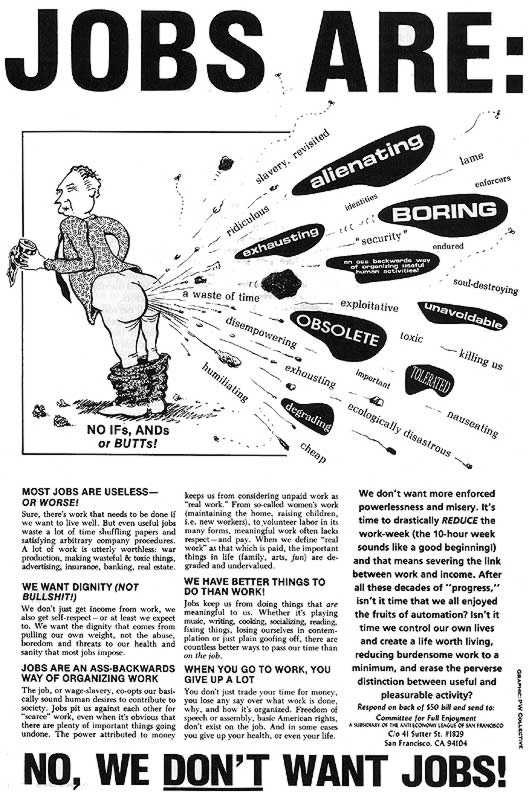
[The piece below sounds very much like Chris Carlsson’s “Jobs Don’t Work” which is linked to in the commentary here. Carlsson’s is much better though – highlights of it will follow eventually.]
On the Phenomenon of Bullshit Jobs – David Graeber
In the year 1930, John Maynard Keynes predicted that, by century’s end, technology would have advanced sufficiently that countries like Great Britain or the United States would have achieved a 15-hour work week. There’s every reason to believe he was right. In technological terms, we are quite capable of this. And yet it didn’t happen. Instead, technology has been marshaled, if anything, to figure out ways to make us all work more. In order to achieve this, jobs have had to be created that are, effectively, pointless. Huge swathes of people, in Europe and North America in particular, spend their entire working lives performing tasks they secretly believe do not really need to be performed. The moral and spiritual damage that comes from this situation is profound. It is a scar across our collective soul. Yet virtually no one talks about it.
…
The answer clearly isn’t economic: it’s moral and political. The ruling class has figured out that a happy and productive population with free time on their hands is a mortal danger (think of what started to happen when this even began to be approximated in the ‘60s). And, on the other hand, the feeling that work is a moral value in itself, and that anyone not willing to submit themselves to some kind of intense work discipline for most of their waking hours deserves nothing, is extraordinarily convenient for them.
…
If someone had designed a work regime perfectly suited to maintaining the power of finance capital, it’s hard to see how they could have done a better job. Real, productive workers are relentlessly squeezed and exploited. The remainder are divided between a terrorised stratum of the, universally reviled, unemployed and a larger stratum who are basically paid to do nothing, in positions designed to make them identify with the perspectives and sensibilities of the ruling class (managers, administrators, etc) – and particularly its financial avatars – but, at the same time, foster a simmering resentment against anyone whose work has clear and undeniable social value. Clearly, the system was never consciously designed. It emerged from almost a century of trial and error. But it is the only explanation for why, despite our technological capacities, we are not all working 3-4 hour days.
The prison of artlike art – Stephen Wright on Rasheed Araeen’s Art Beyond Art
The Escapologist. Rasheed Araeen and the transformative potential of art beyond art – Stephen Wright
[To be clear – I love the field Wright stakes out even though I would argue with many of the details. One specific objection would be the idea of art as an inherently “critical” enterprise. This seems to be demonstrably false as a historical matter and an unnecessary notion ideologically. That is, one might ask – “Wouldn’t it be important to escape capture by the empire of criticality too?” ]
…Third Text’s controlled coefficient of specific visibility as a collective, conceptual artwork situated it in the “art-beyond-art” category — that is, of practices whose self-understanding is as art, but which manage to avoid being performed as art, somehow foiling the powerful apparatus of performative capture within what Araeen calls “the legitimising prisonhouse” of bourgeois aesthetics. Though Third Text, as we know, has since been captured by those very forces it had set out to challenge, Rasheed Araeen, we can be sure, eludes capture.
…
What’s most important about Art Beyond Art, though, is its discussion of the obstacles art faces today, and how it might elude them. Given Araeen’s experience in escapology — not of the Harry-Houdini variety of cuffs and chains, that wouldn’t be his style, but in escaping institutional, epistemic and performative capture — he has some important points to make. Here’s how he sets the stage:
“At the end of the sixties there emerged a concept of art whose true significance has not been generally and fully understood of recognized. Its significance was not in its newness or innovation, but what was conceptually a radical shift from art as displayable objects that can be looked at and contemplated — painting, scultupre, installations, photography, etc — to art as a process of transformation within the everyday. Historically, it was a movement of the idea that entered human imagination with a consciousness that sought integration of art with life, so that it would by becoming part of life’s everyday energy and creativity join its journey towards what for Hegel was its ultimate fulfillment. But this was not to happen. The journey was halted as it entered the cultural citadel of bourgeois capitalist society to seek legitimation. And, as it succumbed and capitulated to the privileges that the bourgeois art institution offered, the idea became trapped with in the logic of the very institutional space it was allowed to enter and occupy.”
…
“What is fundamental to my suggestion is the idea that it is possible to perceive or produce art in a radically different content, an art which locates itself away from the bourgeois institution and is not necessarily dependent on its mediation and legitimation.” This involves, amongst other things, making theory a practice, wresting it away from the academy: “It is with the imaginative power of art that I want to move forward; with a proposition that may lead to a new kind of thinking and produce a new kind of critical practice, out of which may also emerge a revolutionary concept of art based on the nominalism of the everyday work carried out by people themselves or their material production.” …
…
…art, he writes, “must lead a double life.” “On the one hand, it is a conceptual artwork but, on the other, its material form must become independent of whether it is a work of art or not. Only when it can escape from being merely an art concept or form that it can avoid its reification, and only then can it continue to maintain its transformative function within the productive force of everyday life.”
…
“Although what I propose as a collaborative practice results in a material form — it may be a farm, a factory, a supermarket, a transport system, etc, collectively run and owned by the workers themselves — I continue to call it a conceptual artwork. Why? Because it is not possible to get rid of art as a special category or completely dissolve it in other things so long as there exists capitalism and its division of labour. The complete dissolution of art into life so that art loses its identity as art will deprive it of its transformative function. If it is allowed to become like any other thing, without maintaining its specific non-instrumental imaginative power, art will not be able to act upon those things which are the products of consumer culture and turn them into a critical force capable of confronting the bourgeois society. In other s words, art’s function as a liberating force is dependent not only on its becoming something other than art but also maintaining its identity as a specific material as well as a symbolic practice.”
In essence, art secretes a kind of invisible but conceptual otherness within the everyday life processes that it permeates. Acting as a kind of yeast, the idea of art brings about a minimal shift within sameness. Though its dissolution into life may be impossible, it may act like a solvent upon ontologically stable relations. Like mycelium in a mineral, the idea steadily, “without complaint or resentment,” dissolves the obstacle.
Ransacking the Western philosophical tradition – Adam Kirsch on Peter Sloterdijk
Against Cynicism: A philosopher’s brilliant reasons for living – Adam Kirsch
…
Despite its parodic Kantian title, Sloterdijk’s Critique is not a work of theoretical abstraction; it is a highly personal confession of this generational world-weariness. As a philosopher, Sloterdijk is especially struck by the way he and his peers were able to master the most emancipatory and radical philosophical language, but utterly unable to apply its insights to their own lives and their own political situations. Coming after Critical Theory, whose post-Marxist diagnoses of social ills are a key reference point and antagonist for Sloterdijk, younger thinkers have found themselves brilliant at diagnosis and helpless at cure. “Because everything has become problematic, everything is also somehow a matter of indifference,” Sloterdijk observes. The result is cynicism, which he defines in a splendid paradox as “enlightened false consciousness”: “It has learned its lessons in enlightenment, but it has not, and probably was not able to, put them into practice.”
If we are to break out of this learned helplessness, Sloterdijk argues, we must ransack the Western tradition for new philosophical resources. Such ransacking is exactly the method of Sloterdijk’s thought, first in the Critique and then, on an even grander scale, in Bubbles and You Must Change Your Life. Drawing on very wide reading—wider, the reader often feels, than it is deep—Sloterdijk excavates the prehistory of contemporary problems, and some of their possible solutions. In the Critique, he offers an extended analysis of the culture of Weimar Germany, in which he locates the origin of twentieth-century cynicism—as well as describing the many sub-varieties of cynicism (military, sexual, religious), and doing a close reading of Dostoevsky, and cataloguing the meaning of different facial expressions. The effect on the reader is of being shown around a Wunderkammer, where what matters is not the advancing of an argument but the display of various intellectual treasures.
…
In Critique of Cynical Reason, Sloterdijk charted a wholly individual path to a familiar spiritual position, a Romanticism of what Wordsworth called “wise passiveness.” This pattern is repeated in Sloterdijk’s later books: he is better at the forceful restatement of old problems than at the invention of new solutions. This might be regarded as an objection by certain kinds of philosophers, who see themselves as contributors to a technical process that produces concrete results. For Sloterdijk, whose greatest influences are Nietzsche and Heidegger, it is not at all disqualifying, for his goal is, as he writes in You Must Change Your Life, “a provocative re-description of the objects of analysis.” Like a literary writer—and he once told an interviewer that he thought of writing the Spheres trilogy as a novel—Sloterdijk’s goal is to restate our basic quandaries in revelatory new language, to bring them home to us as living experiences instead of stale formulas. The prison of reason, the need for transcendence, the yearning for an absent meaning: these have been the stuff of literature and philosophy and theology for centuries. In Sloterdijk, these old subjects find a timely new interpreter.
…
But if Sloterdijk is not a believer, then where does he think we can actually experience this kind of perfectly trusting togetherness? Where do we find a sphere that is wholly earthly, yet so primal as to retain its power even now? The answer is surprising, even bizarre. In a long section of Bubbles, Sloterdijk argues that the original sphere, the one we all experience and yearn to recapture, is the mother’s womb. This is not, for him, a place of blissful isolation, where the subject can enjoy illusions of omnipotence; if it were, the womb would be only a training ground for selfishness and disillusion. Sloterdijk emphasizes instead that we are all in our mother’s womb along with a placenta. The placenta is what he calls “the With”—our first experience of otherness, but a friendly and nurturing otherness, and thus a model for all future “spheres” of intimacy.
…
The reader who has no patience for this kind of thing—who finds the whole “With” concept New Agey, or unfalsifiable, or just wildly eccentric—will probably not get very far with Sloterdijk. This is not because placenta-ism is central to his thought. On the contrary, it is just one of the many provocative ideas that he develops and then drops in the course of the book, which reads less like a structured argument than a long prose poem. Sloterdijk’s strength and appeal come from the intuitive and metaphorical quality of his thought, his unconventional approaches to familiar problems, his willingness to scandalize. As a theorem, the “With” is easy to refute; as a metaphor, it is weirdly persuasive. It is another way of describing, and accounting for, the central experience of homelessness that drives all of Sloterdijk’s thought. Deprived of our “With,” he writes, “the officially licensed thesis ‘God is dead’ ” must be supplemented “with the private addendum ‘and my own ally is also dead.’ ”
…
The word “practice” is central to Sloterdijk’s argument here, and to his understanding of religion. We are living, he observes, at a time when religion is supposedly making a comeback around the world. The old assurance that all societies must inevitably converge on secularism is failing. For Sloterdijk, however, it is a mistake to think that what people are turning to is faith in the divine. Rather, the part of religion that still matters to us, for which we have a recurring need, is its practices: the “technology,” primarily mental and inner-directed, that allows us to reshape our ways of thinking and feeling. With typical bravado, he argues that “no ‘religion’ or ‘religions’ exist, only misunderstood spiritual regimens.
…
One of the most appealing things about Sloterdijk’s philosophy is that, like literature, it leaves itself vulnerable. It does not attempt to anticipate and to refute all possible objections. And the objections to You Must Change Your Life, as with Bubbles, are not far to seek. For one thing, by conceiving of religion as an elite training regimen, Sloterdijk implies that a religion is justified only by its saints. Anyone who is not a saint is insignificant, and so the average person’s experience of religious meanings—whether metaphysical doctrine or spiritual consolation or tradition or identity or communion—is dismissed out of hand. This is false to the lived reality of religion for most people, and shows how tendentious Sloterdijk’s equation of religion with “practice” really is.
…This is as much as to say that Sloterdijk has not solved the immense problems that he raises, even though he claims to know the way toward the solution. But maybe the philosopher does not need to solve problems, only to make them come alive; and this he does as well as any thinker at work today.
On localization in the arts – Scott E. Walters
Speak Your Piece: The Extractive Arts – Scott E. Walters
…
The problem with Kaiser’s argument is that none of the artists he mentions stayed in their community or even in the states or regions where they were from. They all left and went to the “big coastal city” of New York, just as the anti-arts politicians said, where they entertained the elite, also like the anti-arts politicians said. Kaiser hasn’t, in fact, refuted their beliefs in the least. More importantly, while the artists he mentioned achieved renown, many, many others from similar small towns followed the same path and saw their talents go unappreciated and their gifts unnoticed, talents and gifts that would have added so much to their home towns.
This is the extractive creativity economy in action.
Like clear-cutting a forest or blasting the top off of a mountain in order to send wood and coal to urban dwellers, the American arts system extracts artistic resources in the form of talented young people and tells them that the only place they can make a living in the arts is New York City. Not to put too fine a point on it, but this is a major lie. Let me use a statistic from my area of expertise, the theater, to make my point.
…
My point isn’t that theater (or dance or painting or music or…) is a lousy way to make a living – why should the readers of Daily Yonder care about that? My point is that, given those dismal facts, shouldn’t we be teaching our talented young people the skills needed to practice their art in places other than New York and Los Angeles, in places that are starving for the arts, maybe even places like their own home towns? After all, the bar is pretty low – if you sold tickets to your friends and family you would make more money than did 58% of the so-called professional actors.
…
How would interest in the arts improve across the country, and even in the legislature, if performers put down roots in a place they loved, built a life there and created art that reflected the stories, the songs, the dances, the colors, the shapes of their chosen town? What if the arts world was more like a local farmer’s market, filled with products that grew organically from the dirt, rain and sun of a particular place? What if, like local farmers, local artists found a way to make a living within the context of their specific place, rather than within some generic model created for somewhere else that wastes 58% of what it grows? And why can’t those places include rural areas, where people are just as interested in being entertained and enriched?
Life actually lived rather than frozen in the amber of speculative thought – Edward Mooney, Kierkegaard, faith, and love
Excursions with Kierkegaard: Others, Goods, Death, and Final Faith – Reviewed by Jeffrey Hanson
…
His book is fit for the educated person still open to wonder and a tonic for the academician whose passion has been dulled by bureaucracy and careerism, who has sold her birthright as a teacher in exchange for being — to use a Kierkegaardian term of ridicule — an assistant professor. And his book is for those who still feel the call to which the existentialist once responded: the whispered summons to traipse the wilderness rather than trace yet again the well-worn path to and from the office. Many of Mooney’s metaphors are drawn from the activity of walking and taking in landscapes — if he isn’t a walker himself like his beloved Kierkegaard (or Thoreau, whom he also admires), then he is to be congratulated for his fictive inventiveness, because his imagery strikes the reader as one that is born from life. Indeed, the many meditations in this text positively wriggle with the vitality of the first-hand, like a bucket of eels drawn from a sun-spangled river. Readers expecting a technical account of anything at all will be disappointed. Excursions with Kierkegaard is what its title suggests: more travelogue than treatise. And his companion on the way is lovingly and vividly rendered, a wry Virgil to any Dante who picks up this book. Kierkegaard appears here as by turns sober and wry, difficult and winsome, a poet, a preacher, a prophet, an ironic carnival barker, an astute observer, a friend to the man on the street and a guest of the king, a bon vivant and a Christian, a confidant and critic.
…
This ambivalence is part of the character of our experience, and Mooney seems to appreciate that. Reason goes weak in the knees when it falls in love because in love the giving of reasons rings hollow: Imagine a marriage proposal prefaced by a list of “Things I Really Like about You.” If Mooney is right (and I think he is) that love thrives where reasons leave off, then that is not because our experience just is equivocal and various means and attunements might disclose this but because this is the way love is, and love being what it is renders all experience equivocal. If God is non-metaphorical love par excellence, and I think for Kierkegaard God is, then the aesthetic approach, for all its beauty and splendor, needs the religious to rescue it. Mooney’s poetics are not incompatible with the religious — far from it — but it might help to be a bit clearer that while for Kierkegaard faith without poetics is inconceivable, poetics without faith is unsustainable.
…
Again it is Mooney’s vision that causes us to see Kierkegaard anew, and, as he would admit, no one has an unobstructed vista on the panorama of truth. If he brings us to a new vision, he does so not by force of syllogism but by inviting us to take up a strange and strained perspective. To ask for this fuzziness to be brought to perfect clarity would betray both Mooney’s characteristic tenor and the point of what he wants to convey, which is in no small part that for Kierkegaard ambiguity, openness, and subjective shading are endemic to life actually lived rather than frozen in the amber of speculative thought.
The fig leaf for mediocrity known as “theory.” – Literature vs. The Academy
Who Ruined the Humanities? – Lee Siegel
…
The disheartening fact is that for every college professor who made Shakespeare or Lawrence come alive for the lucky few—the British scholar Frank Kermode kindled Shakespeare into an eternal flame in my head—there were countless others who made the reading of literary masterpieces seem like two hours in the periodontist’s chair. In their numbing hands, the term “humanities” became code for “and you don’t even have to show up to get an A.”
…
The college teaching of literature is a relatively recent phenomenon. Literature did not even become part of the university curriculum until the end of the 19th century. Before that, what came to be called the humanities consisted of learning Greek and Latin, while the Bible was studied in church as the necessary other half of a full education. No one ever thought of teaching novels, stories, poems or plays in a formal course of study. They were part of the leisure of everyday life.
…
…In that moment, teaching literature as an investigation of life’s enigmas struck a deep collective chord. Majoring in English hit its zenith, yet it was this very popularity of literature in the university that spelled its doom, as tendentious pedants of various stripes accelerated the academicization of literary art.
In contrast to the effects of World War II, the purposeless bloodshed of the Vietnam War made all authority suspect. That was when teaching literature acquired an especially intense ideological fervor, when university radicals started their long (and fruitless) march through academic institutions armed with that fig leaf for mediocrity known as “theory.” And that was when majoring in English began its slow decline. The rest is today’s news.Only a knave would applaud the falling-off in the formal study of books that cultivate empathy, curiosity, aesthetic taste and moral refinement. But the academic study of literature leads to nothing of the sort.
…
Trilling was exasperated by the absurdity of teaching morally subversive modernist works in the morally conventional precincts of a university, to the point where he somewhat hysterically exaggerated what he called the “force and terror” of modernist literature (there is terror in Syria, not in Gide). But he was, after all, a college teacher, and he was not able to see that the classroom also ruins literature’s joys, as well as trivializing its jolting dissents.
…
But once in the college classroom, this precious, alternate life inside me got thrown back into that dimension of my existence that vexed or bored me. Homer, Chekhov and Yeats were reduced to right and wrong answers, clear-cut themes, a welter of clever and more clever interpretations. Books that transformed the facts were taught like science and social science and themselves reduced to mere facts. Novels, poems and plays that had been fonts of empathy, and incitements to curiosity, were now occasions of drudgery and toil.
Every other academic subject requires specialized knowledge and a mastery of skills and methods. Literature requires only that you be human. It does not have to be taught any more than dreaming has to be taught. Why does Hector’s infant son, Astyanax, cry when he sees his father put on his helmet? All you need to understand that is a heart.
So you see, I am not making a brief against reading the classics of Western literature. Far from it. I am against taking these startling epiphanies of the irrational, unspoken, unthought-of side of human life into the college classroom and turning them into the bland exercises in competition, hierarchy and information-accumulation that are these works’ mortal enemies.
…
The literary classics are a haven for that part of us that broods over mortal bewilderments, over suffering and death and fleeting happiness. They are a refuge for our secret self that wishes to contemplate the precious singularity of our physical world, that seeks out the expression of feelings too prismatic for rational articulation. ****They are places of quiet, useless stillness in a world that despises any activity that is not profitable or productive.****
Literary art’s sudden, startling truth and beauty make us feel, in the most solitary part of us, that we are not alone, and that there are meanings that cannot be bought, sold or traded, that do not decay and die. This socially and economically worthless experience is called transcendence, and you cannot assign a paper, or a grade, or an academic rank, on that. Literature is too sacred to be taught. It needs only to be read.
…
In “Moby-Dick,” Melville’s narrator, Ishmael, declares that “a whale-ship was my Yale College and my Harvard.” Soon, if all goes well and literature at last disappears from the undergraduate curriculum—my fingers are crossed—increasing numbers of people will be able to say that reading the literary masterworks of the past outside the college classroom, simply in the course of living, was, in fact, their college classroom.
Burning cars – Toward an unproductive infinitude – Baudrillard on art “workers” and cultural “production”
Neither Marx nor Smith: Baudrillard’s Critique of Productivism – Frederick H. Pitts
Baudrillard’s account in The Mirror of Production is motivated primarily by a critique of Marx… Marx endowed production and labor with a “revolutionary title of nobility” that has paralyzed subsequent attempts to formulate a political program derived from Marx’s concepts. Thus, one naturalization was substituted for another (Baudrillard, 18–19).
According to Poster, Baudrillard sees production and labor as the “forms” that Marx used as a foundation for the critique of political economy. However, in so using these forms, a part of Marx’s critique was left incomplete, carrying over entirely uncritically two key concepts of political economy itself (Poster, 2). By basing his critique of political economy around production and labor, Marx retained the theoretical and ideological core of the object of that critique, which inhibited his ability to complete his critique and escape the constraints of classical political economy…
…Thus, Baudrillard goes further than merely associating Marx with an inability to overcome the status of labor in political economy. Marx’s productivism is not merely a humanistic fetishization of labor and those who perform it, but a means by which every aspect of life is seen through the prism of production…
…Rather than maintaining a narrow fixation on the condition of one’s exploitation as labor as the means by which this exploitation can be transcended, Baudrillard argues that workers must liberate themselves from the status of “labor-power,” and “think themselves under another sign than that of production” (Poster, 3).
Under capitalism, workers are exploited not only as a result of the machinations of the system, which dominates them, but also by the code, which co-opts and coerces them. The reinforcement and perpetuation of this code in traditional Marxism ironically services the needs of capitalism. It generates this effect by means of popularizing the myth that labor-power is each individual’s “fundamental human potential” rather than a capitalist social relation. As Baudrillard writes:
“And in this Marxism assists the cunning of capital. It convinces men that they are alienated by the sale of their labor power, thus censoring the much more radical hypothesis that they might be alienated as labor power, as the “inalienable” power of creating value by their labor.” (Baudrillard, 31)
…
The attachment of the sign of the economic to every spontaneous insurrection under the sun is a commonplace in the Marxist tradition. For Baudrillard, bursts of revolutionary activity governed by the “pleasure principle” and the “radicality of revolt”—such as that witnessed in “the destruction of machines, in pre-Marxist, utopian and libertarian discourse as well as in the ideas sustaining ‘the cursed poets or the sexual revolt”—sought a new and more radical “total symbolic configuration of life.” But under the spell of Marxism, these strands of rebellion are abstracted out of movements in political economy, and, at worst, sacrificed as less important moments of the unfolding of history through the “development of productive forces.” It is this sense of finality from which revolutionary activity must escape, of some end toward which our efforts are driven. The “here and now” of revolution must be reinstated. Against the “imposition” of the meaning of revolutionary finality, Baudrillard instead celebrates “the radicality of desire which, in its non-meaning, cuts through all finality” (Baudrillard, 154–55).
…The Marxist paradigm not only provides a poor apparatus through which to rethink class struggle, but also does not allow us to escape the subordination of desire to “productive” finality. As Baudrillard concludes, “[t]o enclose the ‘exploited’ within the single historical possibility of taking power has been the worst diversion the revolution has ever taken” (Baudrillard, 167). It is toward a desire that exceeds this finality that Baudrillard suggests we turn to discover an unproductive infinitude whereby events may satisfy that “[s]omething in all men” that “profoundly rejoices in seeing a car burn” (Baudrillard, 141).
…
This argument has implications for the way in which we conceive of anti-capitalist political action. Trade unions and labor parties must cede the oppositional ground to the demands of social movements composed of desires and symbolic expenditure that exceed and cannot be recouped within a discourse of either production or its flipside, non-production. Plainly, the whole ethico-poltical edifice of capitalism must be challenged. In part, then, Baudrillard comes to the conclusion that the productivist inadequacy of both political economy and its Marxist critique must be themselves be urgently critiqued on the symbolic level of the code. While Baudrillard champions the burning car as the pure expenditure of symbolic exchange par excellence, it is the immanent critique of political economy and its critical counterpart that may in fact mark the beginning of any symbolic attack of la parole against the code. Far from hitting the streets armed with signs and placards heralding the “the right to work” and “jobs, growth and justice,” perhaps the implication of Baudrillard’s thesis is “criticize first, and then do nothing”: that we should instead take to our desks and discussion groups. In other cases, we should do nothing at all, so as not to be put in the position whereby our actions can be put to productive ends.
Meaningless Work – Walter De Maria (R.I.P.)
Meaningless Work – Walter De Maria
Meaningless work is obviously the most important and significant art form today. The aesthetic feeling given by meaningless work can not be described exactly because it varies with each individual doing the work. Meaningless work is honest. Meaningless work will be enjoyed and hated by intellectuals – though they should understand it. Meaningless work can not be sold in art galleries or win prizes in museums – though old fasion records of meaningless work (most all paintings) do partake in these indignities. Like ordinary work, meaningless work can make you sweat if you do it long enough. By meaningless work I simply mean work which does not make money or accomplish a conventional purpose. For instance putting wooden blocks from one box to another, then putting them back to the original box, back and forth, back and forth etc., is a fine example of meaningless work. Or digging a hole, then covering it is another example. Filing letters in a filing cabinet could be considered meaningless work, only if one were not considered a secretary, and if one scattered the file on the floor periodically so that one didn’t get any feeling of accomplishment. Digging in the garden is not meaningless work. Weight lifting, though monotonous, is not meaningless work in its aesthetic since because it will give you muscles and you know it. Caution should be taken that the work chosen should not be too pleasurable, lest pleasure becomes the purpose of the work. Hence, sex, though rhythmic, can not strictly be called meaningless – though I’m sure many people consider it so.
Meaningless work is potentially the most abstract, concrete, individual, foolish, indeterminate, exactly determined, varied, important art-action-experience one can undertake today. This concept is not a joke. Try some meaningless work in the privacy of your own room. In fact, to be fully understood, meaningless work should be done alone or else it becomes entertainment for others and the reaction or lack of reaction of the art lover to the meaningless work can not honestly be felt.
Meaningless work can contain all of the best qualities of old art forms such as painting, writing, etc. It can make you feel and think about yourself, the outside world, morality, reality, unconsciousness, nature, history, time, philosophy, nothing at all, politics, etc. without the limitations of the old art forms.
Meaningless work is individual in nature and it can be done in any form and over any span of time – from one second up to the limits of exhaustion. It can be done fast or slow or both. Rhythmically or not. It can be done anywhere in any weather conditions. Clothing, if any, is left to the individual. Whether the meaningless work, as an art form, is meaningless, in the ordinary sense of that term, is of course up to the individual. Meaningless work is the new way to tell who is square.
Grunt
Get to work
March, 1960.
Art “workers” are to art what sex workers are to sex. – Even more stuff I said on facebook with the really challenging, thoughtful, responses removed
This might clarify:
To describe what sex workers engage in as “sex” is accurate, but only in a *very particular way*. I imagine most folks would agree that it is not the same type of sex one means when talking about consensual relationships. Ergo, for those engaged in art as art “workers,” what they engage in is art, but only in a very particular way as well…
Now, I knew the comparison was dicey from a gender point of view, but it is not the nature of the work I was trying to compare, but the relationship one has to, and in, work. The way that “work” transforms an activity.
So, fighting for improved working conditions for sex workers is clearly laudable. But I think a better strategy would be to focus not (solely) on the conditions of one’s “work,” but on the compulsion to work altogether. In the specific case of sex workers, I think those struggles are better attacked from a human rights angle than from a “work” angle…
Again, to me calling art “work” accepts a set of normative principles and imports a whole ideological framework that I think is unwise. I understand the motivation (or think I do), but it’s the same reason I call what I do out here on the boat “cooking” (with scare quotes) rather than without because what I mean by cooking has a set of qualitative conditions attached that get completely severed by doing it as work.
…
***** – “acknowledgement of the value of cultural labor” is precisely what I continue to object to.
To call something “labor” invites a particular type of “value.” So, do I think artists engage in interesting activity? Yes. Do I think the activity is work? No. Do I think it is valuable? Yes, but the nature of that value and how it is valued is important. If it is indeed, *mere* work (yes, in Bob Black’s sense) then I have no more or less sympathy for it than say selling insurance. If work is supposed to be honorific in some sense, then I think another term might be needed or we need to be expansive in its application (to no good end in my mind other than to be fair and inclusive) so that we speak of juggling “workers”, hiking “workers”, etc. And yeah art *can* be a stand in, and often *desires* to stand in for the “general application of creative principles,” but I think we might need to get away from the word “art” as quickly as we need to get away from the word “work!”
…
I would say talk of compensation is tricky. When I have friends for over for dinner I hardly expect compensation despite the fact that I might have undergone tremendous effort (“work”) to prepare the meal. So if one’s art is akin to a shared experience among friends, talk of payment gets weird. But if it is not for friends, but a professional endeavor, one in which a “service” is provided to a client then talk of money makes sense – to the extent it is such it seems like talk of “art” then becomes tricky…
…
I should have said – *can* become tricky. I definitely don’t want to set up ironclad dichotomies…
The comfortable absurdity of artistic “experimentation.” – Toward an expansive “we” (hint: mom and dad are invited) – Some more stuff I said on facebook with the really challenging, thoughtful, responses removed
Well, after sorting through all of the theoretical gobbledy-gook, I find myself in some agreement (with the intro “Mental Prototypes and Monster Institutions.”) with the spirit… But then I get to the conclusion in which they call for 4 circuits (not feeling all this 90s grad school lingo – “circuits” “monsters” “hybrids” “swarming”). These circuits sound an awful lot like they will need to be populated (and led) by artist-academics. How convenient! Their description does not seem to align with the stated ambitions:
“struggles and forms of social existence that some would accuse of being non-political or contaminated or useless or absurd ”
“monstrous, because they initially appear to be pre-political or simply non-political in form”
“another politics, that is, another way of translating the power of productive subjects into new forms of political behaviour”
I *wish* the proposed circuits, were not circuits at all and were more “useless” or “absurd.” Absurd that is in a way that academics would find uncomfortable rather than the comfortable absurdity of artistic “experimentation.”
…
I wouldn’t characterize my reaction as “phobia.” Rather, I would call it allergic.
The problem with the notion of hybridity advocated here is that the multiple layers don’t really seem all that “multiple.” So describing this writing as “technical” might be right…it is a field manual for the already converted, the ones who already speak the same way, the ones who always do all the speaking and not enough listening. Communication isn’t just about finding the right rhetoric. It is also about developing the proper dispositions right? I would be far less suspicious of the circuits if the notion of collectivity they proposed didn’t seem to place academic/activist/art types at the center (or at the very least, the sorts of programmatic structures they have such an affinity for – educational projects, research projects, media/publishing, and institutes/foundations). In other words, let the monsters rise, but not be created, educated, published, and exhibited within the comfort zones of the academic/activist/artistic industrial complex! Screw their mental prototypes.
…
I am allergic to missionary fervor – to being “saved” or “helped” by those in the know. As you have already guessed, I got nothing. But, yes, folks out there do have something, and I will not lead them. It is true we don’t read the same way, but I am happy to have at least put our readings in contact.
I have been hearing/reading big plans and big ideas from academic art types for quite some time and the track record here in the US is pretty paltry. Until they figure out a form of (non, anti, new) political engagement that has them at the margins, that has small ambitions, that isn’t predicated on “producing knowledge,” that stops thinking only in terms of urban space, that advocates diversity without being dismissive of *actually* dissenting points of view, that accepts pleasure (especially “unhealthy” sorts), and especially gives up the romance of avant gardism – I too feel like I’ll be waiting for them to work their “magic” forever…
Happy 4th of July!
…
I would say to your last question that *not all* art criticism, cultural theory, and yes, even urban planning is technocratic. And I would add that the technocrats have had ample opportunity to use their “expertise” to manifest something good and have very little to show for it…
Yes “we” have art, “we” have culture, and “we” have education – but a point of contention here is how expansive that “we” is. From my 20+ years around academic/art/activist types it has become clear to me that the “we” is pretty narrow. My white heterosexual middle class mom who has no interest in overthrowing capitalism, or has much clue what heteronormativity might be is pretty clearly excluded even though she might agree in spirit with the notion that a fairer allocation of resources might be a pretty neat idea…I am for a “we” that isn’t the hollow fantasy of grad school romantics, one that includes their moms and dads and all the unironic mall shopping conformists they think they are so much better informed than. I am for a “we” that includes gun owners and people who don’t have a clue who Zizek is (or even Chomsky). And I have no problem at all with attempting to “contribute towards the emergence of a non-centralized liberatory culture.” I just wish for a little more humility a little less grandiosity and maybe less occupying of parks (which is indeed useful) and more strolls. And I do think you sell short the power of the stroll vs. the dérive, or what I might call (thanks to Scott Stroud) artful living vs. art. Here is a snippet from him that may or may not help (asterisks added for emphasis):
“***Life is always lived in some present, and it is here that the battle of life is fought***; one can come armed with habits that foster engagement with that present, or one can bring in ways of viewing the here and now (be it an art object or a work task) as a mere means to achieve something in the remote future. Both of these approaches will affect and tone the quality of lived, transactive experience. Dewey’s point, which I will explore at length in this work, is that the former approach is constitutive of artful living.”
I am for a criticism that is in love with something other than itself – Alex Ross – Listen to this
…
For at least a century, the music has been captive to a cult of mediocre élitism that tries to manufacture self-esteem by clutching at empty formulas of intellectual superiority. Consider some of the rival names in circulation: “art” music, “serious” music, “great” music, “good” music. Yes, the music can be great and serious; but greatness and seriousness are not its defining characteristics. It can also be stupid, vulgar, and insane. Music is too personal a medium to support an absolute hierarchy of values. The best music is music that persuades us that there is no other music in the world. This morning, for me, it was Sibelius’s Fifth; late last night, Dylan’s “Sad-Eyed Lady of the Lowlands”; tomorrow, it may be something entirely new. I can’t rank my favorite music any more than I can rank my memories. Yet some discerning souls believe that the music should be marketed as a luxury good, one that supplants an inferior popular product. They say, in effect, “The music you love is trash. Listen instead to our great, arty music.” They gesture toward the heavens, but they speak the language of high-end real estate. They are making little headway with the unconverted because they have forgotten to define the music as something worth loving. If it is worth loving, it must be great; no more need be said.
…
…What I refuse to accept is that one kind of music soothes the mind and another kind soothes the soul. Depends on whose mind, whose soul.
…
All music becomes classical music in the end. Reading the histories of other genres, I often get a warm sense of déjà vu. The story of jazz, for example, seems to recapitulate classical history at high speed. First, the youth-rebellion period: Satchmo and the Duke and Bix and Jelly Roll teach a generation to lose itself in the music. Second, the era of bourgeois grandeur: the high-class swing band parallels the Romantic orchestra. Stage 3: artists rebel against the bourgeois image, echoing the classical modernist revolution, sometimes by direct citation (Charlie Parker works the opening notes of “The Rite of Spring” into “Salt Peanuts”). Stage 4: free jazz marks the point at which the vanguard loses touch with the mass and becomes a self-contained avant-garde. Stage 5: a period of retrenchment. Wynton Marsalis’s attempt to launch a traditionalist jazz revival parallels the neo-Romantic music of many late-twentieth-century composers. But this effort comes too late to restore the art to the popular mainstream. Jazz recordings sell about the same as classical recordings, three per cent of the market.
The same progression worms its way through rock and roll. What were my hyper-educated punk-rock friends but Stage 3 high modernists, rebelling against the bloated Romanticism of Stage 2 stadium rock? Right now, there seems to be a lot of Stage 5 classicism going on in what remains of rock and roll. The Strokes, the Hives, the Vines, the Stills, the Thrills, and so on hark back to some lost pure moment of the sixties or seventies. Their names are all variations on the Kinks. Many of them use old instruments, old amplifiers, old soundboards. One rocker was recently quoted as saying, “I intentionally won’t use something I haven’t heard before.”Macht Neues, kids! So far, hip-hop has proved resistant to this kind of classicizing cycle, but you never know. It is just a short step from old school to the Second Viennese School.
…
…The symphony became a fragmentary, unfinished thing, and unfinished it remains. It becomes whole again only in the mind and soul of someone listening for the first time, and listening again. The hero is you.
“…everyday life will then become so full of beauty that it will become art.” – No, it already *is* full of such beauty, but thankfully is *not* art
Changing Places – Dan Fox talks to Nils Norman, Timotheus Vermeulen, Anton Vidokle and Sharon Zukin
DF: One of the problems is that the ‘art world’ superstructure has grown so large that it’s difficult to navigate our way through it with a clear perspective on our own roles. How do you stay independent or achieve agency amid such a tangle of institutions and businesses? One option would involve leaving the ‘art world’ altogether, although most people would be reluctant to do so. I also think cognitive dissonances can be identified amongst those who Nils says ‘are critical of how they are inscribed within gentrification processes’. For instance, artists who claim radical political positions from within the support structure of major museum or commercial gallery exhibitions, and who speak in visual codes legible to those in the specialist subculture of art. But it’s tricky; even having this conversation is complicated by whatever its host context may be, whether that’s an art magazine, not-for-profit venue, or wherever.
AV: Economic dependency on the art industry is probably not the only thing that keeps artists from just walking away: you can also support your art practice by doing something else and many do just that. All of these institutions you mention control access to audiences, be it the professional audience of your peers or a broader audience interested in art. This is also probably one of the main reasons why artists tend to live in cities: to be a part of a community, a conversation. Cities are not merely markets.
There have been several moments in recent history when artists tried to move out of cities for various reasons, most recently in the ’70s. It seems to me this was unsustainable and most have moved back since then. Martha Rosler, in her 2010 essay ‘Culture Class: Art, Creativity, Urbanism’, cites Chantal Mouffe’s suggestion that artists should not abandon the museum – meaning the art world – and adds that we should also not abandon the city. I fully agree with this.
…
AV:…While as an artist you may think that you are free to do what you want, in order for it to be economically sustainable, critically acknowledged or just even to bring it into contact with the art audience, it needs to conform to certain network protocols that dictate what sort of production can enter circulation. With the ever-increasing professionalization in the arts today, and the economic restraints of the art world, it seems that the field is moving towards restoring a more prescriptive position towards the artist.
TV: I agree. Artistic sovereignty is a discursive construct, perhaps even a myth, that is always negotiated through cultural, spatial and historical parameters.
…
There is a more cynical take on the relation between art, cities and capitalism, which is that the city always already allows for numerous areas to adhere to the possibility of alternate rhythms. In this view, it doesn’t make a difference whether artists or institutions are the canaries in the mine. After all, the mine is owned by the same people that own the canaries …
AV: This resonates strongly for me. It could be interesting to try to describe this ‘artistic rhythm’ you speak of. We seem to inhabit this sort of flattened, urban, capitalistic time, in which each tick of the clock is a potential investment, because we use time to make money. That’s a really monotonous rhythm.
Someone like the Croatian artist Mladen Stilinovic´ comes to mind, and his photographic series of himself sleeping or thinking in bed: ‘Artist at Work’ [1978]. In his writings from that time, he suggests that Western artists are bad artists because they work too much, and that a good artist is a lazy artist. That’s a different rhythm: syncopated by a certain refusal to perform, to be productive. Very different from, say, flexible time in creative industries today.
NN: Discussions around gentrification tend to romanticize the subversive and autonomous agency artist’s projects have in these processes – the tactics, the skipping, the interventions. This is combined with an idea that somehow everybody wants to live like artists, a theme heavily exploited by Richard Florida.
…
SZ: What about Marina Abramovic´, who plans to convert an old theatre in the newly gentrified Hudson River Valley, north of New York City, into an arts centre named after her and focused on her long-duration performance pieces? In The New York Times [7 May 2012], she said: ‘The concept is very clear. I’m asking you to give me your time. And if you give me your time, I give you experience.’ Has she found a way to market Conceptualism that seems to compensate for our time-starved modernity?
AV: Sounds frightening. Does one have to be naked the whole time there too?
DF: To me, Abramovic´ reinforces a stereo-type of the artist who has access to mystic truths; that crypto-religious thing, whereby if you make the pilgrimage to the temple to sit in front of the oracle and stare into her face, you will access some profound emotional core of your being, because the oracle has endured extremes of pain and discomfort (and spent large amounts of free time) on your behalf. It’s another version of the skipping game: the artist as an individual with a direct line to some higher level of knowledge/experience.
…
SZ: …
Any artist who wants to sell their work must apply to the gatekeepers of one or more of these hierarchically arrayed districts, a point graphically made by William Powhida in Oligopoly (Revised) [2011]. These gatekeepers are curators, gallerists, critics, journalists and, above all, entrepreneurs. They may be entrepreneurs for economic reasons, or for cultural reasons: to provide goods and services for people who share their aesthetic tastes. And for social reasons: to create a community. In brief: many art-world entrepreneurs are artists.
…
SZ: How can we create alternatives to the mainstream market economy? By trying to withdraw from it – say, to a mountain in Utah or Nepal? By changing our individual awareness of consumers’ effect on the cosmos – and consuming slow, or less, or not at all? By developing diversified networks of exchange like Ithaca Hours or community-supported agriculture or barters? Or by making structural changes to eliminate over-production, to tax those who consume too much, or to turn the production of toxic goods to goods that benefit collective well-being? And how does any of that apply to the production of art?
AV: Well that’s the economic aspect of production, but as an artist one also has to produce meaning and affect. It’s not only about working with minimal damage to the environment or to others. How do we talk about that? How do we account for it?
SZ: Consumption takes in the production of meaning and feelings, it’s not just economic or environmental. There’s a deep spiritual longing – for the good, the beautiful and the true, as I discovered when I did research on shopping a few years ago; for authenticity, if we use that to mean what is good both inside and outside the self; for communion, community and satisfaction – all longings that are often pursued through consumption. Artists express these longings, and we who are not artists sometimes manage to craft something – a loaf of bread, a specially knitted scarf, a self-built table – that expresses them too. How can we make it possible for everyone to develop means of expression? Or are critics, artists and writers going to remain in opposition in every form of society?
AV: My favourite passage in Karl Marx’s writings is where he describes how life can be organized without narrow professionalization: one day you can be an artist, next day a cook, then a ‘critical critic’, and so forth. Identities in such a society will be fluid and alienation will disappear. I think that everyday life will then become so full of beauty that it will become art. In such a society, artists, critics and writers will not remain in opposition. But, until then, opposition is ok with me …
The one that got away – Donald Hall feat. Katy Perry
They say being a parent changes everything and it is true, but not all at once. There is the immediate annihilation of available time, but there is also the slow accretion of change as bits of what seemed solid about your identity get worn away.
My son, my executioner
I take you in my arms
Quiet and small and just astir
and whom my body warms
Sweet death, small son,
our instrument of immortality,
your cries and hunger document
our bodily decay.
We twenty two and twenty five,
who seemed to live forever,
observe enduring life in you
and start to die together.
– Donald Hall
So there is the literal death foretold in birth, but also this subjective death. I do not lament it. Mortality becomes as present as a blister in contact with a hot stone. Everything becomes both more, and less, urgent. Every little shard of experience lies in wait. A potential sabotage. Another bifurcation point in an unfolding narrative. So Katy Perry talks of young love lost, but it is also a tale of alternate paths – lives lived and not lived, the melancholy of the could, the should…I get that feeling every time I’m in an airport or see a plane passing overhead. But I especially feel it each morning whether faced with rain on glass, cold sunshine, or the grim darkness of hotel drapes.
In another life
I would be your girl
We’d keep all our promises
Be us against the world
In another life
I would make you stay
So I don’t have to say
You were the one that got away
The one that got away
– Katy Perry
Baby breath becomes laughter. Words become poetry. Skin becomes soil. And pop music becomes philosophy. Happy birthday June babies – it is July already.
 Lebenskünstler
leave a comment