Scott Stroud’s “John Dewey and the Artful Life: Pragmatism, Aesthetics, and Morality” – Chapter Five
…all experience can be experienced as aesthetic.
…
Dewey advocates the method of the sciences because it seems to him to be the best way to usefully ground philosophy (and reflection in general) **in** experience without doing damage **to** experience. What is damaging of course, is when this description is taken to **be** the experience – for instance, the overly intellectualized and misguided notion that we **experience** “patches of brown in a chairlike shape.” The empirical method starts by acknowledging the integrated unity of primary experience and then applies distinctions in reflection, all the while judging these distinctions as to their value in use and consequences for future experience. This is the general orientation of this approach, and one who takes this empirical method to heart thereby incorporates this orientation to the world and reflection upon it. The question then becomes, how does this impact such an individual’s reflective activities?
…
…Dewey notes in Experience and Culture as well as in Art as Experience – immediate experience is different in **feel** from reflective activity. To take reflective experience for **all** experience is to commit the fallacy of intellectualism. Knowledge is a reflective endeavor involving conscious thought, justification and propositional statements. Immediate experience is just that – immediate and prior to detailed reflection. If there are discursive elements to immediate experience, it is because the concepts/words have been rendered as habitually meaningful…
…experience **is** specific experience…A definition is different from the experience of something, and while it may be useful, it always exists for a purpose and lacks something of the immediate feel of an experience of some event. No definition **exhausts** the experience of what is being defined.
…
…The value of criticism for Dewey, including philosophy as criticism of criticism, is in the opening up of possibilities for newer and deeper experience. Aesthetic criticism broadens one’s thinking about the experience of art, which in turn leads to those experiences being even more meaningful.
…
…By “morality,” he [Dewey] “means that kind of expansion in meaning which is consequent upon observations of the conditions and outcome of conduct…It is learning the meaning of what we are about and employing that meaning in action.”
…
…The present, not the future, is ours. No shrewdness, no store of information will make it ours. But by constant watchfulness concerning the tendency of acts, by noting disparities between former judgments and actual outcomes, and tracing that part of the disparity that was due to deficient and excess in disposition, we come to know the meaning of present acts, and to guide them in light of that meaning.
…
…The framing of one part of life in a narrative is detached from life in one regard, largely because of cultural institutions surrounding the production, delivery, and reception of such an art object. In another sense, however, it is still vividly engaging in a practical sense as it is a framed presentation **of life.** It frames and focuses the audience’s attention on some part of life, be it a value, action, strategy, etc. and forces the audience to reflect and deliberate on the value of what is presented **for their projects and activities.** One notices this functioning and framing and, more important, attention in Dewey’s reading of the value of aesthetic experience – it is revelatory, and “revelation in art is the quickened expansion of experience” Notice that what art reveals **is** internal to the experience of the art object; life is revealed insofar art it is experienced in the particular fashion that an art object, either intentionally or through the critical orientation of an audience frames it.
…[Richard Shusterman] “art’s apparent diversion from real life may be a needed path of indirection that leads us back to experience life more fully through the infectious intensity of aesthetic experience and its release from affective inhibitions.”

Scott Stroud’s “John Dewey and the Artful Life: Pragmatism, Aesthetics, and Morality” – Chapter Four (part 2)
…
In Art as Experience, Dewey explains this last trait of underlying quality thus: “An experience has a unity that gives it its name, **that** meal, **that** storm, **that** rupture of friendship. The existence of this unity is constituted by a single **quality** that pervades the entire experience in spite of the variation of its constituent parts.” As to whether or not this unifying property comes after the experience in the activities of reflection or discourse, Dewey is quite clear: “This unity is neither emotional, practical, nor intellectual, for these terms name distinctions that reflection can make within it [experience].” Dewey is claiming that this quality is something immediate and is internal to one’s experience, whereas what is brought up and dissected in reflection is usually external to that which is being reflected upon…
…
…Dewey places much importance on cultivating habits of attention to the present situation…
…
…Dewey’s collapse of artistic means into artistic ends – the pigments do not **cause** the painting, they **are** the painting. The means **are** the end to be achieved and this fact is what makes an artistic means a **medium**. It is not a **mere** means to some disconnected end, it is **the** end itself. The collective group of the parts of an art object (say, the scenes in a play) **is** the art object. What Dewey’s concept of rhythm provides is the **quality** that links these parts together in such a way that they do not become mere means to an external end. This is an integral part of rhythm, “for whenever each step forward is at the same time a summing up and fulfillment of what precedes, and every consummation carries expectation tensely forward, there is rhythm.”
…
…R. Keith Sawyer notes that Dewey’s reading of aesthetic experience highlights the fact that the process is the product, but he fails to account for the moral value of seeing the process (of continuously advancing present) a morally valuable. What is vital to notice is that the process is valuable because it is the process that moral cultivation aims at – attention to the merging of past and future, capacity and environment in a conscious present situation experienced by an agent. Dewey notes this educational import of art in terms of life; he states: “The living being is characterized by having a past and a present; having them as possessions of the present, not just externally. And I suggest that it is precisely when we get from an art product the feeling of dealing with a **career**, a history, perceived at a particular point of its development, that we have the impression of life.” Like the sort of action we ought to aim for in life, art is a focus on a present funded by a history and anticipating future activities. Aesthetic experience, such as that initiated by attending to an art object, is morally valuable because it is an instance of attention to a present situation with connections to past history and future activity. Dewey captures this value by noting that if art objects reproduce anything, it is not the details of life, but instead must be the energy or flow of the experience of life. The moral value of art is closely tied to the immediacy of meaning and value as experienced, and it is internal to the experience of the art object itself. This is what makes such an account different from the **casual** variety, and instead renders what I have called an **experiential** account. The morally valuable features of aesthetic experience itself is an instance of moral cultivation.
…
…Morality is a lifelong project and I can now claim that aesthetic experience is a vital part of that project. How large a part can aesthetic experience play if most of our everyday life and activity does not involve art objects? The answer to this question was hinted at in Dewey’s example of the ferryboat passengers that opened this chapter – if art objects are special merely because they are very effective at creating the conditions for aesthetic experience, then it is possible that **any** activity could be experienced as aesthetic if conditions and attitudes cooperate to make it so. The question can then be asked, could not the majority of one’s life be an aesthetic experience or artful activity?
…
…moral value always resides in some present, either the present of today or the present that will be experienced tomorrow…
…
Cannot one attain such an aesthetic focus on the present in the ordinary activities of life? Like the ferryboat passengers, a human can adopt the orientation toward activity that sees it as valuable and as the here and now in which life exists…In discussing the topic of using nondemocratic means to achieve ends that are democratic, he notes that democracy is only created by instantiating a form of it **now**. This is because the **now** reflects our attitudes and values as well as shapes future attitudes and values. it is both an instantiation of the endpoint (democracy) as well as preparation for futures instantiations of that endpoint. Those who think that the present can be sacrificed (in other words, treated as mere means to a future goal) are forgetting the **value** of the present in immediate experience. Dewey reminds us that “we must always remember the the dependence of ends upon means is such that the only ultimate result is the result attained today, tomorrow, the next day, and day after day, in the succession of years and generations.”
…
[Dewey] “The ideal of using the present simply to get ready for the future contradicts itself. It omits, and even shuts out, the very condition by which a person can be prepared for his future. We always live at the time that we live and not at some other time, and only by extracting at each present time the full meaning of each present experience are we prepared for doing the same thing in the future.” It is the **meaning** of the present that is **in** the experience, and that is what ought to be the focus of attention, not some remote end or state.
…
…Why ought we to exclude any object from the realm of those things that can be potentially involved in the having of an aesthetic experience?…Attention to and absorption in the development of activity, be it that of art or life, is what a fully flourishing, growing, and adjusted human must continually strive to attain. This is a purpose higher than that reached by defining certain events in certain ways and it is a move that has much more practical value in how individuals experience the world.
Scott Stroud’s “John Dewey and the Artful Life: Pragmatism, Aesthetics, and Morality” – Chapter Four (part 1)
…
…Dewey’s aesthetics resists this move [the separation of aesthetic and moral value], however, noting that such a result is the consequence of the accidental separation of art from life, and not a feature of art itself…
…
…A certain way of experiencing an object with a certain sort of **attention** and **absorption** characterizes what Dewey labels “aesthetic experience.” The question now becomes, can such a way of experiencing a situation or object (be it a work of art or a nonintentional skyline) be morally valuable or cultivating? In other words, is such an experience **merely** aesthetic, or does it connect in some close way to moral betterment?
…
…[Dewey’s aesthetics supports] that aesthetic experience **is** an experience of moral cultivation insofar as it **is** an experience of attention to one’s situation and the relationships in which one is embedded.
…
The important point I want to emphasize here, however, is that moral cultivation ought to end with the agent being optimally adjusted to his or her environment; this means expressing his or her impulses, habits, and so forth in a sustainable, meaningful, and effective fashion in light of the present situation (environment). Dewey translates this point into the idiom of judgment (and with it, conscious direction of practical activity) by defining right actions as those that “tend to expand, invigorate, harmonize, and in general organize the self.” Moral cultivation of the self involves a revealing of that self and its capacities in a certain situation, but it also deals with better or worse ways to **express** impulse in action. Creating a character that expresses impulses that are well adjusted to other impulses and the agent’s environment is vital to moral activity for Dewey, as actions flow from an agent’s character, and both are evoked and formed in light of some prevailing environment. Self-expression is the expression of the self we ought to be – the harmonized system of impulses given meaning in light of our present environment.
…
…The endpoint of moral cultivation, progressive adjustment, is not a set of certain actions that are morally worthy or a specific virtue that is mandatory, but instead involves the “development of character, a certain spirit and method of conduct.” Thus, **any** activity can have moral value insofar as **any** activity can affect one’s character and serve as the forming ground of the aforementioned spirit and method of conduct. Like the putative category of moral activities, Dewey holds that there is no delineated realm of moral value (and objects that posses it) because of the wide nature of character and the ways it can be developed…
…character involves a certain **way** (spirit or method) of going about action…Thus, moral cultivation involves the development of attentiveness to one’s present situation…first, attention is vital because the moral situation is fundamentally a present situation, and second, because the ends and implicated goals of moral activity always occupy a present situation.
…
…The more important claim Dewey is making is that the development of the individual **is** the development of the community, and vice versa…
…
[Dewey] “happiness, reasonableness, virtue, perfecting are on the contrary parts of the present significance of present action. Memory of the past, observation of the present, foresight of the future are indispensable. But they are indispensable **to** a present liberation, an enriching growth of action.” It is this aspect of presentness that will be foregrounded by the aesthetic.
…
…Aesthetic experience is a **way** that experience can be…[it] can encompass most of life, and that life becomes the “supreme art” that one is to master. Speaking on this connection of aesthetic experience (as related to artistic production) to the activities of life, [Dewey] states “Living itself is the supreme art; it requires fineness of touch; skill and thoroughness of workmanship; susceptible response and delicate adjustment to a situation apart from reflective analysis; instinctive perception of the proper harmonies of act and act, of man and man [sic].” Art is important to moral matters largely because it is (commonly) connected to a type of experience that is called “aesthetic.”
…
…there are ways we can **skillfully make** most activities of our lives aesthetic, and therefore artful…
…
…Dewey’s notion of the aesthetic experience and the work of art is separate from the art object itself. The painting is not the work of art; the latter requires interaction with the viewer to become a work of art. Thus, aesthetic experience is an integral part of something truly being a work of art. The suppressed premise, of course, is that the honorific title of “art” is to be applied to those situations and objects that have value for us. Dewey could have gone with the common notion of art (the museum conception), but he instead begins with the commitment to ordinary value and naturalism in aesthetic theory. He therefore must link what is really art to the interaction with those whom the value affects- humans with their interests and needs. The art object, like other environmental forces, challenges the human in its givenness; the human then interacts with the object and what it offers in terms of material for experience, often adding their own interpretation and meaning to it, to produce the work of art through this interactive experience.
…
…[Dewey describes] science as a reflective method to instruct other on how they can have a similar experience with those aspects of reality described in the data…
Scott Stroud’s “John Dewey and the Artful Life: Pragmatism, Aesthetics, and Morality” – Chapters Two and Three
…
…a major point of Dewey’s aesthetics (and general philosophy of experience) is to find a way to reflect on experience so as to **improve** future lived experience…
…
[aesthetic experiences of disinterestedness and interestedness] vary only in degree, not kind…the aesthetic attitude is not clearly demarcated from the practical attitude…One can merely indicate the ways that a certain experience tends toward having more of this quality and less of another quality.
…
…one’s experience of art is not of developing of imagination, calming tensions, etc., but is of a certain invigorated **experience** closely tied to some particular art object. The focus should be on the **experience** of art and its value, and not on the **effects** of that experience as related to other, equally ordinary,ways of achieving those effects.
…
…[Dewey] “When intellectual experience and its material are taken to be primary, the cord that binds experience and nature is cut.”
…
…In reflection, the hallmark activity is that of breaking experience into distinct concepts that are cognitive in the sense of being consciously connected to other states of affairs. This is an experience in itself, but it is not the whole human experience, nor is it identical with what is being analyzed with such concepts. Dewey recognizes this limitation of cognitive components to experience, and points out that “the cognitive is never all-inclusive; that is, when the material of a prior non-cognitive experience is the object of knowledge, it and the act of knowing are themselves included within a new and wider non-cognitive experience – and **this** situation can never be transcended.”…The whole of experience, however, is never reflective, but is qualitative. This is Dewey’s point, and it is a point that is lost when philosophers knowingly or unknowingly adopt the causal approach to understanding aesthetic experience.
…
…criticism, like reflection, should not be confused with the felt experience of life…
…
…Value is a difficult concept because it denotes a **way** of prizing or acting toward something, and it can also refer to a process of justifying such prizing…[non-cognitive, immediate value] Such a value is shown when one takes delight in something directly, as when one hears a favorite song or reads a poem that accords with his or her preferences. One does not need to establish that such things are good or valued; they just are valued or experienced as good…it makes the point that Dewey wants to make in his ethics and aesthetics – much of our confrontation with the world is in the form of habits, and these include what can be called values and the activity of valuing. Only in certain cases do humans **evaluate** or **valuate** – create and justify some value in reference to other possible or actual values.
…
…Dewey recommends a notion of intrinsic value that is existential. By existential he does not mean that the value exists apart from the experience of a subject, but instead that the value **qua** quality belongs to that object in experience. When one sees a white paper, it is experienced as white. Whiteness is intrinsic to to the object, **in those conditions.** The same applies for value. As Dewey notes, “**all** qualities whatever are ‘intrinsic’ to the things they qualify at the time and place of the occurrence of the latter.”
…
…Dewey argues that “the contrast in question is to be regarded not as a contrast between something good only in an ‘extrinsic’ or accidental sense and that which is good because of an eternal and universal nature, but as a contrast between a good which is **immediately** such and one determined as good upon **reflection** covering an extensive number of existing cases.”
…If one sees that it is possible to conceive of intrinsic value as **immediate** value experienced in the situation, then one needs not to be forced to argue with essentialist presuppositions. The immediate value of art is tied to to what it is **experienced** as, and what one can call its instrumental value can be the **same** experience considered in light of its conditions and consequences as connected to other states of affairs.
…
…Dewey identifies this as a problem with modern thought, and one that leads to the demeaning oc actual ends in nature – namely, the **quality** of one’s experience. Dewey notes that the quality of one’s experience is part of ancient teleology that is left out of the modern view of the world. On this point, he argues that “empirically, the existence of objects of direct grasp, possession, use and enjoyment cannot be denied. Empirically, things are poignant, tragic, beautiful, humorous, settled, disturbed, comfortable, annoying, barren, harsh, consoling, splendid, fearful; are such immediately and in their own right and behalf…[E]sthetic quality, immediate, final, or self-enclosed, indubitably characterizes natural situations as they empirically occur…**Any** quality as such is final; it is at once initial and terminal; just what it is as it exists.”
…Modern mechanistic approaches to science and the natural world shift the focus away from this (crucial) aspect of first person experience, and, as such, lead to real effects as to the quality of this experience. Dewey hints at this one-sided focus on the “intellectual or instrumental phase” of things, saying that “in principle the step is taken whenever objects are so reduced from their status of complete objects as to be treated as signs or indications of other objects.” This is a hallmark of scientific reduction of quality in the world…
…
…the experience of an art object is an experience of moral cultivation…
…
…Instead of removing art from practical matters (including moral improvement), Dewey finds in art the potential for a different situation – art as a part of life. The way Dewey wants to go about bringing aesthetic experience back into contact with the activities of life is by emphasizing how art unifies means and ends…There is no single sentence that can convey the point of Othello or Christo’s Gates; instead, the experience of the whole art object **is** the end that is to be actualized.
…
…The art object is not a mere means to an aesthetic experience; experiencing the art object (and its qualities) **is** an aesthetic experience.
…
…Dewey is noting that it is the experience of the art object in the present that is so powerful…The art object would not be so absorbing if this unity and qualitative richness were not present in it, parts and whole. If it were a mere means, one would see the experience of its parts and qualities as a mere mechanistic way to cause some effect…
…
…Means and ends are combined in this conscious and reflective activity, and [Dewey]”the process is art and its product, no matter at what stage it be taken, is a work of art.” The “ideal,” to be discussed later, is the transformation of much of our everyday activity into such a work of art – this is the endpoint of making present activity meaningful, intelligent, and ultimately efficacious.
…
…Goals are always of some present, and in pursuing a remote ideal the tendency is to ignore the present here and now. Cognition and reflective activity should not become so abstract that they totally remove one from the qualities of the present, **including the qualities of the present as given meaning through reflection.**…This involves a commitment to the present; as Dewey notes in reference to a person’s orientation toward his activity. “control of future living, such as it may turn out to be, is wholly dependent upon taking his present activity, seriously and devotedly, as an end, not as means.”
…important qualities of aesthetic experience are qualities of moral experience and moral cultivation, Moral uses of art in this sense will not be external or instrumental in the sense of using some experience as a mere means to an effect; instead, the experience of an artwork **is** an experience of morally important and beneficial matters.
Scott Stroud’s “John Dewey and the Artful Life: Pragmatism, Aesthetics, and Morality” – Chapter One
…
…If one can do things that render one’s experience aesthetic in quality, then such activity can be called artful…
…
…I want to examine how art can be seen as a way of moral cultivation…
…
At various places, Dewey’s work provides us with tantalizing clues to his **real** project – the task of making more of life aesthetic or artful…I want to develop the idea that more (if not all) of life’s everyday activities could be rendered as artful or aesthetic…[Dewey] “If the necessary part played in conduct by artistic cultivation is not so plain, it is largely because ‘Art’ has been made such an unreal Fetich [sic] – a sort of superfine and extraneous polish to be acquired only by specially cultivated people. In reality, living is itself the supreme art…”
…
The important point is to find a way to talk about the special degree of quality in aesthetic experience without making this value a special kind of value (viz., intrinsic)…
…
I will argue that aesthetic experience is morally cultivating because it **is** an experience of such attentiveness to situations…what is moral about conduct is a certain **way** of attending to whatever present situation one is in…not making the present a mere means to a distant end. Aesthetic experience is the attention to and absorption in the rich present, and such a present can be that of viewing art objects or of participating in any other sort of activity. What is important is the **way** that activity proceeds. This is moral cultivation, and this is how aesthetic experience can be immediately valuable.
…
…Both embodied and mental practices attempt to inculcate habits of attending to the present situation that are intelligent, adaptable, and beneficial in making one’s individual and relational experience more meaningful…
…
…The promise of Dewey’s aesthetics is not merely in providing an airtight definition of art or a theoretical reading of the relationship between art and moral value. Instead, Dewey theorizes to meliorate or improve lived experience. The insight of Dewey’s work on art is that what makes art aesthetic is not any particular property of that particular human practice, but rather its tendency to encourage the sort of absorptive, engaged attention to the rich present that is so often lost in today’s fragmented world. The way to substantially improve our experience is not by merely waiting for the material setup of the world to change, but instead lies in the intelligent altering of our deep-seated habits (orientations) toward activity and toward other individuals. The purpose of this book is not to end debate on the relationship between art and morality, but instead to explore ways that Deweyan thought can guide us in our attempts to meliorate our orientations toward life in order to foster and recover the sense of enthralled absorption in the activities in which we are engaged. Life is always lived in some present, and it is here that the battle of life is fought; one can come armed with habits that foster engagement with that present, or one can bring in ways of viewing the here and now (be it an art object or a work task) as a mere means to achieve something in the remote future. Both of these approaches will affect and tone the quality of lived, transactive experience. Dewey’s point, which I will explore at length in this work, is that the former approach is constitutive of artful living.
what do we gain by calling something bad art? – stuff I said on Bad at Sports with the really challenging, thoughtful, responses removed
FORGET THE OLYMPICS. WHAT THE SECOND CITY REALLY NEEDS IS FIRST-CLASS ART NEWS
AFC’s post was hardly a “takedown,” more like a differing opinion. Paddy is smug, snarky, and elitist, in other words a typical art blogger. Note that my merely asserting that doesn’t make it so any more than her asserting something is “bad art” makes it true.
What do we gain by calling something bad art? Especially if non-art people like it? Paddy hyperbolically mentions “cigarettes and candy” not being good for you, but please provide plausible evidence of the harm so-called bad art inflicts – actual harm comparable to diabetes, heart disease, emphysema, etc.
One person’s “spectacle” is another’s “value.” There are plenty of folks who haven’t been *trained* to see Jeff Koons’s puppies or his Macy’s balloon as any less spectacular or insubstantial as Johnson’s piece. In fact the question of “value” in an art critical sense is mostly irrelevant to the entire discussion, except of course, for the small group of people who like those sorts of conversations. Why is the Tribune obliged to have paid staff to address them?
I’m not sure I even understand what the complaint is. Not all art requires a “rigorous discourse” does it? Does this piece? If not, why lament the coverage?
It’s “not newsworthy?” Here again, I have to wonder – says who?
The complaint I hear all too often is that ordinary/non-art people don’t “properly” understand art. Art world folks seem to think that a critic can help educate the public and “draw attention to bad decisions and art world folly while at the same time placing new developments within a larger cultural and historical context.” Surely there is truth to this, but it seems to me that the situation is backwards – rather than try to have ordinary folks understand the art world, the art world should try to understand ordinary/non-art world people. Why is it exactly that people like this sculpture or the singing cowboy? Is using the buzzword “spectacle” the best answer? Why not go out and actually ask people – the ones whose reaction is being dismissed as being wasted on “bad art?” I suspect (and will gladly wager with someone)that the word spectacle would rarely be used.
Let me leave you with Carl Wilson:
“The kind of contempt that’s mobilized by “cool” taste is inimical to an aesthetics that might support a good public life.”
Enough with the snarky my tastes are more informed/sophisticated/smarter/cooler/complexly articulated/ stuff. How about a little more humility, a little more curiosity about what makes others like the things they like?
Or quoting Wilson again (regarding music) “I would be relieved to have fewer debates over who is right or wrong about music, and more that go, “Wow, you hate all the music I like and I hate all the music you like. What might we make of that?”
…
Yes you were implicated in my comment, but the buzzword comment was directed more at the AFC post that you seemed to endorse – perhaps only in spirit and not in tone. And you’re right, spectacle is hardly an intimidating word, but I stand by my speculation that few would cite it as why they like the sculpture. I’ll gladly go down to the site and talk to an agreed upon number of people to count how many times the word is used.
Of course art people interact with non-art people. I never meant to imply otherwise. When looking at this coverage, and the negative reaction, it is clear that either huge assumptions are being made about the subjective experience of others or that experience was being dismissed as “bad taste.” Your implication was that if someone “qualified” had the opportunity to write about the piece they either wouldn’t (the mere fact that people *actually* like it not being newsworthy) or they might be able to contextualize it (explain why it is in bad taste or superficial to “qualified” tastes).
I don’t want to get in a tit for tat thing here but, “entrenched” is a bit strong. More importantly, ask any of the people I’m “entrenched” with how often I talk about art with them. Art is hardly the basis of the relationship. And don’t forget that I literally spend half of my life living with non-art people from all over the country. Granted they don’t live in Chicago, so maybe the point is moot, but they’re not clamoring for more or better arts coverage. In fact, the only people I ever hear clamoring for it are art people. And to this question of yours, “And for that matter, why should you assume the opinions and curiosities of non art world folks would be so radically different?” As above, it is simply my experience. Maybe this is a class and/or urban/rural thing. My small town parents certainly don’t approach art with a “probing” or “critical” mindset and neither do the guys on the boat. It doesn’t occur to them that either of those things have anything to do with art. When it comes to art, they like pretty things. They have “bad taste.”
The fact that your urban “culturally savvy” lawyers, p.r. people, social workers, and stay at home moms do bring those qualities to their art viewing experience doesn’t do much for me because that just means they already share some basic assumptions with you and the capital A art world about what features art should have. For them, you’re probably right that a Christopher Knight sort of critic might serve their interests.
My central question was never addressed – what do we gain by calling something bad art? And to follow up – What does “art” gain by dismissing the taste of people like my parents? Rather than condescendingly attempting to educate them, isn’t it humbler to assume you and I, might have something to learn from them and their taste for “pretty bad art?”
PS For the record, I did not find your post to be snarky, but you did cite two rather snarky sources for your feelings of embarrassment at the Trib’s coverage. If anyone should be embarrassed it should be Johnson and Knight.
PPS Here’s hoping this doesn’t affect Halloween – wink!
PPPS This is too much work. Hopefully nothing egregiously provocative will be said so that I can avoid responding any further…
…
Thanks for the suggestion ***. Now here’s some suggested reading for you that might “educate” you regarding your, to put it charitably, questionable assertion, “Art is by definition not a matter of taste…”
P. Bourdieu – Distinction: A Social Critique of the Judgment of Taste
AND The Rules of Art: Genesis and Structure of the Literary Field
Carl Wilson – Let’s Talk About Love: A Journey to the End of Taste
David Halle – Inside Culture: Art and Class in the American Home
Lawrence Levine – Highbrow/Lowbrow: The Emergence of Cultural Hierarchy in America
Howard Becker – Art Worlds
Herbert Gans – Popular Culture And High Culture: An Analysis And Evaluation Of Taste
Peter Swirski – From Lowbrow to Nobrow
As to the perspective offered by calling something bad art, there is no doubt that *a* perspective is offered. The question is *whose* perspective? And what does that perspective bring to public life and what does it exclude?
You are also tautologically correct that there is a difference between Britney (not Brittany) Spears and Beethoven. Unfortunately, yes, I would argue that it is largely a matter of taste (and power). Although we might disagree on what might replace it/them, isn’t the rise of the “consensus curator” precisely about the imposition of and/or blind adherence to, a certain taste, a taste saturated by power and the pursuit of cultural and social capital? Obviously you still believe in art’s autonomy and obviously I don’t which may be the crux of the disagreement…To you perhaps, not believing in art’s autonomy means not having any conception of art whatsoever?
You’re right, the difference between art and craft is important here, especially how the two notions are situated hierarchically within and across different social classes and cultures (if the distinction exists at all in some of them). The great variability between cultures appears to be an argument for the inextricable link between art and taste. This is doubly so if you look at how popular/low works morph into “high/fine” ones over historical stretches (See Levine’s (above) analysis of Opera’s transition to “high art” in the 19th century U.S.).
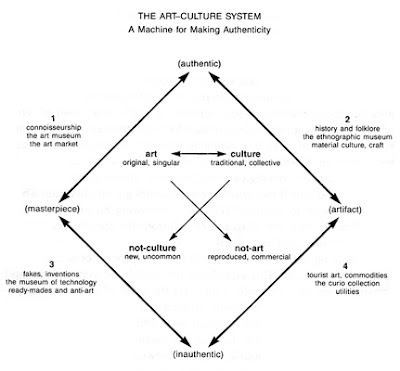
Finally regarding anthropology and art as it pertains to this discussion, James Clifford’s The Predicament of Culture: Twentieth-Century Ethnography, Literature, and Art is crucial. See especially the essay “On Collecting Art and Culture” which address the West’s appropriation (while “searching out the origins of modern man” as you put it) of artifacts from other cultures and contextualizing them as art.
This diagram of his gives a quick and dirty guide to the fluidity of the categories as he sees them:
Thanks for actually addressing my question, albeit in a snarky, err, *** way.
…
I am going to skip my disagreement with what you’ve said and focus on our common ground as I’m one of those boring types “attempting to coexist peacefully” with others.
Yes tacit and explicit knowledge. I have a great deal of interest in this. I hate to be rattling off even more reading, but Polanyi’s Tacit Dimension is central here. I even wrote some sloppy blog posts on the notion:
http://leisurearts.blogspot.com/2006/03/mathematics-practice-abstract-systems.html
http://leisurearts.blogspot.com/2006/04/wildenbateson-tacitexplicit.html
http://leisurearts.blogspot.com/2006/04/takeuchinonaka-social-ecology-of-art.html
My thinking has changed a bit as I unfortunately gave explicit knowledge a bit of the upper hand in art practice which you will immediately see is a mistake. I have become far more pragmatic (as in the actual philosophic tradition) since initially writing those posts so let me throw out some “chum” from that school for you that we can also agree on (especially with regard to your de Kooning comment):
Any idea that ignores the necessary role of intelligence in the
production of works of art is based upon identification of thinking
with use of one special kind of material, verbal signs and words. To
think effectively in terms of relations of qualities is as severe a
demand upon thought as to think in terms of symbols, verbal and
mathematical. Indeed, since words are easily manipulated in mechanical
ways, the production of a work of genuine art probably demands more
intelligence than does most of the so-called thinking that goes on
among those who pride themselves on being ‘intellectuals.’
— John Dewey, Art as Experience
…
Amen. I would add to that – dialogue that is *only* critical and only takes place among “scholarly chroniclers” and insists that being “deep” is of utmost value, then that too is a problem.
I would take more time to address your thoughtful comments, but I have to go make jambalaya for my crew (jobs – ugh!)
…
*** – thanks for wanting me included. Given I’m the soft hearted, populist, egalitarian, inclusivist that you suspect me to be, it means a lot.
You seem to have one misperception though. I actually don’t care all that much to write about art and really don’t (care to) know much about it, especially the kind that makes its way into galleries. Aesthetic experience, on the other hand, I have a great interest in. Being the slacker I am writing about it is just too much work.
Allow me an analogy. I see you as an old line Catholic dispirited at the direction of the church (artworld). Angry at the Protestants (post-conceptualists, “bad” painters, etc.) and their heretical relationship to god (art). Now perhaps the consensus curators and the neo-cons are far more deviant to you. So maybe they’re more like Scientologists from your theological perspective. Maybe *** is Episcopalian – a dissenter, but still sympathetic to Rome in form at least. Come to think of it, maybe you’re more Pentecostal, wanting to throw out all of the middlemen (curators, critics, gallerists) between the believers and god. In this ridiculous analogy I would say I’m an apatheist – dismissing the very question of god (art) as irrelevant altogether (but no atheist). Now I must admit that I’m trending toward a more searching relationship with god (art) and maybe I’ll soon be a Unitarian Universalist an appropriately pluralist and personal faith for me. A faith rooted not in the formalities of dogma or ritual, but in personal experience.
So yeah, thanks but no thanks.
…
Damn you ***. I really thought I might get a chance to watch a romantic comedy tonight and now I find myself responding…
Don’t be so quick to assume my endorsement of solely crowdsourced criticism. My advocacy of pluralism is not a knee-jerk relativism nor is it to say that there are people’s opinions that aren’t worth more than others.
Earlier I was warning against throwing out data (the aesthetic tastes of others) too quickly. Being a pragmatist, it is also important to contextualize epistemic claims, and to weigh their effects – thus questions like what do we gain by calling something bad art? So I always look to see from what position a claim is being made and what how that claim might operate. Of course this is not just something from pragmatism. I also look to feminist theorists like Harstock (standpoint epistemology) and Haraway (situated knowledge). I swear I’m going to stop the name dropping!
To get back to the “worth” of opinions…If your car is broken you will likely trust the opinion (another way of saying a hypothesis) of your mechanic as to its underlying cause over the opinion of your dentist. The value of the mechanic’s opinion will be tested in experience (a pragmatist touchstone) when you authorize them to fix it. If they turn out to be wrong, the value of their future opinions may very well begin to “fade away” like the font mentioned above. In my example we have a relatively easy test of a problematic situation. In art criticism things get messier no? What is the problem we’re trying to solve when we turn to critical writing? Some possible problems:
1. I have a limited amount of time. Do I want to take the time to see this exhibition?
2. I saw this exhibition and I’m looking for some help making sense of what I experienced.
3. I will be unable to see this exhibition. Can someone give me a reliable account of what it was like?
4. I’m researching “x” and I need some useful thinking on it.
5. I am looking to be made aware of new and interesting things.
There are clearly more. If you break it down in this pragmatist spirit it becomes clearer to me what “quality” is and it also becomes easier to square the two notions you ask about ***. The “quality” of an idea is its usefulness in carrying one through a problematic situation (any of items 1-5 for instance). In the case of criticism, quality can largely come to mean trust – “I trust that Richard Shusterman will provide me with an analysis of a book that will serve my ends.” So *** just hasn’t found Knight all that reliable (despite being a mechanic) in assessing what’s broken with his car, so maybe he’s found that his neighbor (who is a “mere” tinkerer) has done a better job. The neighbor produces higher quality repairs. Of course if the neighbor does this just for *** and can’t do this for anyone else, then the quality is greatly diminished. Correspondingly, if the mechanic fails only ***, but satisfies most other, over time, the quality of his work will reveal itself as tested socially (see below in re: personal truth too).
There are also some forms of crowdsourcing that are better (again meaning more reliable at “solving” something problematic) than others. Amazon reviews are fine, but the structure is difficult to establish trusting (quality) relationships with reviewers. Delicious, Goodreads, and LibraryThing incorporate a social networking aspect that allows you to aggregate and follow a person’s reviews/annotations of websites and books respectively. On delicious for instance you can see everyone that has saved a particular link you find interesting and then you can look at all of their other saved links to determine if this shared interest was an aberration or if there’s a pattern of congruity (also quality). You can then add that person to your network thus adding another curatorial filter (had to make the reference).
Sooooo…one can certainly make claims about quality in my pluralist vision. it’s not the chaos you seem to imagine. It’s just that it limits one to small , not sweeping assertions. To be a properly pragmatist aesthetic populist ones claims must be fallibilistic and meliorist in spirit. The truth of a judgment is determined by a highly contextualized set of qualifiers. That truth is not merely personal however as experience is always part of a social context and will be tested over time. Let’s not forget that human culture has been crowdsourcing a very long time – that’s what capital C culture is right? the judgments of millions of people, some experts, some not coalescing around a set of ideas and practices to create legacies. It’s just that as post-colonialists, feminists, this process is suffused with power and a history of exclusions, thus the need to examine how “expertise” is determined and who is included in the process so that we know how much quality our quality truly merits versus obliges from us out of the laziness of consensus…
Sorry to the two of you still awake after reading my ramble!
…
I will concede the existence of masterpieces, but let’s not clink our champagne glasses just yet because I do so in the same spirit that I concede the existence of UFOs. That is, there certainly are flying objects that remain unidentified and those UFOs are real in a qualified sense. Masterpieces certainly exist in that there are cultures, and groups within those cultures that discuss and identify them. However there are cultures and groups within cultures that do not. So once again, context is of the utmost importance, you happen to be native (I think?) to a language and culture that has a (constructed) conception of the masterpiece and thus they are quite real to you and whether you accept it or not, I would argue that you have been trained to make the distinction between “schlock” as you called it and “genius.” I prefer Madonna to Bach, and given a certain set of values I can determine which is a masterpiece. The key being what values do I judge by? If you say a masterpiece is something that makes the dance floor fill up consistently and inspires dancing then Madonna’s oeuvre (you must be wincing at seeing those words next to each other) wins. In fact, she now has two decades of the evidence of her “genius.” Again, this leads me to ask though what do we gain by declaring something genius or a masterpiece beyond the emotional satisfaction of declaring our affection? Perhaps in the cause of preservation it is useful…but making these categorical proclamations seems counterproductive unless the ability to exclude some people from recognition is a desired end, which for me is not urgent at all!
Errrgh. Running out of time, so I’m not sure I said this exactly as I’d like…
 Lebenskünstler
leave a comment