The despotism of theory and careerism – Slackers, the humanities, and understanding the difference between laziness and leisure
Deinstitutionalizing the Humanities? – Peter Augustine Lawler
[This addresses a piece by Lee Siegel that I posted earlier. Sometimes I roll with conservatives.]
…
Siegel reminds us that literature wasn’t taught in our colleges until the end of the nineteenth century because reading novels and poetry “were part of the leisure of ordinary life.” That’s what an educated person did, and not, of course, for college credit. Thoughts and imaginations were shaped by literature as much as anything else. Sometimes they may have been silly thoughts and romantic imaginations—such as the chivalrous southerners who were moved by Sir Walter Scott to choose a very bloody and very optional war. And sometimes, as in the case of Abraham Lincoln, Shakespeare and the Bible almost all alone were enough to discover and “communicate” both the urgency and poetic/theological significance of the seemingly prosaic American proposition.
…
There was, as Siegel suggests, a kind of “existentialist” moment that began after World War II and persisted through part of the Sixties. The focus on one’s personal destiny in a world distorted by technology and ideology—a world that produced unprecedented mass slaughter—privileged literature over other forms of “communication.” Insofar as philosophy was existential—and so obsessed with Camus, Heidegger, and Sartre, even it seemed more like literature than a technical or “theoretical” discipline. The goal was to save reflection on the truthfully irreducible situation of the particular person from the clutches of theory. The predicament of the person born to trouble—or at least a brush with absurdity—is what novels are about. And the insufficiency of philosophic prose to display that predicament explains why Sartre, Camus, and Walker Percy, for philosophic reasons, wrote novels. It is close, at least, to why Plato wrote dialogues and why St. Augustine wrote his Confessions.
As the great critic Lionel Trilling pointed out, it might have been near-ridiculous to teach books that should make us radically discontent with our ordinary lives in the newly standardized format of American higher education in the 1950s. And it increasingly became doubly ridiculous to have those books taught by careerist professors with the souls without spirit and heart of specialized scholars. It might be triply ridiculous to expect administrators, bureaucrats, and other certifiers of competencies to be able to understand—much less articulate—a credible defense of “the humanities.”
The existentialist point of “the humanities” is to experience the mysterious singularity of the particular being stuck for a moment between two abysses, born to love and die, to be moved by the sometimes inexpressible suffering of the being who must love and die, to experience the joy of “insight” with others, an experience that has nothing to do with “collaborative learning.” …
…
…They were about concerns that should animate one’s whole life. But today, we sadly say, the humanities aren’t typically a refuge from either the despotism of fashion or the despotism of theory, much less the despotism of careerism. That’s one reason among many they seem like a boring waste of valuable time for most students.
Given what most of our institutions of higher education are really like today, Siegel celebrates their abandonment of the humanities. Now literature is free to flourish somewhere else. It’s true enough, I can add, that Socrates never taught for money. And he never could have gotten tenure. He didn’t publish, and his student evaluations would have been uneven. It’s far from clear why it would help a great writer to get any degree at all, and certainly not one in “creative writing.” Someone could argue, of course, that things were different when people routinely read real books outside of class. But there’s no reason why they can’t do so again.
…
There is probably something to Siegel’s perception that the effort to defend the humanities everywhere in our educational system might be misguided. Maybe the focus should be on “countercultural” (which doesn’t mean all about the Sixties) institutions that exist in a communal context and that have what it takes to resist standardization, trendy theory, and the understandable but still excessive focus on techno-productivity. Maybe they can in some indirect way elevate us all.
Or maybe we should ask that there be just a lot more celebration of the diversity that still characterizes higher education in America, even in particular institutions and sometimes within particular departments. The enemy of this diversity is standardization—what comes from shamefully intrusive accrediting agencies, government bureaucrats, the use of “branding” and various forms of management-speak to describe liberal education, the adoption of the skills-and-competencies model (which is okay for tech schools) to evaluate higher education, and the insistence that the standard of productivity should drive all educational funding.
One advantage of standardization, of course, is that it holds slackers accountable. But we shouldn’t work too hard to get rid of all those slackers (such as those “tenured radicals”). Otherwise, we’ll too often mistake leisure for laziness. We might even mistake metaphysics, theology, poetry, and so forth for self-indulgent pursuits that don’t prepare students for the rigors of the competitive twenty-first-century marketplace. More than ever, it seems to me, it is essential to hold members of our “cognitive elite” to a standard higher than productivity. All Americans’ lives would be less pathological—and so, for one thing, more productive—if imaginations were, once again, filled with “real books.”
“…like libraries, without the party atmosphere.” – Why I hate museums
Opinion: Why I hate museums – James Durston
[Fun to read this in light of this piece wistful about good old fashioned museum experience and this one defending the new “participatory” experience. But I do take issue with condemning the exhibition displaying an “old brick, an old piece of rock, some hair and a napkin.” Sounds pretty great.]
Graveyards for stuff. Tombs for inanimate things.
Their cavernous rooms and deep corridors reverberate with the soft, dead sounds of tourists shuffling and employees yawning.
They’re like libraries, without the party atmosphere.
…
I’ve always hated museums.
Yet twice or three times a year, I somehow find myself within one, shuffling from glass case to glass case, reading the little inscriptions, peering closely at the details, doing what any “good traveler” does.
Two hours later I walk out bored, hungry and far less glad to be on vacation than when I went in.
The main thing you learn in museums, it seems, is how not to run a museum.…
Worst of all, there’s a climate of snobbery surrounding this whole industry.
Confess that rather than stare glumly at an old beer chalice on a plinth you’d prefer to drink happily from a shiny new one in a pub, and you risk being outed as an ignoramus.
Well, I’m outing myself. I’m a museo-phobe.
…
They provide an umbilical link between our planet and our history to the future.
But inside these crypts of curatorship, the connection to humankind falls short.
Last year I visited Doha’s Museum of Islamic Art — a landmark at least as celebrated, if not more so, for its architecture than its contents, and no wonder.After the 200th glass case containing an old bowl — or was it a plate, or perhaps it was some more cutlery, who knows, who cares — I decided the photo opportunity across the sea was the best thing about the place.
…
Where’s the “muse” in all these museums? Where’s the theater?
…
Fair enough, I don’t question the wider benefits of museums, economic or otherwise.
But the collect-and-cage policy that defines the visible exhibits, much of which is not even visible most of the time, is anathema to an engaging experience.
…
This smacks of the most smugly provocative modern art, which insists that anything the curate deigns to put inside the building inevitably becomes “interesting.”
…
Where’s the relevance? Why, in places designed to celebrate life and all its variety, is there such a lack of vitality?
…
My trip two years ago to Hong Kong’s Science Museum convinced me that if there were a World Championship for Most Dreary Things To Do On Vacation, museums would be disqualified for going over the top.
…
But where’s the equivalent for adults? Why should over-16-year-olds, who still make up the significant majority of museum-goers, be subjected to stiff, dry, academia-laced presentations as if fun were a dirty word?
Where’s your joy gone, museums?…
“smartly dressed and supposedly knowledgeable” – Professional curators, who needs ’em?

What happened to the expert curator? – Daniel Blight
…
A space has now opened up – both physically and online – where anyone can give curating a go. If you are part of culture, then you are qualified to contribute to the arrangement of its artefacts. The practice of curating now occupies museums, public and commercial galleries, project spaces and, of course, the internet.
Within these contexts, the act of arranging objects, images or sounds into an order that may or may not have meaning has proliferated throughout the creative and cultural industries. The curator is now a producer: you might curate your Flickr feed, your mates playing records at a bar or festival or an exhibition in your own apartment – a trend showcased by the Serpentine Gallery’s co-director Hans Ulrich Obrist, a master orator of what he calls a “global dialogue… in space and time”.
While the practice of curating within cultural institutions may have changed, the elitism and sense of privileged access remains – abundantly. Even now, you can walk into a museum or gallery and be overwhelmed with the feeling of being in a place where meaning is inaccessible to the layperson, other than through spaces specifically created for audience participation.
…
What, then, if we’re looking in the wrong place for qualified, ground-breaking curators? Perhaps they are no longer in museums, galleries or cultural institutions, but instead in front of a screen – sociable and connected. Curating in the age of the internet is the act of responding to social and technological developments: their usability, instability and the various networks of communication in which they are presented online.…
In this, we return to the movement from expert to amateur. The sheer quantity of material being collected and curated on the internet, and indeed the rate at which this activity can represent culture and form social networks, is staggering. Institutionalised curators are, along with the institutions themselves, being left woefully behind.
In fact, their attempt to keep up may soon become their authorial downfall: people are creating meaning themselves – online, inside, outside and in rings around the snail-paced bureaucracy that has come to characterise most cultural institutions.
…
Whatever our response to this, one thing is abundantly clear – we cannot do it by bandwagoning internet art, nor will it be helped along bythe ostentatious character of the curator in itself. The cultural institution, tied in the UK to the wider governmental logic of the Department for Media, Culture and Sport, may need to shift its priorities structurally and ideologically. In times where money is harder to come by and people’s access and thirst for knowledge is more readily satisfied via the internet, curators need to play a much more transparent and far less haughty game if they are to stay ahead.
Bullshit Jobs – David Graeber sounding a lot like Chris Carlsson
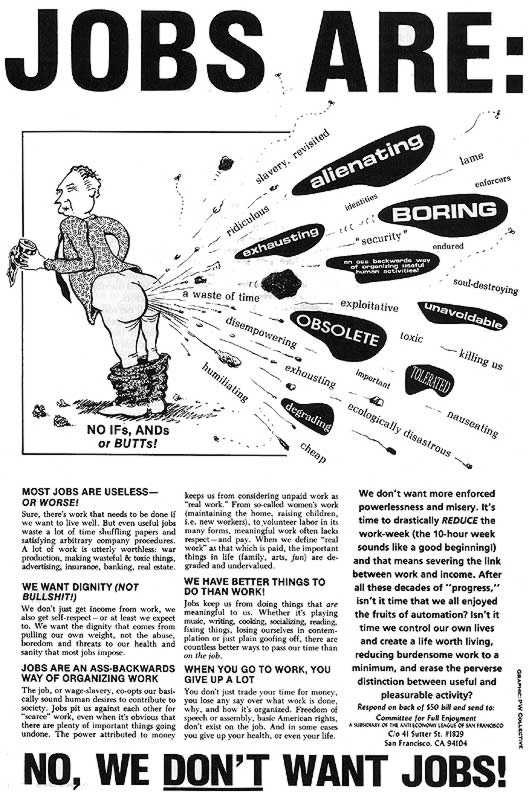
[The piece below sounds very much like Chris Carlsson’s “Jobs Don’t Work” which is linked to in the commentary here. Carlsson’s is much better though – highlights of it will follow eventually.]
On the Phenomenon of Bullshit Jobs – David Graeber
In the year 1930, John Maynard Keynes predicted that, by century’s end, technology would have advanced sufficiently that countries like Great Britain or the United States would have achieved a 15-hour work week. There’s every reason to believe he was right. In technological terms, we are quite capable of this. And yet it didn’t happen. Instead, technology has been marshaled, if anything, to figure out ways to make us all work more. In order to achieve this, jobs have had to be created that are, effectively, pointless. Huge swathes of people, in Europe and North America in particular, spend their entire working lives performing tasks they secretly believe do not really need to be performed. The moral and spiritual damage that comes from this situation is profound. It is a scar across our collective soul. Yet virtually no one talks about it.
…
The answer clearly isn’t economic: it’s moral and political. The ruling class has figured out that a happy and productive population with free time on their hands is a mortal danger (think of what started to happen when this even began to be approximated in the ‘60s). And, on the other hand, the feeling that work is a moral value in itself, and that anyone not willing to submit themselves to some kind of intense work discipline for most of their waking hours deserves nothing, is extraordinarily convenient for them.
…
If someone had designed a work regime perfectly suited to maintaining the power of finance capital, it’s hard to see how they could have done a better job. Real, productive workers are relentlessly squeezed and exploited. The remainder are divided between a terrorised stratum of the, universally reviled, unemployed and a larger stratum who are basically paid to do nothing, in positions designed to make them identify with the perspectives and sensibilities of the ruling class (managers, administrators, etc) – and particularly its financial avatars – but, at the same time, foster a simmering resentment against anyone whose work has clear and undeniable social value. Clearly, the system was never consciously designed. It emerged from almost a century of trial and error. But it is the only explanation for why, despite our technological capacities, we are not all working 3-4 hour days.
The prison of artlike art – Stephen Wright on Rasheed Araeen’s Art Beyond Art
The Escapologist. Rasheed Araeen and the transformative potential of art beyond art – Stephen Wright
[To be clear – I love the field Wright stakes out even though I would argue with many of the details. One specific objection would be the idea of art as an inherently “critical” enterprise. This seems to be demonstrably false as a historical matter and an unnecessary notion ideologically. That is, one might ask – “Wouldn’t it be important to escape capture by the empire of criticality too?” ]
…Third Text’s controlled coefficient of specific visibility as a collective, conceptual artwork situated it in the “art-beyond-art” category — that is, of practices whose self-understanding is as art, but which manage to avoid being performed as art, somehow foiling the powerful apparatus of performative capture within what Araeen calls “the legitimising prisonhouse” of bourgeois aesthetics. Though Third Text, as we know, has since been captured by those very forces it had set out to challenge, Rasheed Araeen, we can be sure, eludes capture.
…
What’s most important about Art Beyond Art, though, is its discussion of the obstacles art faces today, and how it might elude them. Given Araeen’s experience in escapology — not of the Harry-Houdini variety of cuffs and chains, that wouldn’t be his style, but in escaping institutional, epistemic and performative capture — he has some important points to make. Here’s how he sets the stage:
“At the end of the sixties there emerged a concept of art whose true significance has not been generally and fully understood of recognized. Its significance was not in its newness or innovation, but what was conceptually a radical shift from art as displayable objects that can be looked at and contemplated — painting, scultupre, installations, photography, etc — to art as a process of transformation within the everyday. Historically, it was a movement of the idea that entered human imagination with a consciousness that sought integration of art with life, so that it would by becoming part of life’s everyday energy and creativity join its journey towards what for Hegel was its ultimate fulfillment. But this was not to happen. The journey was halted as it entered the cultural citadel of bourgeois capitalist society to seek legitimation. And, as it succumbed and capitulated to the privileges that the bourgeois art institution offered, the idea became trapped with in the logic of the very institutional space it was allowed to enter and occupy.”
…
“What is fundamental to my suggestion is the idea that it is possible to perceive or produce art in a radically different content, an art which locates itself away from the bourgeois institution and is not necessarily dependent on its mediation and legitimation.” This involves, amongst other things, making theory a practice, wresting it away from the academy: “It is with the imaginative power of art that I want to move forward; with a proposition that may lead to a new kind of thinking and produce a new kind of critical practice, out of which may also emerge a revolutionary concept of art based on the nominalism of the everyday work carried out by people themselves or their material production.” …
…
…art, he writes, “must lead a double life.” “On the one hand, it is a conceptual artwork but, on the other, its material form must become independent of whether it is a work of art or not. Only when it can escape from being merely an art concept or form that it can avoid its reification, and only then can it continue to maintain its transformative function within the productive force of everyday life.”
…
“Although what I propose as a collaborative practice results in a material form — it may be a farm, a factory, a supermarket, a transport system, etc, collectively run and owned by the workers themselves — I continue to call it a conceptual artwork. Why? Because it is not possible to get rid of art as a special category or completely dissolve it in other things so long as there exists capitalism and its division of labour. The complete dissolution of art into life so that art loses its identity as art will deprive it of its transformative function. If it is allowed to become like any other thing, without maintaining its specific non-instrumental imaginative power, art will not be able to act upon those things which are the products of consumer culture and turn them into a critical force capable of confronting the bourgeois society. In other s words, art’s function as a liberating force is dependent not only on its becoming something other than art but also maintaining its identity as a specific material as well as a symbolic practice.”
In essence, art secretes a kind of invisible but conceptual otherness within the everyday life processes that it permeates. Acting as a kind of yeast, the idea of art brings about a minimal shift within sameness. Though its dissolution into life may be impossible, it may act like a solvent upon ontologically stable relations. Like mycelium in a mineral, the idea steadily, “without complaint or resentment,” dissolves the obstacle.
Ransacking the Western philosophical tradition – Adam Kirsch on Peter Sloterdijk
Against Cynicism: A philosopher’s brilliant reasons for living – Adam Kirsch
…
Despite its parodic Kantian title, Sloterdijk’s Critique is not a work of theoretical abstraction; it is a highly personal confession of this generational world-weariness. As a philosopher, Sloterdijk is especially struck by the way he and his peers were able to master the most emancipatory and radical philosophical language, but utterly unable to apply its insights to their own lives and their own political situations. Coming after Critical Theory, whose post-Marxist diagnoses of social ills are a key reference point and antagonist for Sloterdijk, younger thinkers have found themselves brilliant at diagnosis and helpless at cure. “Because everything has become problematic, everything is also somehow a matter of indifference,” Sloterdijk observes. The result is cynicism, which he defines in a splendid paradox as “enlightened false consciousness”: “It has learned its lessons in enlightenment, but it has not, and probably was not able to, put them into practice.”
If we are to break out of this learned helplessness, Sloterdijk argues, we must ransack the Western tradition for new philosophical resources. Such ransacking is exactly the method of Sloterdijk’s thought, first in the Critique and then, on an even grander scale, in Bubbles and You Must Change Your Life. Drawing on very wide reading—wider, the reader often feels, than it is deep—Sloterdijk excavates the prehistory of contemporary problems, and some of their possible solutions. In the Critique, he offers an extended analysis of the culture of Weimar Germany, in which he locates the origin of twentieth-century cynicism—as well as describing the many sub-varieties of cynicism (military, sexual, religious), and doing a close reading of Dostoevsky, and cataloguing the meaning of different facial expressions. The effect on the reader is of being shown around a Wunderkammer, where what matters is not the advancing of an argument but the display of various intellectual treasures.
…
In Critique of Cynical Reason, Sloterdijk charted a wholly individual path to a familiar spiritual position, a Romanticism of what Wordsworth called “wise passiveness.” This pattern is repeated in Sloterdijk’s later books: he is better at the forceful restatement of old problems than at the invention of new solutions. This might be regarded as an objection by certain kinds of philosophers, who see themselves as contributors to a technical process that produces concrete results. For Sloterdijk, whose greatest influences are Nietzsche and Heidegger, it is not at all disqualifying, for his goal is, as he writes in You Must Change Your Life, “a provocative re-description of the objects of analysis.” Like a literary writer—and he once told an interviewer that he thought of writing the Spheres trilogy as a novel—Sloterdijk’s goal is to restate our basic quandaries in revelatory new language, to bring them home to us as living experiences instead of stale formulas. The prison of reason, the need for transcendence, the yearning for an absent meaning: these have been the stuff of literature and philosophy and theology for centuries. In Sloterdijk, these old subjects find a timely new interpreter.
…
But if Sloterdijk is not a believer, then where does he think we can actually experience this kind of perfectly trusting togetherness? Where do we find a sphere that is wholly earthly, yet so primal as to retain its power even now? The answer is surprising, even bizarre. In a long section of Bubbles, Sloterdijk argues that the original sphere, the one we all experience and yearn to recapture, is the mother’s womb. This is not, for him, a place of blissful isolation, where the subject can enjoy illusions of omnipotence; if it were, the womb would be only a training ground for selfishness and disillusion. Sloterdijk emphasizes instead that we are all in our mother’s womb along with a placenta. The placenta is what he calls “the With”—our first experience of otherness, but a friendly and nurturing otherness, and thus a model for all future “spheres” of intimacy.
…
The reader who has no patience for this kind of thing—who finds the whole “With” concept New Agey, or unfalsifiable, or just wildly eccentric—will probably not get very far with Sloterdijk. This is not because placenta-ism is central to his thought. On the contrary, it is just one of the many provocative ideas that he develops and then drops in the course of the book, which reads less like a structured argument than a long prose poem. Sloterdijk’s strength and appeal come from the intuitive and metaphorical quality of his thought, his unconventional approaches to familiar problems, his willingness to scandalize. As a theorem, the “With” is easy to refute; as a metaphor, it is weirdly persuasive. It is another way of describing, and accounting for, the central experience of homelessness that drives all of Sloterdijk’s thought. Deprived of our “With,” he writes, “the officially licensed thesis ‘God is dead’ ” must be supplemented “with the private addendum ‘and my own ally is also dead.’ ”
…
The word “practice” is central to Sloterdijk’s argument here, and to his understanding of religion. We are living, he observes, at a time when religion is supposedly making a comeback around the world. The old assurance that all societies must inevitably converge on secularism is failing. For Sloterdijk, however, it is a mistake to think that what people are turning to is faith in the divine. Rather, the part of religion that still matters to us, for which we have a recurring need, is its practices: the “technology,” primarily mental and inner-directed, that allows us to reshape our ways of thinking and feeling. With typical bravado, he argues that “no ‘religion’ or ‘religions’ exist, only misunderstood spiritual regimens.
…
One of the most appealing things about Sloterdijk’s philosophy is that, like literature, it leaves itself vulnerable. It does not attempt to anticipate and to refute all possible objections. And the objections to You Must Change Your Life, as with Bubbles, are not far to seek. For one thing, by conceiving of religion as an elite training regimen, Sloterdijk implies that a religion is justified only by its saints. Anyone who is not a saint is insignificant, and so the average person’s experience of religious meanings—whether metaphysical doctrine or spiritual consolation or tradition or identity or communion—is dismissed out of hand. This is false to the lived reality of religion for most people, and shows how tendentious Sloterdijk’s equation of religion with “practice” really is.
…This is as much as to say that Sloterdijk has not solved the immense problems that he raises, even though he claims to know the way toward the solution. But maybe the philosopher does not need to solve problems, only to make them come alive; and this he does as well as any thinker at work today.
On localization in the arts – Scott E. Walters
Speak Your Piece: The Extractive Arts – Scott E. Walters
…
The problem with Kaiser’s argument is that none of the artists he mentions stayed in their community or even in the states or regions where they were from. They all left and went to the “big coastal city” of New York, just as the anti-arts politicians said, where they entertained the elite, also like the anti-arts politicians said. Kaiser hasn’t, in fact, refuted their beliefs in the least. More importantly, while the artists he mentioned achieved renown, many, many others from similar small towns followed the same path and saw their talents go unappreciated and their gifts unnoticed, talents and gifts that would have added so much to their home towns.
This is the extractive creativity economy in action.
Like clear-cutting a forest or blasting the top off of a mountain in order to send wood and coal to urban dwellers, the American arts system extracts artistic resources in the form of talented young people and tells them that the only place they can make a living in the arts is New York City. Not to put too fine a point on it, but this is a major lie. Let me use a statistic from my area of expertise, the theater, to make my point.
…
My point isn’t that theater (or dance or painting or music or…) is a lousy way to make a living – why should the readers of Daily Yonder care about that? My point is that, given those dismal facts, shouldn’t we be teaching our talented young people the skills needed to practice their art in places other than New York and Los Angeles, in places that are starving for the arts, maybe even places like their own home towns? After all, the bar is pretty low – if you sold tickets to your friends and family you would make more money than did 58% of the so-called professional actors.
…
How would interest in the arts improve across the country, and even in the legislature, if performers put down roots in a place they loved, built a life there and created art that reflected the stories, the songs, the dances, the colors, the shapes of their chosen town? What if the arts world was more like a local farmer’s market, filled with products that grew organically from the dirt, rain and sun of a particular place? What if, like local farmers, local artists found a way to make a living within the context of their specific place, rather than within some generic model created for somewhere else that wastes 58% of what it grows? And why can’t those places include rural areas, where people are just as interested in being entertained and enriched?
Life actually lived rather than frozen in the amber of speculative thought – Edward Mooney, Kierkegaard, faith, and love
Excursions with Kierkegaard: Others, Goods, Death, and Final Faith – Reviewed by Jeffrey Hanson
…
His book is fit for the educated person still open to wonder and a tonic for the academician whose passion has been dulled by bureaucracy and careerism, who has sold her birthright as a teacher in exchange for being — to use a Kierkegaardian term of ridicule — an assistant professor. And his book is for those who still feel the call to which the existentialist once responded: the whispered summons to traipse the wilderness rather than trace yet again the well-worn path to and from the office. Many of Mooney’s metaphors are drawn from the activity of walking and taking in landscapes — if he isn’t a walker himself like his beloved Kierkegaard (or Thoreau, whom he also admires), then he is to be congratulated for his fictive inventiveness, because his imagery strikes the reader as one that is born from life. Indeed, the many meditations in this text positively wriggle with the vitality of the first-hand, like a bucket of eels drawn from a sun-spangled river. Readers expecting a technical account of anything at all will be disappointed. Excursions with Kierkegaard is what its title suggests: more travelogue than treatise. And his companion on the way is lovingly and vividly rendered, a wry Virgil to any Dante who picks up this book. Kierkegaard appears here as by turns sober and wry, difficult and winsome, a poet, a preacher, a prophet, an ironic carnival barker, an astute observer, a friend to the man on the street and a guest of the king, a bon vivant and a Christian, a confidant and critic.
…
This ambivalence is part of the character of our experience, and Mooney seems to appreciate that. Reason goes weak in the knees when it falls in love because in love the giving of reasons rings hollow: Imagine a marriage proposal prefaced by a list of “Things I Really Like about You.” If Mooney is right (and I think he is) that love thrives where reasons leave off, then that is not because our experience just is equivocal and various means and attunements might disclose this but because this is the way love is, and love being what it is renders all experience equivocal. If God is non-metaphorical love par excellence, and I think for Kierkegaard God is, then the aesthetic approach, for all its beauty and splendor, needs the religious to rescue it. Mooney’s poetics are not incompatible with the religious — far from it — but it might help to be a bit clearer that while for Kierkegaard faith without poetics is inconceivable, poetics without faith is unsustainable.
…
Again it is Mooney’s vision that causes us to see Kierkegaard anew, and, as he would admit, no one has an unobstructed vista on the panorama of truth. If he brings us to a new vision, he does so not by force of syllogism but by inviting us to take up a strange and strained perspective. To ask for this fuzziness to be brought to perfect clarity would betray both Mooney’s characteristic tenor and the point of what he wants to convey, which is in no small part that for Kierkegaard ambiguity, openness, and subjective shading are endemic to life actually lived rather than frozen in the amber of speculative thought.
 Lebenskünstler
leave a comment